
-
by sayum
28 August 2026 2:11 PM







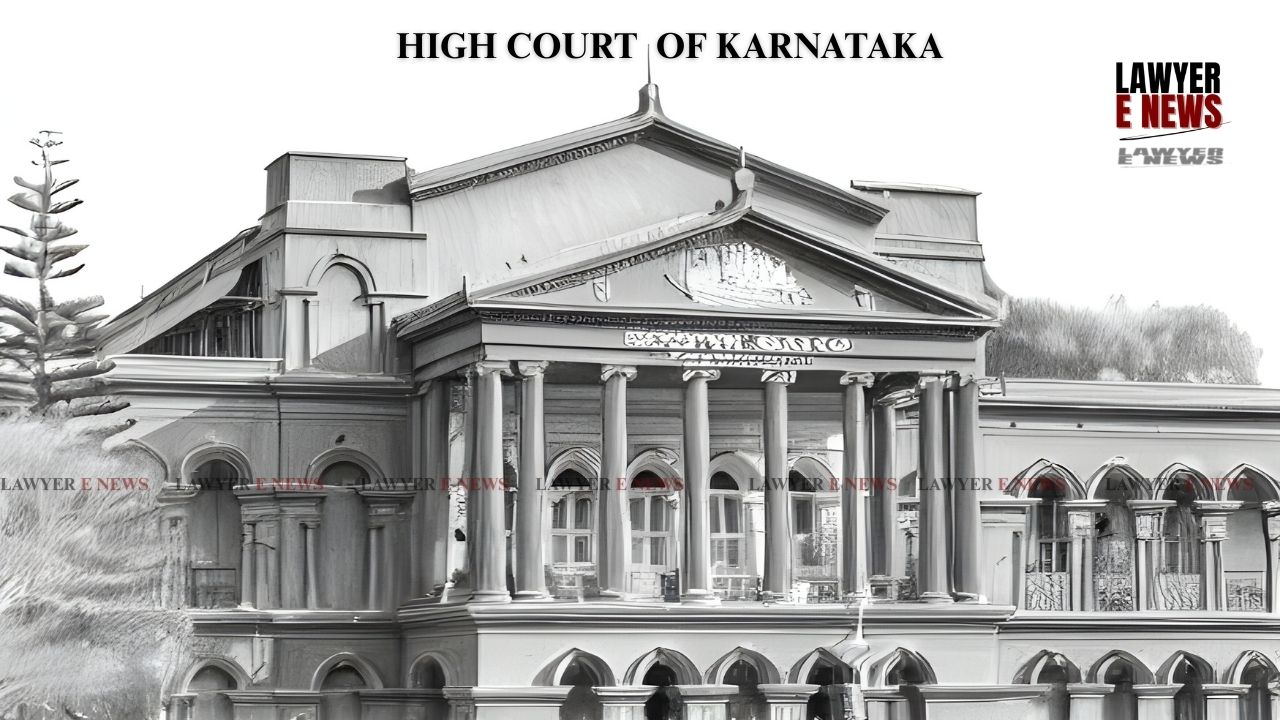
"Fraud unravels all actions, as fraud is intrinsic, collateral act and fraud of an egregious nature, as fraud is an act of deliberate deception with a design to secure something, which is otherwise not due. It is trite that fraud and justice never dwell together, " High Court of Karnataka, in a decisive ruling, held that a writ court cannot exercise its extraordinary jurisdiction under Article 226 to validate claims based on engineered and fabricated documents.
A Division Bench of Justice D.K. Singh and Justice T.M. Nadaf observed that when a party approaches the court with "soiled hands" and attempts to defraud the state to engulf public property, they debar themselves from claiming any equity.
The court was dealing with intra-court appeals filed by Sree Siddaganga Mutt and the State of Karnataka against a Single Judge's order. The Single Judge had previously allowed a writ petition filed by alleged land grantees, setting aside the allotment of nearly 15 acres of land to the Mutt for a charitable food distribution center (Dasoha Prasada Distributing Centre).
The dispute originated from a claim by five individuals belonging to the Adi Karnataka community who alleged they were granted 3 acres of land each in Kadaranahalli Village back in 1982. However, in 2010, the State allotted 14 acres and 25 guntas of the same land to Sree Siddaganga Mutt for charitable purposes. The petitioners challenged this allotment before the Karnataka Appellate Tribunal (KAT) and subsequently the High Court, claiming their prior rights were ignored.
While the KAT dismissed their appeal finding no evidence of a concluded grant, the Single Judge of the High Court reversed this, relying on documents produced by the petitioners during the writ proceedings. The Single Judge directed the Tahsildar to enter the petitioners' names in revenue records and ordered the State to find alternative land for the Mutt.
The primary question before the court was whether the documents produced by the petitioners to substantiate the 1982 land grant were genuine or fabricated. The court was also called upon to determine if the writ court was justified in adjudicating complex and disputed questions of title involving allegations of fraud and forgery under Article 226 of the Constitution of India.
Inconsistency In Petitioners' Prayer Reveals Absence Of Original Grant
The Division Bench noted a glaring inconsistency in the petitioners' legal stand. Initially, the petitioners sought a writ of mandamus to direct the authorities to "conclude" the grant proceedings and issue a 'Saguvali Chit' (cultivation certificate). The court observed that this prayer itself presupposed that there was no concluded order of grant in their favour at the time of filing the petition.
The bench remarked that it was only during the pendency of the matter, approximately 42 years after the alleged grant, that the petitioners produced an "Official Memorandum" and "upset price receipts" to claim that the grant was already finalized. The court found this sudden emergence of documents highly suspicious and concluded that the case was built up as an afterthought to suit the petitioners' claims.
"The prayer takes away the entire case of the petitioners that there is a grant in their favour."
FSL Report Confirms Documents Were Created On A Single Typewriter
A critical piece of evidence relied upon by the Bench was the report from the State Forensic Science Laboratory (FSL). The report indicated that various documents, purportedly issued by different government offices and officials at different points in time, were actually typed on the exact same typewriter.
The court noted that while the age of the ink could not be scientifically determined, the "super imposition technique" used by experts confirmed that the fonts, sizes, and unique identifying marks were identical across documents from disparate departments. The bench held that this clearly indicated the records were "engineered" and "fabricated" to engulf State property.
Court Refuses To Exercise Writ Jurisdiction Over Fabricated Claims
The court emphasized that the extraordinary jurisdiction under Article 226 is not meant for the adjudication of complex and disputed questions of fact, especially when the authenticity of title documents is in serious doubt. Citing Supreme Court precedents like State of Rajasthan vs. Bhawant Singh and Gunwant Kaur vs. Municipal Committee, Bhatinda, the Bench reiterated that a declaration of title cannot be sought in a writ petition when the title is very much in dispute.
The bench observed that the writ court had failed to consider that the Regional Commissioner and Tahsildars had filed affidavits stating that the alleged grant records were not found in the original official files. The court held that the Single Judge was "swayed only on the opinion expressed by the FSL" regarding the ink age, while ignoring the definitive finding on the use of a single typewriter.
"The writ court has failed to consider these aspects... and swayed only on the opinion expressed by the FSL to the fact that the age of the ink cannot be clearly given."
Fraud Vitiates All Judicial And Administrative Acts
Invoking the pristine legal maxim fraus et jus nunquam cohabitant (fraud and justice never dwell together), the court held that any order obtained by playing fraud on the court is a nullity and non est in the eye of the law. The Bench cited the recent Supreme Court decision in Vishnu Vardhan vs. State of Uttar Pradesh, reinforcing that judicial orders procured by subverting the process through concealment of material facts cannot be allowed to stand.
The court expressed its disappointment that the petitioners, who were seeking equity, had approached the court with "soiled hands." The Bench stated that while it initially considered directing the State to sympathetically consider the landless petitioners for a fresh grant, their conduct of fabrication and forgery debarred them from any such equitable relief.
"Such acts of the parties defrauding the Court require to be dealt with iron hands."
The Division Bench allowed both writ appeals, setting aside the Single Judge’s order dated July 15, 2025. Consequently, the original writ petition filed by the alleged grantees was dismissed, and the orders of the Karnataka Appellate Tribunal were upheld. The court also upheld the grant made in favour of Sree Siddaganga Mutt for the establishment of the 'Dasoha Kendra' to feed the poor. Although the court noted that the facts demanded heavy costs, it refrained from imposing them considering the petitioners were villagers.
Date of Decision: 11 June 2026





