-
by sayum
14 November 2026 12:13 PM







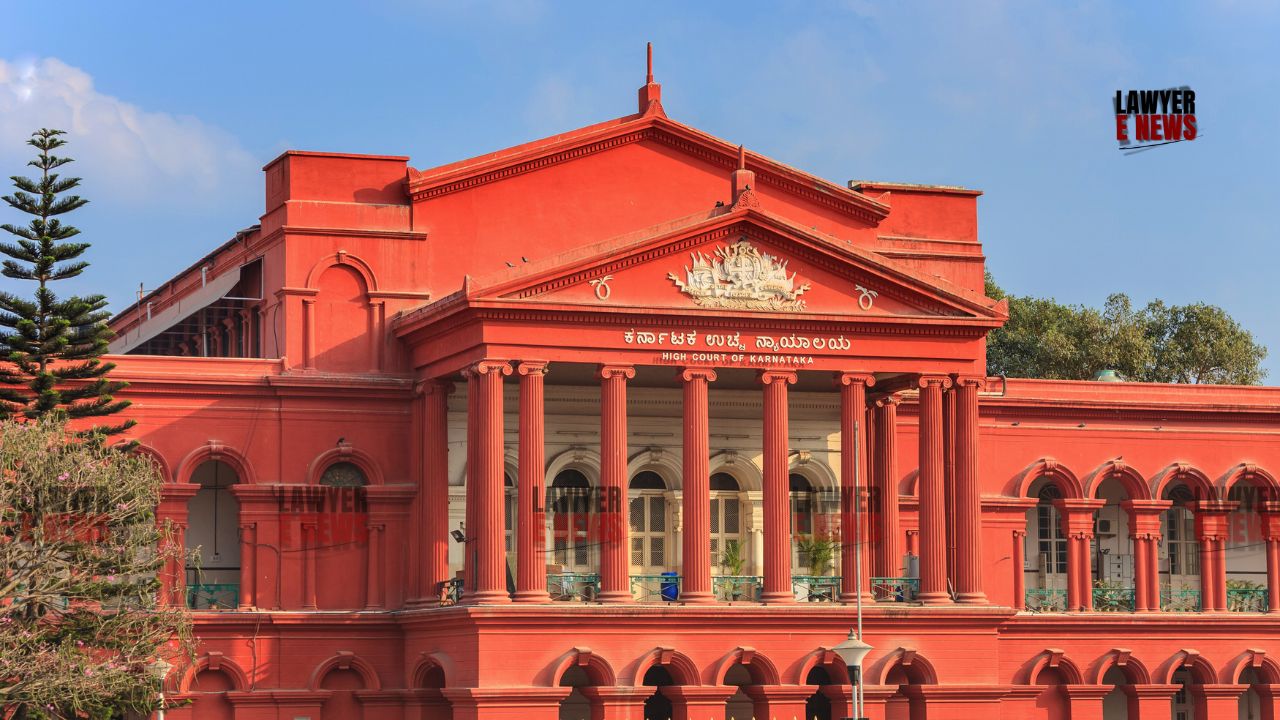
Karnataka High Court has held that under Section 64 of the Indian Contract Act, 1872, restitution requires proof of actual, legally recognizable benefit derived by the rescinding party and cannot be presumed merely from the expenditure incurred by a defaulting contractor. A Division Bench comprising Chief Justice Vibhu Bakhru and Justice K.S. Hemalekha observed on November 4, 2026, that an arbitral tribunal commits a patent illegality under Section 34 of the Arbitration and Conciliation Act, 1996 if it awards monetary compensation representing project expenditure without determining the existence, nature, and extent of the benefit received by the landowners.
The dispute arose out of joint development agreements executed in 2014 between a developer and landowners for forming residential layouts in Shivamogga, which were terminated by the landowners in 2016 after the developer carried out certain infrastructure works without securing renewed statutory layout sanctions from the urban development authority. The sole arbitrator declined specific performance due to the developer's contractual breach but directed the landowners under Section 64 of the Contract Act to reimburse over Rs 2.31 crore towards expenses incurred. On cross-petitions filed under Section 34 of the Arbitration and Conciliation Act, the Commercial Court upheld the refusal of specific performance but set aside the monetary award, prompting the developer to prefer appeals under Section 37(1)(c) read with Section 13(1A) of the Commercial Courts Act, 2015.
The court was called upon to determine whether the Commercial Court exceeded its jurisdiction under Section 34 of the Arbitration and Conciliation Act in setting aside the arbitral award granting monetary restitution under Section 64 of the Contract Act. It further examined whether an arbitral tribunal can grant restitution under Section 64 based entirely on expenditure incurred in executing unauthorized development works without adjudicating whether an actual corresponding benefit was conferred upon the rescinding party.
Examining the developer's challenge against the refusal of specific performance, the High Court affirmed the findings that the developer had fundamentally breached clauses 6 and 8 of the development agreements. The Bench noted that the contractual obligations squarely mandated the developer to obtain layout sanctions and approvals from the Shivamogga Urban Development Authority at its own cost, which it admittedly failed to secure.
Contractual obligations to obtain statutory sanctions cannot be dispensed with by relying on landowner acquiescence.
The court stressed that knowledge or lack of protest by landowners could not cure the statutory defect or substitute compliance. "Even assuming that the landowners had knowledge of the works undertaken, their conduct cannot dispense with the statutory compliance governing approval of residential layouts," the Bench noted, upholding the finding that the developer failed to prove continuous readiness and willingness.
Addressing the monetary award, the Division Bench scrutinized the scope and operation of Section 64 of the Contract Act, which mandates that a party rescinding a voidable contract must restore any benefit received thereunder. The court underscored that establishing expenditure incurred in part-performance does not automatically translate into a quantifiable benefit for the other party.
Proof of expenditure incurred by a defaulting contractor cannot be treated as proof of benefit received by the rescinding landowner.
The court ruled that the arbitral tribunal committed a fundamental error by equating expenditure with restitution without assessing its real value to the landowners. "Section 64 contemplates restoration of the benefit received by a party rescinding a voidable contract. The statutory requirement is therefore not merely that the other contracting party should have incurred expenditure in performance of the agreement. What is required to be established is that the party rescinding the contract has actually received a benefit thereunder which is liable to be restored," the Bench held.
The Bench observed that the arbitral award focused entirely on vouchers and commissioner inspections to verify the money spent, completely failing to investigate whether unapproved, unauthorized layout works possessed any lawful utility or conferred any actual benefit upon the landowners.
Arbitrators cannot bypass essential statutory pre-conditions under the guise of rendering a plausible view.
Rejecting the appellant's argument that the Commercial Court had impermissibly reappreciated evidence, the Division Bench held that judicial deference to plausible views does not protect awards that ignore statutory ingredients. "Where the statutory provision invoked by the Arbitral Tribunal requires proof of a particular fact, and the award proceeds to grant relief without determining that essential requirement, the conclusion cannot be protected merely by describing it as a plausible view," the Bench observed.
The High Court held that the burden of proving that unapproved infrastructure works conferred a lawfully utilizable benefit rested squarely on the developer, and the arbitral tribunal's failure to make an independent determination on this vital question constituted an error going to the root of the matter.
Dismissing all four commercial appeals, the High Court affirmed the Commercial Court's decision, holding that the arbitral award suffered from patent illegality in awarding monetary compensation under Section 64 of the Contract Act and that the refusal of specific performance was fully justified.
Date of Decision: November 04, 2026