-
by sayum
26 August 2026 12:18 PM







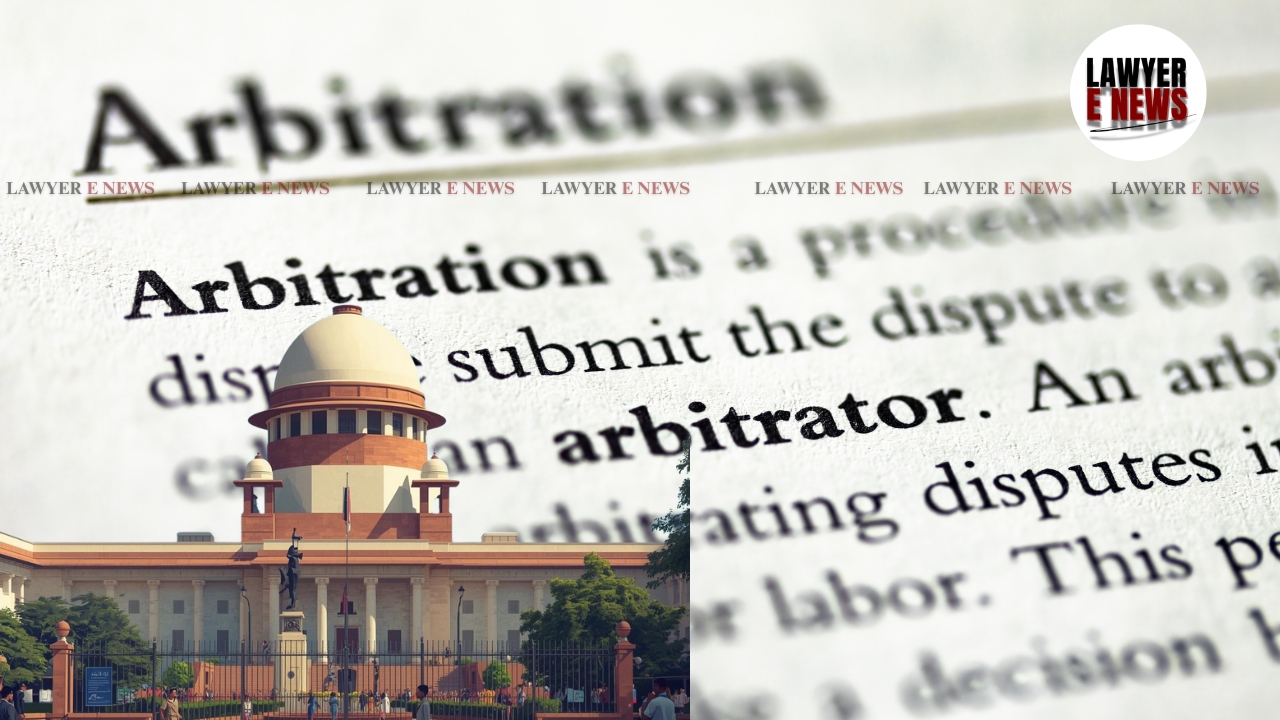
“The matter must end here. There is an arbitration agreement... let all that be said before the arbitral tribunal” – In a vital reaffirmation of the minimal judicial interference under Section 11(6) of the Arbitration and Conciliation Act, 1996, the Supreme Court of India held that courts cannot reject a request for appointment of an arbitrator merely because the underlying arbitral award is under challenge, and that questions regarding arbitrability or cause of action must be left for the arbitral tribunal to decide.
The ruling came in M/s Hindustan Prefab Limited v. National Law University Odisha, arising from a High Court order rejecting a Section 11(6) application on the ground that no cause of action had arisen since the arbitral award, which formed the basis of the claim, was under challenge and had not yet been paid.
Setting aside the Orissa High Court’s ruling, the Supreme Court held:
“As we find that there is no dispute as regards existence of the arbitration agreement... the issue whether the liability of the respondent would trigger when payment of the arbitral award is made or becomes payable... is a matter for the arbitrator to decide.”
“High Court fell in error in rejecting arbitration merely because award was under challenge”
The dispute arose from a works contract awarded by National Law University Odisha to Hindustan Prefab Ltd. (HPL). HPL subcontracted the execution to a contractor. Disputes between HPL and the contractor led to arbitration, resulting in an arbitral award against HPL.
HPL then invoked a clause in its agreement with NLU Odisha, Clause 47, which mandated that cost of any arbitration award or court decree in favour of the contractor shall be borne by the client—in this case, the respondent-university.
However, since the arbitral award against HPL was challenged and stayed under Section 34 of the Arbitration Act, NLU Odisha refused to accept any liability until the award attained finality. When no arbitrator was appointed despite invocation, HPL approached the Orissa High Court under Section 11(6).
The High Court dismissed the application, holding that no enforceable cause of action existed, as payment had not been made under the award and the claim was premature.
“The correct course was to leave the issue of arbitrability to the arbitral tribunal” – SC cites Office for Alternative Architecture ruling
Disagreeing with the High Court, the Supreme Court Bench of Justices Manoj Misra and Ujjal Bhuyan drew upon settled precedents, particularly the ruling in Office for Alternative Architecture v. IRCON Infrastructure, where it was held:
“The High Court fell in error in bisecting the claim... The correct course for the High Court was to leave it open to the party to raise the issue of non-arbitrability of certain claims before the arbitral tribunal.”
In clear terms, the Court reiterated the object of the 2015 amendment to Section 11, introducing sub-section (6A), which limits judicial scrutiny at the appointment stage only to the existence of an arbitration agreement, and not to questions of arbitrability, cause of action, or merit.
The Court declared:
“While we agree with Mr. Ranjit Kumar’s submissions that his client has much to say, let all that be said before the arbitral tribunal. It is... just as necessary to follow a precedent as it is to make one.”
“Whether the claim is sustainable or not is not for the court to decide under Section 11(6)”
HPL had argued that Clause 47 of the agreement clearly shifted the financial burden of arbitral awards to NLU Odisha, and that its claim under arbitration was directly based on this contractual liability, regardless of whether the award had been paid or not.
The Supreme Court agreed that such a contractual interpretation and its implications are fit for determination by an arbitral tribunal, not the High Court at the stage of appointment.
Referring to the 2024 Constitution Bench decision in In Re: Interplay between Arbitration Agreements and the Stamp Act, the Court underscored the shift in judicial approach toward preserving arbitral autonomy:
“Questions as to whether the claim is sustainable; and whether a cause of action has arisen to maintain the claim are best left for the arbitrator to decide.”
Justice Bhaskar Bhattacharya Appointed as Sole Arbitrator
Having allowed the appeal, the Supreme Court exercised its power under Section 11(6) to appoint Justice Bhaskar Bhattacharya, former Chief Justice of the Gujarat High Court, as the sole arbitrator to adjudicate the dispute between the parties.
The arbitrator was directed to make a declaration under the Sixth Schedule within 15 days and conduct proceedings under the prescribed fee structure of the Fourth Schedule of the 1996 Act.
Existence of Arbitration Agreement Ends Judicial Scrutiny — Arbitrability and Merits Are for the Tribunal
The judgment stands as a resounding reaffirmation of arbitral primacy and procedural clarity under Section 11(6). Courts, even when confronted with disputes over ripeness of claims or contingent liabilities, must confine themselves strictly to verifying whether an arbitration agreement exists between the parties.
The decision effectively prevents pre-emptive judicial rejection of arbitration proceedings, especially in commercial contracts where liabilities may flow from downstream arbitral or judicial outcomes.
By declaring that “the matter must end here. There is an arbitration agreement,” the Court has issued a clear directive to lower courts: let arbitrators decide the merits, scope, and arbitrability of claims unless they are manifestly non-arbitrable.
Date of Decision: October 28, 2025