-
by sayum
26 August 2026 6:42 AM







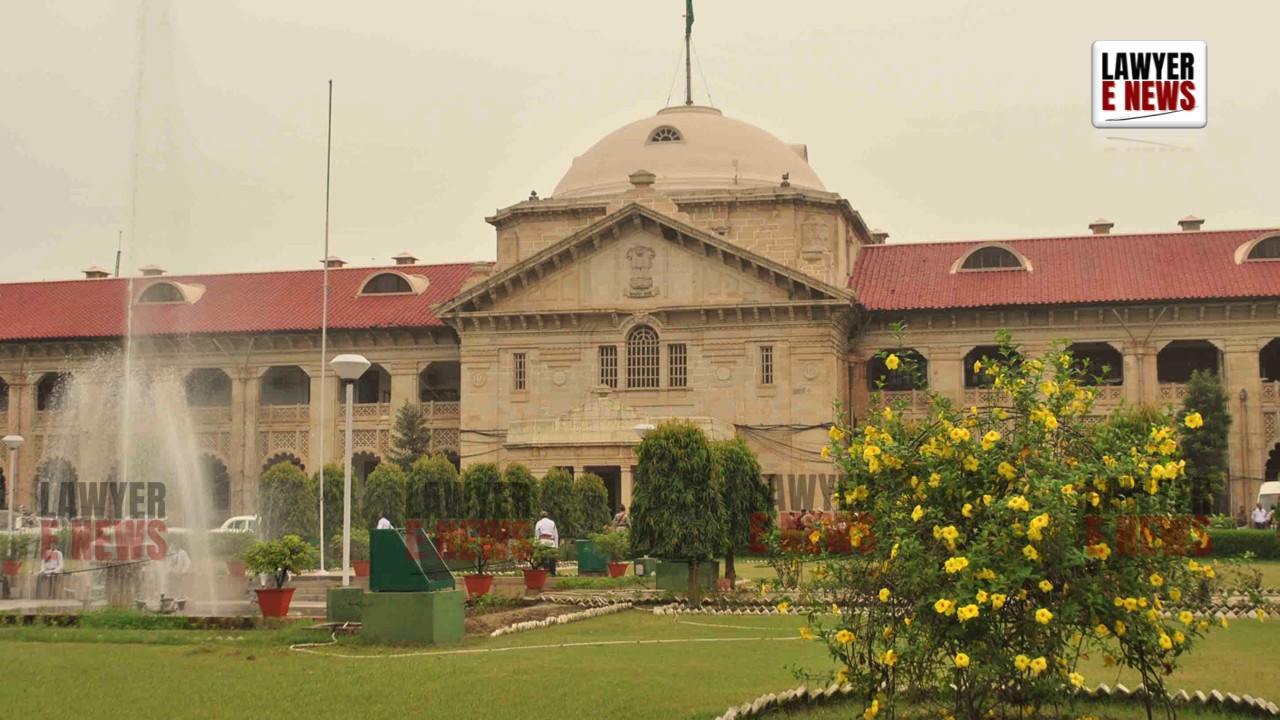
“Offences Of This Nature Are Ordinarily Committed In A Clandestine Manner… Not Openly In Electric Light Without Concealing Identity”, High Court of Judicature at Allahabad delivered a significant judgment setting aside the conviction of four appellants under Section 396 of the Indian Penal Code for dacoity with murder. The Division Bench of Justice J.J. Munir and Justice Vinai Kumar Dwivedi held that the prosecution story was riddled with improbabilities, doubtful identification, non-recovery of looted property and prior enmity that cast serious doubt on the veracity of the case.
Allowing the appeal, the Court acquitted Amar Singh, Prakash @ Om Prakash, Bahori and Biri Singh, while recording that the appeal of Hardayal had already abated due to his death. The Court directed compliance under Section 481 of the Bharatiya Nagarik Suraksha Sanhita, 2023.
The case arose from a judgment dated 22 December 1987 passed by the Ist Additional Sessions Judge, Mathura, convicting the appellants under Section 396 IPC and sentencing them to life imprisonment. The prosecution alleged that during the intervening night of 10/11 November 1985, a group of 10–12 dacoits committed armed dacoity at the house of Pohap Singh in village Sakarva, District Mathura, resulting in the death of one Summera and injuries to nine others.
The High Court, after reappreciating the evidence, found the prosecution version “improbable and artificial,” holding that the conviction could not be sustained in law.
According to the FIR lodged promptly at 3:30 a.m. on 11 November 1985 by Tika Ram, the informant, the dacoits were armed with country-made pistols, lathis and axes. It was claimed that the accused were clearly identified in electric light and that none had concealed their faces.
The prosecution further alleged prior enmity. It was stated that Hardayal had eloped with the wife of one Deepa, and that Pohap Singh had assisted Deepa. Additionally, Hardayal had executed, and later cancelled, a will in favour of the informant’s son. These incidents were projected as motive.
The Trial Court relied on the testimonies of three related eyewitnesses and convicted the accused under Section 396 IPC.
The High Court examined several core legal issues: reliability of identification in electric light, effect of prior enmity, non-recovery of looted property, withholding of material witness, and inherent improbabilities in the prosecution case.
On identification, the Court found it “very surprising” that known persons would commit dacoity in electric light without covering their faces. It observed that “any person who is committing a crime tries his best to conceal his identity,” and that the prosecution’s version was “against human nature.”
The Bench emphasized that no official from the electricity department was examined to prove that electricity supply was available at 2:00 a.m. in the village. The omission, according to the Court, was significant because “it is a fundamental principle of criminal law that the burden lies upon the prosecution to prove its case beyond reasonable doubt.”
On the issue of enmity, the Court invoked settled Supreme Court precedent and reiterated: “Enmity is a double edged weapon which cut both ways. It may constitute motive for the commission of the crime and at the same time it may also provide a motive for false implication.” In the present case, the admitted animosity arising from personal disputes and cancellation of a will created serious doubt about the prosecution’s narrative.
The Court also highlighted the complete failure of recovery of looted ornaments, cash or valuables from any accused. Despite prompt lodging of the FIR and raids conducted, “not a single ornament, valuable or thing” was recovered. Relying on Iqbal v. State of U.P. and Lakshman Prasad v. State of Bihar, the Bench noted that absence of recovery in a dacoity case weakens the prosecution when no other reliable connecting evidence exists.
Another critical lapse was the non-examination of Pohap Singh, at whose house the dacoity allegedly occurred. The Court observed that the prosecution offered no explanation for withholding him and drew an adverse inference.
In a telling remark, the Court stated: “While witnesses may lie, circumstances do not.” The intrinsic improbabilities, coupled with prior enmity and lack of corroboration, made the prosecution version unsafe to rely upon.
The Bench concluded that the Trial Court had failed to consider the aspect of enmity in the correct perspective and had overlooked material improbabilities. It held that the findings of conviction were “not sustainable in the eyes of law.”
The Court set aside the conviction and sentence dated 22 December 1987. The appeal of Hardayal stood abated. The remaining appellants were acquitted and their bail bonds cancelled, subject to execution of bonds under Section 481 BNSS for appearance in case of further appeal.
The Allahabad High Court’s ruling reinforces the foundational principle that suspicion, however strong, cannot substitute proof beyond reasonable doubt. By emphasizing that identification must pass the test of human probabilities and that enmity cannot be the sole basis for conviction, the Court extended the benefit of doubt to the accused.
The judgment serves as a reminder that in serious offences like dacoity with murder under Section 396 IPC, courts must carefully scrutinize intrinsic probabilities, corroborative evidence, and investigative lapses before upholding a conviction.
Date of Decision: 24 February 2026





