
-
by sayum
25 August 2026 12:32 PM







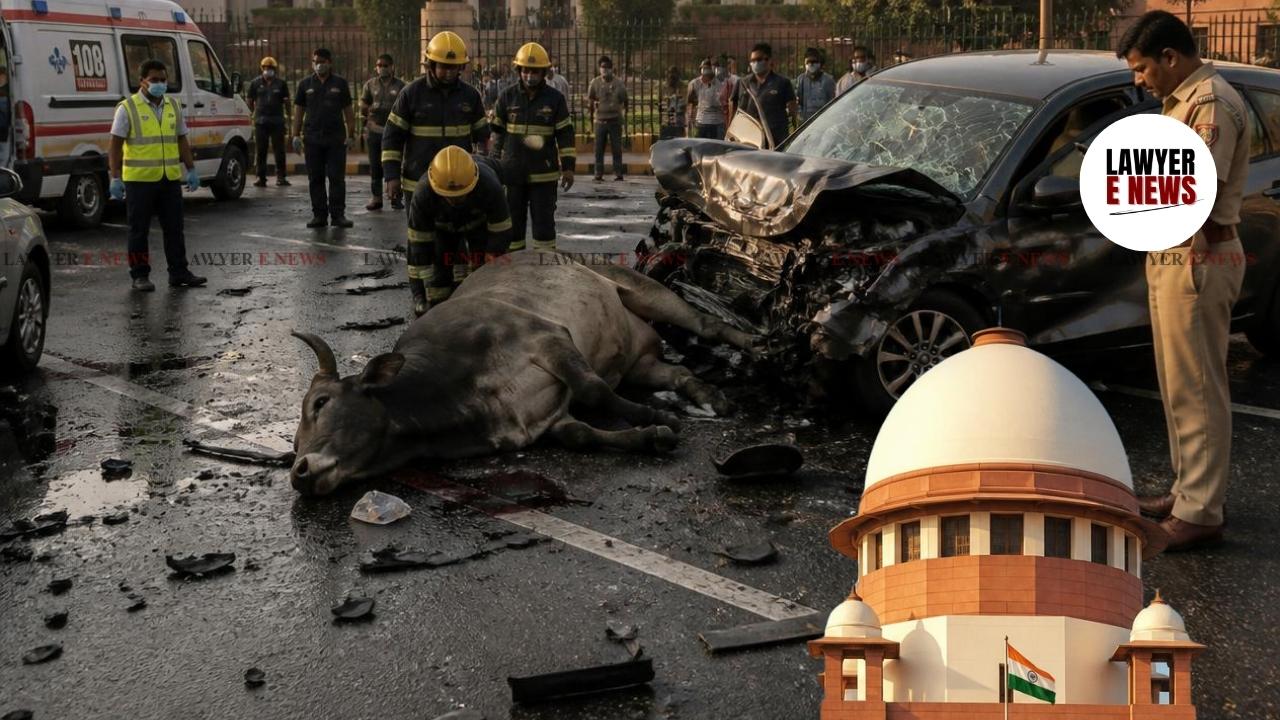
"Now, after such a long time, even if there is legal merit in the statement that a claim should have been filed before the competent Civil Court, where does that leave the claimants? The simple answer is, remediless." Supreme Court of India, in a significant ruling dated July 31, 2026, overturned a Division Bench judgment of the Punjab and Haryana High Court, holding that a writ petition for compensation arising from a stray bull incident was maintainable.
A bench of Justices Sanjay Karol and Nongmeikapam Kotiswar Singh observed that dismissing the petition on the ground of "disputed questions of fact" after a substantial efflux of time would render the claimants "remediless," especially when the facts were largely undisputed. The Court awarded a lump sum compensation of ₹15 lakhs to the appellant.
The case originated from an incident on September 21, 2007, where Vijay Kumar was fatally struck by a stray bull, sustaining a head injury. After his demise, his widow, Nisha, filed a writ petition before the High Court seeking compensation. The learned Single Judge initially awarded compensation of ₹29,32,000/- with 6% interest, applying principles from the Motor Vehicles Act, 1988. However, the Division Bench subsequently set aside this order on November 12, 2025, stating that the writ petition involved "disputed questions of fact" and was therefore not maintainable, granting liberty to approach a Civil Court. Nisha then appealed to the Supreme Court.
The primary question before the Supreme Court was whether the High Court's Division Bench was correct in setting aside the compensation award on grounds of maintainability due to "disputed questions of fact." The court also considered the broader mechanism for compensating victims of stray animal incidents and the responsibilities of civic bodies.
Efflux of Time Renders Civil Remedy Unjust
The Supreme Court found the Division Bench's reasoning, though "appealing at first blush," flawed. It underscored that the incident occurred in 2007, the writ was filed in 2010, the Single Judge decided in 2019, and the Division Bench ruled in 2025. After such a prolonged period, directing the claimant to a civil court would effectively leave them without a remedy.
Undisputed Nature of Facts
The Court highlighted that the incident was never questioned or denied by the respondent. An FIR was lodged, and the deceased had previously sought compensation from the Deputy Commissioner, Sangrur, which was not favourably considered solely because the authority "does not receive any fund which can be given as compensation." These circumstances pointed to the undisputed nature of the incident itself.
Compensation for Stray Animal Incidents
The Court acknowledged that while the Single Judge applied principles governing compensation under the Motor Vehicles Act, 1988, this method "cannot be accepted as being applicable as a matter of rule in every case." However, for incidents after 2020, specific rules in Punjab quantify compensation, creating an ambiguity only for prior cases like the present one.
State's Constitutional Duty Towards Animals and Public Safety
The bench emphasized India's agrarian economy and the indispensable role of bovines. It referenced Article 48 of the Constitution of India, a Directive Principle of State Policy, which implores the State to organize agriculture and animal husbandry on modern methods and prevent cow slaughter. It also cited Article 51-A(g), a fundamental duty, which enjoins every citizen to "have compassion for all living beings."
"After all, they are not meant to be natural speed breakers, placed willy-nilly on the National Highways, roads and streets."
The Court expressed concern over the increasing number of "Bovine related incidents and accidents" and noted that animals roaming on roads suffer "unnecessary pain and suffering," a point acknowledged by the Constitution Bench in Animal Welfare Board of India v. Union of India (2023) 9 SCC 322. It presented statistics showing thousands of persons killed by animals annually nationwide, highlighting a larger societal issue.
Existing Legal Framework and State Initiatives
The judgment detailed the statutory framework, including the pre-constitutional Cattle Trespass Act, 1871, which provides for impounding stray cattle and levying fines. Post-independence, the Prevention of Cruelty to Animals Act, 1960, establishes the Animal Welfare Board of India, mandates animal care, and defines cruelty. Section 11(h) addresses owners failing to provide food, drink, or shelter.
The Court provided a comprehensive table outlining legislations from at least 24 States/UTs aimed at cattle preservation and protection. These laws often mandate the establishment of "Gaushalas" or "institutions" for the care of "uneconomic cows" (stray, unprotected, infirm, diseased, or barren). States like Punjab, Haryana, Himachal Pradesh, and Chandigarh have specific provisions for impounding, auction, and crucially, tagging of cattle.
Owner Responsibility and Social Reality
The Court observed the "deeply flawed, human world" where animals are often let go once their economic utility dwindles. It referred to the Constitution Bench judgment in Mohd. Hanif Quareshi v. State of Bihar (1958 SCC OnLine SC 176), which, even in 1958, recognized "useless and inefficient cattle" as a "nuisance and a source of danger." While Section 289 of the IPC addresses negligent conduct with animals causing harm, the Court questioned if this adequately answers the "call of need from the injured or the family of the deceased."
Punjab's Compensation Scheme for Victims
The Court specifically noted the Punjab Municipal (Registration and Proper Control of Stray Animals) Bye-Laws, 2006, which established a fund for victims of stray cattle, though it did not quantify the amount. Subsequent notifications in 2020 and 2023 by the Punjab Government enhanced compensation to ₹5 lakhs for death and ₹2 lakhs for permanent incapacitation, applicable from 2020 onwards.
Lump Sum Award and Non-Precedent Status
Given the long pendency of the matter and the severe injury suffered by the deceased, the Supreme Court deemed it appropriate to award a lump sum compensation of ₹15 lakhs. The Court explicitly stated that this order was passed based on the "attending facts and circumstances of the case and shall not be treated as a precedent."
Suggestions for Centre and State Governments
Finally, the Supreme Court made five key suggestions for consideration and implementation by the Centre and State Governments:
The Supreme Court allowed Nisha's appeal, setting aside the Division Bench's judgment and restoring compensation, albeit in a modified lump sum of ₹15 lakhs. This landmark decision not only brings relief to the appellant after a prolonged legal battle but also highlights the critical need for a comprehensive, national approach to managing stray animals, ensuring public safety, and providing timely compensation to victims, emphasizing the State's constitutional and statutory duties.
Date of Decision: July 31, 2026





