
-
by kapil
17 October 2026 7:51 AM







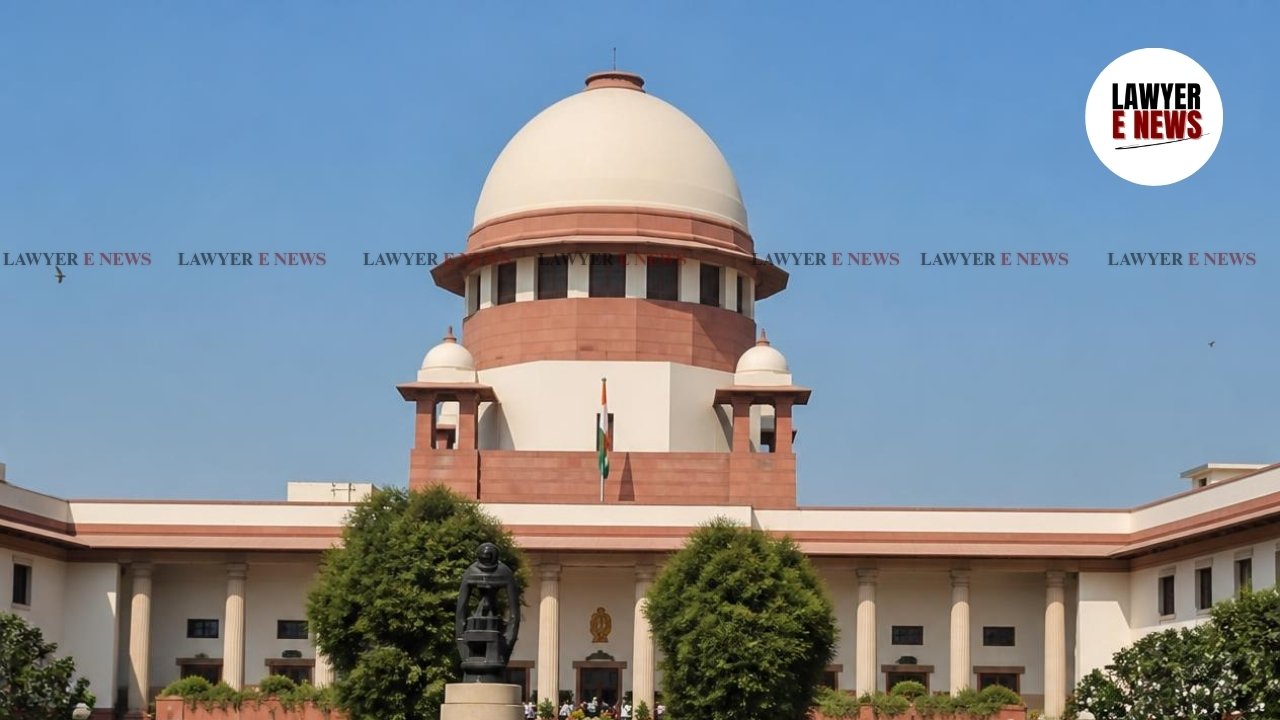
"The mere addition of a causal requirement and a removal of the presumption that when a member joins service healthy, and, if, he leaves with a disability, it ought to be attributable to the military service, does not, by itself, change the core scheme of the Entitlement Rules 2008" Supreme Court, in a significant ruling dated September 15, 2026, held that disability pension is not an automatic consequence of any illness manifesting during military service, emphasizing that a definitive causal connection between the disability and military service conditions must be established.
A bench comprising Justices Pamidighantam Sri Narasimha and Alok Aradhe observed that while the core beneficial principles remain intact, claimants must satisfy the requirement of causal nexus, particularly in cases involving degenerative or constitutional diseases.
Court Rejects Mechanical Application of Precedents
The Court addressed a massive batch of over 271 Civil Appeals and Special Leave Petitions filed by the Union of India against ex-servicemen. The bench noted that these matters were often pursued despite conclusive judgments and despite many cases being barred by limitation. The Court expressed concern over the "burgeoning docket" of litigation and the failure of the system to resolve disability pension disputes definitively.
Union's Failure to Prove Validity of 2008 Rules
A critical issue examined by the Court was the legitimacy of the Entitlement Rules for Casualty Pensionary Awards, 2008. The bench pointedly remarked on the "great amount of uncertainty" surrounding these rules, noting that the Union repeatedly failed to demonstrate their valid promulgation. The Court referenced the 2015 Raksha Mantri Report, which cast serious doubt on the sanctity of the 2008 Rules, describing them as having been introduced by a "sleight of hand" without proper cabinet or departmental approval.
Continuity of Beneficial Principles
Despite questioning the procedural validity of the 2008 Rules, the Court conducted a comparative analysis with the 1982 Entitlement Rules. It concluded that the core protective structure for servicemen remains largely consistent. The Court affirmed that the onus of proof regarding non-entitlement continues to lie primarily on the employer, maintaining the liberal interpretation approach established in Dharamvir Singh v. Union of India.
No Absolute Presumption of Attributability
The bench clarified that the 2008 Rules did not entirely dismantle the claimant-protective framework, but they did strengthen the requirement for a causal nexus. The Court observed that the mere fact that a disease manifested during service does not per se establish attributability. It stressed that medical boards are expert bodies whose opinions deserve due weight and should not be substituted by courts unless a clear defect or manifest error is demonstrated.
Shifting Onus in Belated Claims
The Court highlighted a specific change in the 2008 regime regarding the burden of proof. It held that while the establishment carries the burden for claims made within 15 years, the principle in Rule 7 of the 2008 Rules shifts the onus to the claimant for any claims preferred after this 15-year threshold. The Court emphasized that in such belated cases, the applicant must discharge the burden of proving that the disability is attributable to or aggravated by military service.
Concluding the matter, the Court dismissed the entire batch of appeals, noting that they lacked merit and were filed with significant delay. The bench directed that in all pending matters, Tribunals must rigorously scrutinize the reasoning provided by Medical Boards before adjudicating claims. It reiterated that the burden of proof is only shifted to the applicant in cases where the claim is raised after the fifteen-year limitation period, reinforcing the necessity for meticulous evidence-based decision-making.
Date of Decision: 15 September 2026