-
by sayum
14 August 2026 3:21 PM







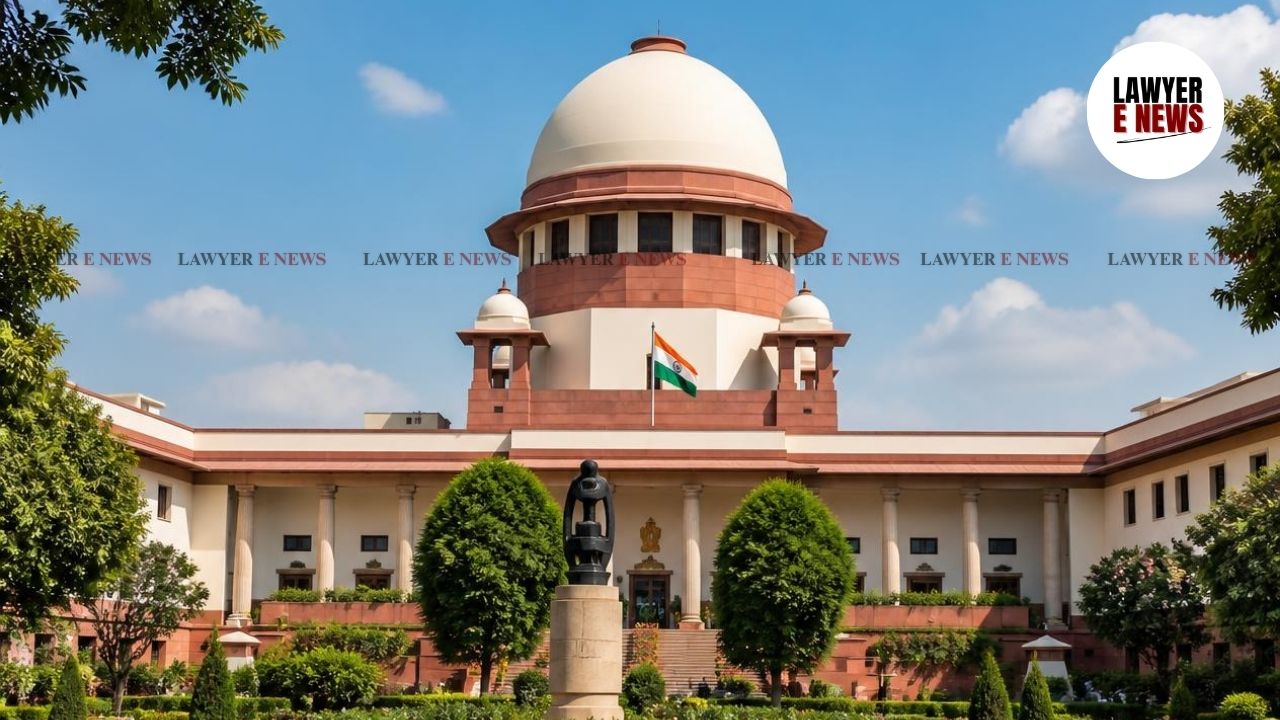
"The constitutional guarantee of a fair trial is absolutely non-negotiable and cannot be sacrificed at the altar of practical convenience." Supreme Court of India, in a significant ruling dated July 21, 2026, held that the denial of effective legal representation to an accused facing capital punishment vitiates the entire trial process and violates the fundamental right to a fair trial under Article 21 of the Constitution.
A bench comprising Justices Vikram Nath, Sanjay Karol, and Sandeep Mehta observed that the constitutional obligation of the court does not stand discharged merely because an accused is physically present. Emphasizing that the requirement is one of real and meaningful representation, the Court set aside the death sentence awarded to Dr. Abdul Hameed in the 1996 Samleti bus bomb blast case and ordered a de-novo trial.
The case stems from a devastating bomb blast on May 22, 1996, inside a Rajasthan Roadways bus near Samleti village, which claimed fourteen lives and seriously injured thirty-seven others. Following a prolonged investigation, several individuals were charged with murder, criminal conspiracy, and offences under the Explosive Substances Act. The trial court convicted Dr. Abdul Hameed and awarded him the death penalty, which was subsequently confirmed by the Rajasthan High Court. Another accused, Pappu @ Salim, was sentenced to life imprisonment, while several other co-accused were acquitted, prompting a batch of appeals before the Supreme Court.
The primary question before the court was whether the trial culminating in the death sentence of Dr. Abdul Hameed was conducted in conformity with the constitutional guarantee of a fair trial, given that he remained undefended throughout the proceedings. The court was also called upon to determine the evidentiary value of retracted confessional statements and whether they could form the sole basis for the conviction of an accused.
Denial Of Legal Aid Vitiates Trial
The Supreme Court expressed grave concern over the fact that Dr. Abdul Hameed was left to fend for himself during the trial without any legal assistance. The bench noted that the trial court never offered the services of a legal aid counsel or appointed an amicus curiae, compelling the accused to cross-examine witnesses and address arguments on his own. The Court firmly stated that the right to be defended by a legal practitioner is not an empty ritual but a substantive safeguard against the risk of prejudice and arbitrariness.
Duty Of Court In Capital Cases
Emphasizing the heightened responsibility of trial judges in severe offences, the Court observed that the obligation to ensure competent representation becomes particularly onerous when the accused faces the death penalty. The bench noted that a trial reduced to a mere formality cannot command the confidence of the justice delivery system. The Court reiterated that justice must not only be done but must manifestly be seen to be done, safeguarding the rights of the accused without bypassing constitutional guarantees.
"In the hallowed halls of justice, the essence of a fair and impartial trial lies in the steadfast embrace of judicial calm."
De-Novo Trial Ordered To Balance Justice
While acknowledging the severe constitutional infirmity, the Court ruled that an outright acquittal would not serve the ends of justice given the catastrophic nature of the terrorist act. The bench explained that the magnitude of the crime, which struck at public order and national security, necessitated a fresh adjudication. Balancing the fundamental rights of the accused with legitimate societal interests, the Court remitted the matter to a designated Special Court for a de-novo trial, directing that the proceedings be concluded within one year.
Retracted Confessions Require Strict Corroboration
Turning to the appeal of co-accused Pappu @ Salim, the Court heavily criticized the reliance placed by the lower courts on his retracted confessional statements. The bench observed that the confessions were recorded after protracted delays and suffered from serious procedural irregularities under Section 164 of the CrPC. The Court emphasized that once the maker of a confession challenges the circumstances of its recording and repudiates its contents, such material must be approached with the utmost caution.
Absence Of Independent Evidence Is Fatal
The Court found that the prosecution's case against Pappu @ Salim was completely devoid of any independent corroborative evidence, such as incriminating recoveries or forensic links to the conspiracy. Highlighting that a retracted confession requires strong and independent corroboration from reliable evidence, the bench ruled that the findings of the lower courts were based on conjectures rather than legally admissible material. Consequently, the Court set aside his conviction and acquitted him of all charges.
Acquittal Of Co-Accused Upheld
Addressing the State's appeals against the acquittal of other co-accused, including Javed Khan and Abdul Goni, the Supreme Court found no grounds for interference. The Court noted that the prosecution's case rested almost entirely on the weak foundation of a co-accused's confessional statement, which did not attribute any specific overt act to them regarding the Samleti blast. The bench reiterated the settled principle that an appellate court should not disturb a finding of acquittal unless it is palpably wrong or manifestly erroneous.
The Supreme Court partly allowed the appeal filed by Dr. Abdul Hameed, setting aside his conviction and death sentence while remanding his case for a fresh trial before a designated Special Court. Furthermore, the Court acquitted Pappu @ Salim of all charges and dismissed the State's appeals against the acquittal of the remaining co-accused, bringing a significant closure to the prolonged legal battle while reaffirming stringent fair trial standards.
Date of Decision: 21 July 2026