-
by sayum
25 August 2026 11:12 PM







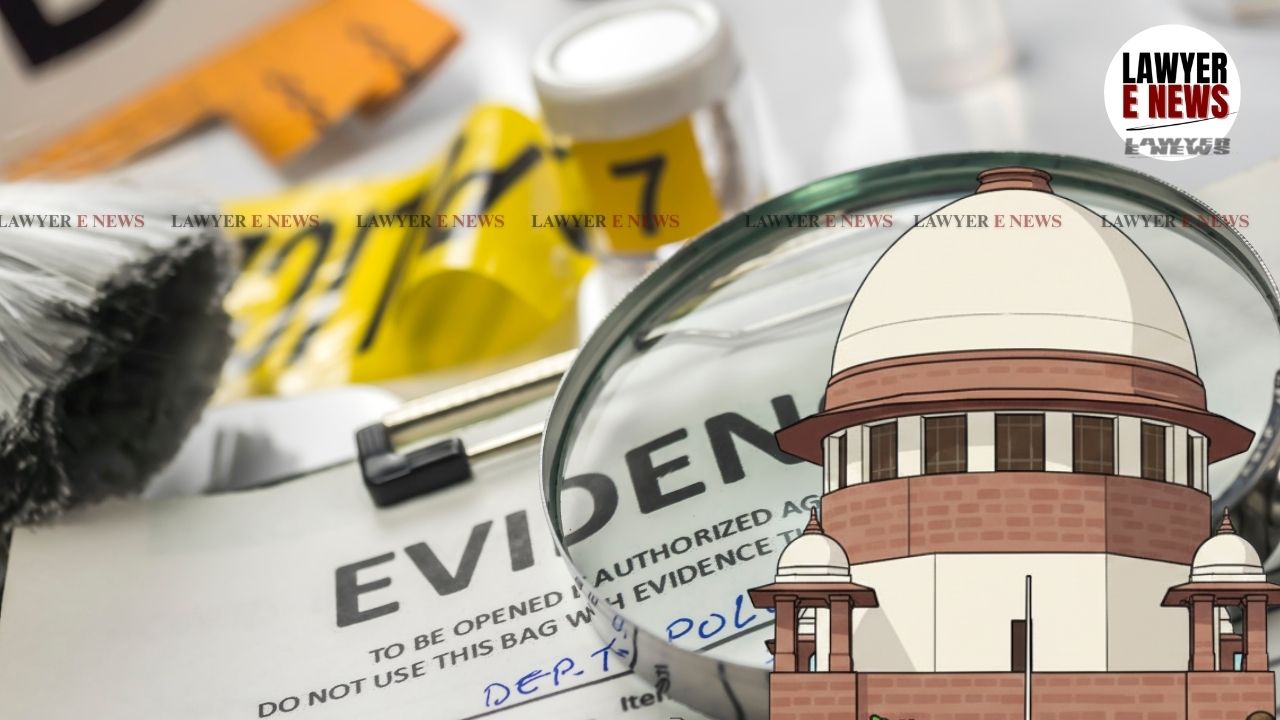
“Simply relying upon the deposition of an interested witness, conviction cannot be recorded”, Today, On 18 December 2025, the Supreme Court of India setting aside the life imprisonment awarded to seven accused persons for a 2010 murder case.
A Bench comprising Justice Prashant Kumar Mishra and Justice Vipul M. Pancholi, speaking through Justice Vipul M. Pancholi, held that the prosecution had failed to prove its case beyond reasonable doubt, and that the courts below had erred in placing sole reliance on a contradictory and unreliable eyewitness account, unsupported by independent or medical evidence.
The Court categorically ruled that “simply relying upon the deposition given by PW-4, conviction cannot be recorded”, and acquitted all the appellants.
The case arose out of an incident dated 14 July 2010 in a village in Baloda Bazar district, Chhattisgarh, where Goreylal was allegedly assaulted near a pond and later found dead.
According to the prosecution, the informant Parasbai (PW-4)—mother of the deceased—claimed that her granddaughter Indu Bai informed her that members of the Teli caste were assaulting her son. PW-4 alleged that upon reaching the spot, she saw seven accused persons beating Goreylal with lathis and stones, after tying his hands behind his back.
An FIR was lodged the same day under Section 302 read with Section 34 IPC, later charges being framed under Sections 302 read with 149 and 148 IPC, along with Section 506-B IPC against one accused.
On 01 September 2012, the IInd Additional Sessions Judge, Baloda Bazar, convicted all accused and sentenced them to life imprisonment. The Chhattisgarh High Court, by judgment dated 17 February 2021, dismissed the appeals and affirmed the conviction—prompting the present appeals before the Supreme Court.
“Material contradictions strike at the root of the prosecution case”: Court on eyewitness testimony
The prosecution’s case primarily rested on PW-4, the mother of the deceased. While reiterating the settled principle that testimony of a related witness is not to be discarded merely on that ground, the Court emphasised that such evidence must withstand close and careful scrutiny.
Upon examination, the Bench found serious inconsistencies in PW-4’s version. The judgment notes that in the FIR, PW-4 stated she witnessed the assault, whereas in her deposition she claimed her granddaughter told her that the accused had already killed Goreylal. The Court observed:
“There are major contradictions in the deposition given by PW-4 regarding the manner in which the incident took place and with regard to which the information about the incident was given by her granddaughter.”
Crucially, PW-4 admitted in cross-examination that when she reached the spot, the deceased was already injured, and that she could not say which accused’s lathi or stone caused the injuries.
“Failure to examine the most natural witness”: Non-examination of granddaughter proves fatal
A key circumstance highlighted by the Supreme Court was the non-examination of Indu Bai, the granddaughter who allegedly first witnessed the assault and informed PW-4.
The Court found this omission unexplained and significant, noting:
“The prosecution has failed to examine Indu Bai who had given the information to the informant.”
Given that Indu Bai was projected as the first informant of the occurrence, her absence from the witness box cast a serious shadow over the prosecution narrative.
“Independent witnesses did not support the prosecution”: Hostile witnesses weaken recovery evidence
The Court also took note of the fact that independent witnesses PW-1, PW-2 (Sarpanch), PW-3 and PW-9 turned hostile.
PW-2 categorically stated that no memorandum statements were made by the accused in his presence, nor were any weapons seized before him. PW-3 similarly did not support the prosecution.
In this backdrop, the Court held:
“The recovery/production of the weapons from/by the accused persons through their memorandum of statement also cannot be believed.”
“Medical evidence does not bridge the gap”: Incised wounds unexplained by seized stone
The post-mortem was conducted by PW-7, Dr. Chain Singh Painkara, who found multiple injuries, including three incised wounds.
While the doctor opined that injuries were “possibly” caused by the sticks and stone shown to him, the Court found this opinion inconclusive. It was emphasised that:
“The doctor admitted that he has not mentioned in the post-mortem report as to which wounds were caused by which weapon.”
More importantly, only one triangular stone was seized, and the Court found it “difficult to believe that three incise wounds have been caused by one stone,” especially when the prosecution never alleged repeated blows with the same stone.
“Benefit of doubt must follow”: Supreme Court overturns concurrent findings
Rejecting the concurrent findings of the Trial Court and the High Court, the Supreme Court concluded that the chain of evidence was incomplete and unreliable.
Summing up its reasoning, the Bench held:
“The prosecution has failed to prove the case against the appellants-accused persons beyond reasonable doubt, despite which the Trial Court has recorded the judgment of conviction.”
Acquittal after 15 years of prosecution
Allowing both criminal appeals, the Supreme Court set aside the judgment of the Chhattisgarh High Court dated 17.02.2021, as well as the conviction and sentence imposed by the Trial Court.
All appellants, who had already been released on bail on 30 July 2025, were ordered to have their bail bonds discharged. Pending applications were disposed of.
The judgment reinforces a core criminal law principle: suspicion, however strong, cannot replace proof, and convictions—especially for offences carrying life imprisonment—must rest on consistent, credible and corroborated evidence.
Date of Decision: 18 December 2025