-
by sayum
05 August 2026 3:07 PM








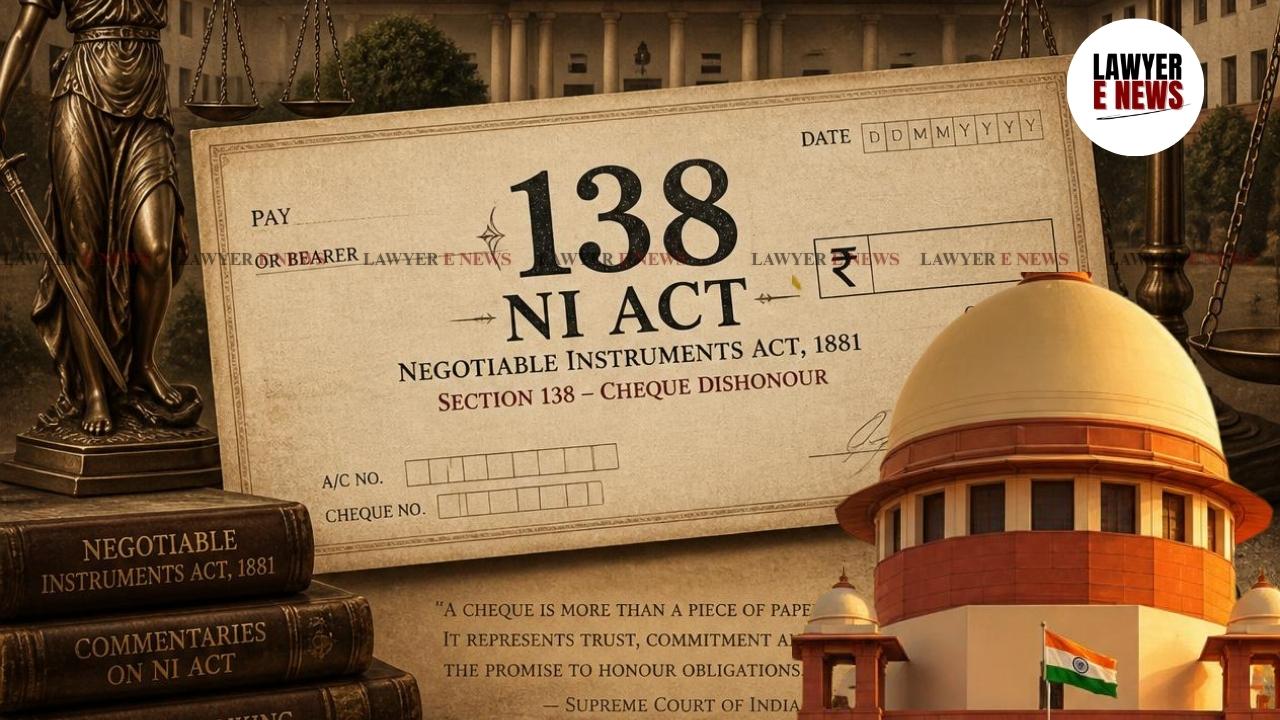
“Right to Be Heard Cannot Be Sacrificed on Technical Grounds”: High Court of Rajasthan at Jodhpur, through Justice Manoj Kumar Garg, delivered a significant ruling upholding the fundamental right to be heard before the law. In Criminal Revision Petition the Court set aside an appellate order dismissing a criminal appeal under Section 138 of the Negotiable Instruments Act, 1881, for non-prosecution. The Court firmly reiterated that in criminal matters, particularly those involving conviction, appellate courts are duty-bound to decide cases on merits, irrespective of the presence or absence of the accused or their counsel.
The petitioner, Firm Jehtmal & Sons, was convicted by the Special Judge (NI Act No.2), Bikaner, on 22 July 2021, for an offence under Section 138 of the NI Act and sentenced to one-year simple imprisonment with a fine of ₹8 lakhs. Against this conviction, the petitioner filed an appeal before the Additional District & Sessions Judge No.7, Bikaner. However, on 23 August 2022, the appellate court dismissed the appeal summarily for non-prosecution due to the absence of the petitioner or his counsel and issued an arrest warrant.
Aggrieved by this mechanical dismissal, the petitioner approached the High Court through a revision petition, seeking restoration of the appeal for adjudication on merits.
The key legal issue before the Court was whether an appeal against conviction can be dismissed solely for non-prosecution and whether the principles of natural justice mandate a decision on merits despite the absence of the appellant or their counsel.
Justice Manoj Kumar Garg answered in the affirmative for the petitioner, holding:
“Dismissal of appeal for non-appearance, especially against conviction, is against the settled principles of criminal jurisprudence and violates the doctrine of audi alteram partem.”
The Court emphasised that the foundational principle of natural justice mandates that no person should be condemned unheard, citing well-established Supreme Court jurisprudence. It ruled that an appellate court cannot avoid its duty to adjudicate on merits, even if the accused fails to appear.
“A Person Cannot Be Punished for the Negligence of Their Counsel—Failure to Appear Does Not Justify Mechanical Dismissal”: High Court
In unequivocal terms, the Court noted:
“The order dismissing the appeal is mechanical, cursory, and bereft of any reasoning or findings. Such an order contravenes the basic tenets of justice and fairness.”
Justice Garg relied on the celebrated judgment in Bani Singh v. State of Uttar Pradesh, AIR 1996 SC 2439, where the Supreme Court held that appeals against conviction must be decided on merits even in the absence of appellants or their lawyers. Quoting from Bani Singh, the Court observed:
“It is the duty of the court to peruse the record and decide on merits; the law does not authorise dismissing criminal appeals in default.”
Further strengthening this legal stance, the Court cited Sakunthala v. State, Cr. Appeal No. 474/2020, where the Supreme Court reaffirmed:
“An appeal against an order of conviction cannot be dismissed in default but must be taken up and decided on merits even if the appellant in-person or the counsel representing him is not present.”
Criticising the approach of the lower court, Justice Garg observed:
“Every judicial order must reflect application of mind and provide reasons. A cryptic dismissal, especially in conviction appeals, is a violation of fair trial rights.”
Setting aside the dismissal order dated 23 August 2022, the High Court remanded the case back to the Additional District & Sessions Judge No.7, Bikaner, directing:
“The appellate court shall pass a detailed, reasoned, and speaking order after considering all evidence and after granting due opportunity of hearing to the petitioner.”
The petitioner was directed to appear before the appellate court on 4 August 2025.
Conclusion:
This judgment by the Rajasthan High Court upholds a core safeguard of criminal justice—the right to be heard—by ensuring that technical absences or procedural lapses do not defeat substantive justice. It affirms that appellate courts cannot abrogate their duty to decide cases on merits, especially where life, liberty, or reputation of a person is involved.
Date of Decision: 11/07/2025