-
by sayum
21 October 2026 1:30 PM







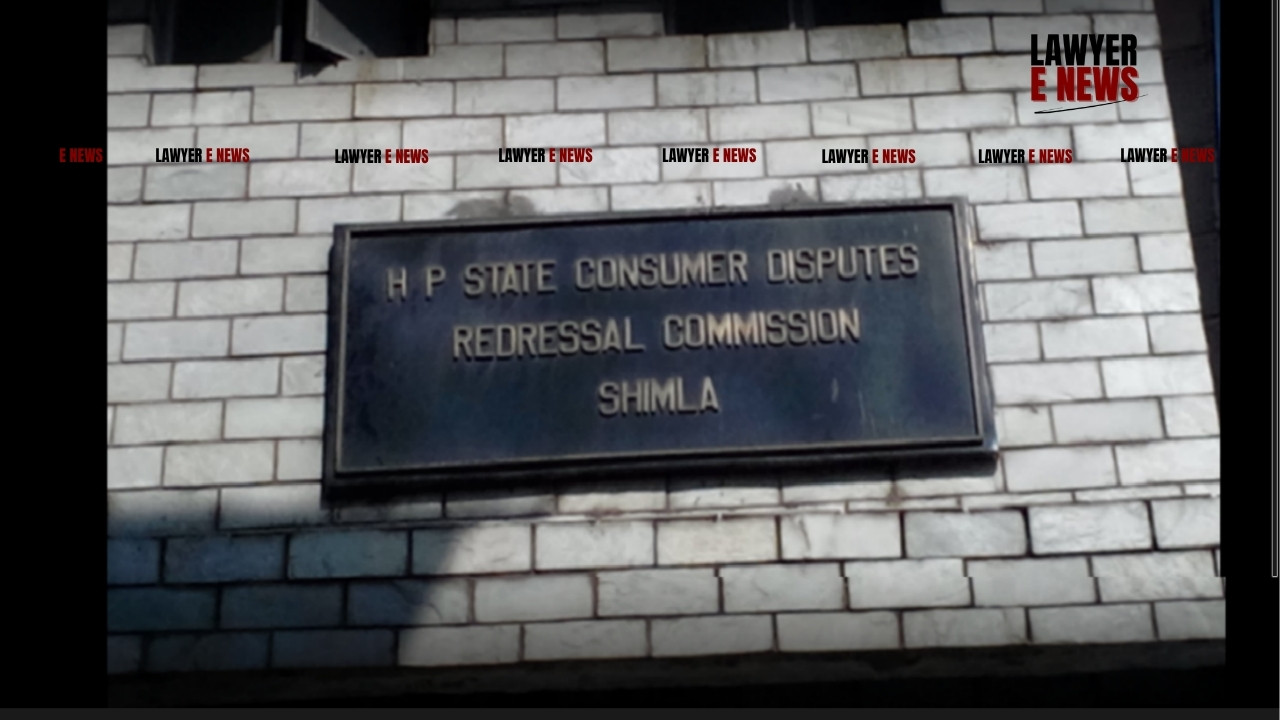
"If complaints were to be spurned on the specious ground that the consumers knew what they were purchasing, the object and purpose of the enactment would be defeated. Any deficiency detected post-purchase opens up an avenue for the aggrieved consumer to seek relief before the consumer fora." Himachal Pradesh State Consumer Disputes Redressal Commission, in a significant ruling dated 18 September 2026, held that an auctioneer cannot escape liability for the sale of a vehicle encumbered by legal proceedings by taking shelter behind an 'as is where is' clause.
A bench presided by Justice Inder Singh Mehta observed that the doctrine of caveat emptor (let the buyer beware) has been effectively replaced by caveat venditor (let the seller beware) in the context of beneficial consumer legislation.
The complainant participated in a public auction conducted by the appellant (Opposite Party No. 1) and purchased a Tata Tiago vehicle for Rs. 2,35,000. Despite paying the purchase price and commission, the complainant was never provided with the necessary documents, such as a No Objection Certificate (NOC) or a sale affidavit, to facilitate the transfer of ownership. It was later discovered that the vehicle had been released on supurdari (custody) by a Judicial Magistrate in an NDPS case and was still under a hire-purchase lien.
The core legal questions before the Commission were whether an auction purchaser of a movable asset can be classified as a 'consumer' under the Consumer Protection Act, 2019, and whether an auctioneer acting as an intermediary can be held liable for the sale of a vehicle with a latent defect in title. Additionally, the court addressed whether the existence of an arbitration clause in the service agreement ousts the jurisdiction of Consumer Fora.
Auction Purchaser as a Consumer
The Commission rejected the contention that an auction purchaser is not a 'consumer'. Relying on the Supreme Court's decision in Madan Kumar Singh (D) through LRs v. District Magistrate, Sultanpur, the Commission held that since the sale of movable goods was involved, the purchaser falls squarely within the definition of a 'consumer' under Section 2(7) of the Act.
Auctioneer as Service Provider
The bench emphasized that the appellant charged facilitation fees and explicitly styled itself as a 'service provider' in its own documentation. Therefore, it could not claim immunity by labeling itself a mere intermediary. The court applied the doctrine of contra proferentem, noting that any ambiguity in the service agreement drafted by the appellant must be construed against it.
Doctrine of Caveat Venditor
Addressing the appellant's reliance on the 'as is where is' clause, the Commission held that such a clause applies only to visible, apparent defects. A latent defect, such as a judicial bar on transferability due to an ongoing criminal trial, could not have been ascertained by the buyer upon inspection.
Application of Caveat Venditor
The bench underscored that modern consumer law places the burden of disclosure on the seller. The Commission noted that the doctrine of caveat venditor has superseded caveat emptor to ensure that the primary objective of the Consumer Protection Act—the protection of consumers—is not defeated by technical contractual clauses.
"The jurisdiction of a Court is not determined by the fastest finger first, but the nature of the dispute, the public policy in the matter, the will of the legislature, the election or choice of the consumer amongst various factors."
Non-Arbitrability of Consumer Disputes
The Commission reaffirmed that the existence of an arbitration clause does not oust the jurisdiction of Consumer Fora. Citing M. Hemalatha Devi v. B. Udayasri, the bench held that the Consumer Protection Act is a piece of beneficial legislation, and consumers cannot be forced into private fora like arbitration when they elect to seek redressal before public fora established by the statute.
The Commission modified the District Commission's order, directing the appellant to clear the encumbrances and provide all necessary documents within 45 days. In the event of failure to do so, the appellant is directed to refund the purchase price and improvement costs, totaling Rs. 3,26,634, along with Rs. 50,000 as compensation. If the appellant fails to comply within the 45-day window, the amount shall carry interest at 9% per annum.
Date of Decision: 18 September 2026