-
by sayum
16 August 2026 12:05 PM







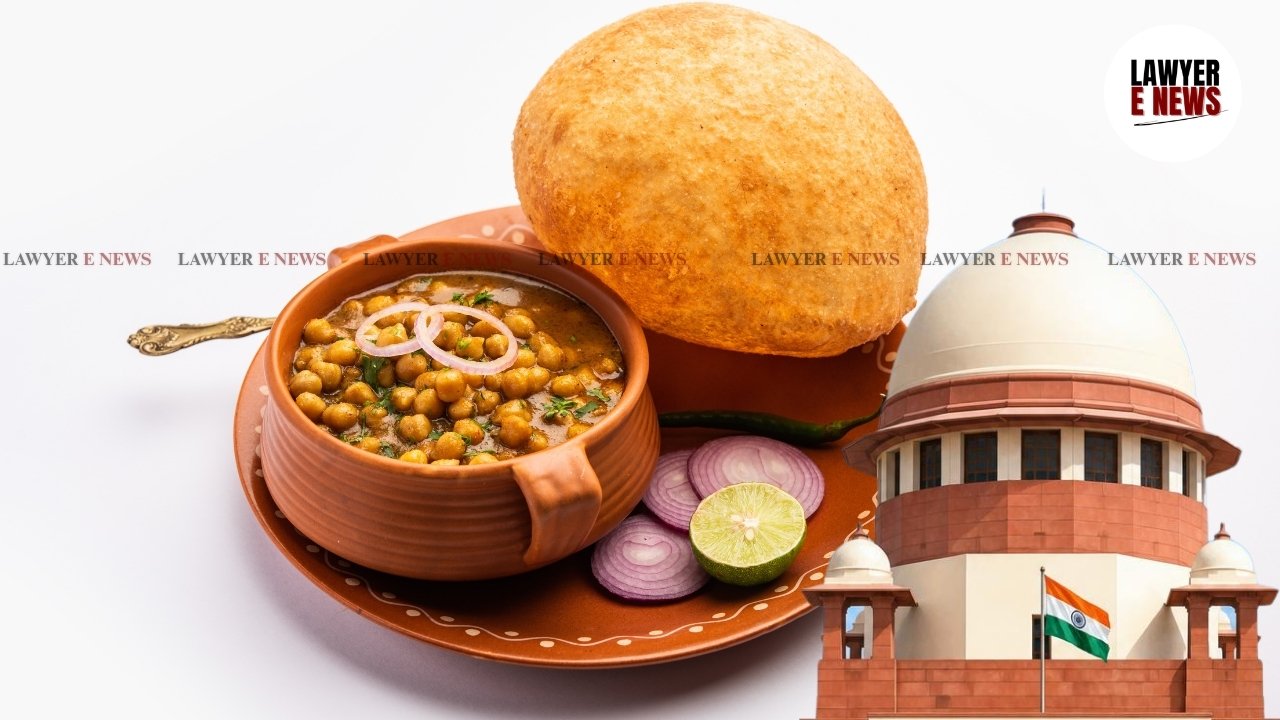
"Since it was brought out during the peculiar, stressful and unique conditions of the national disaster – COVID 19, it has outlived its object, purpose and utility, and accordingly, needs to be set aside, restoring status quo ante," Supreme Court of India, in a notable order dated July 1, 2026, quashed a 2020 Chandigarh Administration notification that had significantly expanded the definition of 'Essential Service Providers' (ESP) to include food items like Chhole Bhature and Paranthas.
A bench comprising Justice Sanjay Karol and Justice Nongmeikapam Kotiswar Singh observed that while such expansions were introduced during the "peculiar and stressful" conditions of the COVID-19 pandemic, they have now outlived their utility. The Court held that maintaining such a broad definition would dilute the regulatory framework intended for street vending and encroachment management in the Union Territory.
The matter reached the apex court through a civil appeal concerning the regulation of street vendors and the removal of encroachments in Chandigarh. During the COVID-19 pandemic, the Chandigarh Administration issued a notification on July 17, 2020, amending the Street Vendors Bye-laws to include a wide array of food vendors under the 'Essential Service Provider' category. The original petitioners and the learned amicus curiae challenged this expansion, arguing that it allowed unauthorized vendors to occupy public spaces under the guise of providing essential services, thereby hindering post-pandemic urban management.
The primary question before the Court was whether the expanded definition of 'Essential Service Providers' under the 2020 Amendment Bye-laws remained legally sustainable in a post-pandemic context. The Court was also called upon to determine the adequacy of the steps taken by the Chandigarh Municipal Corporation (MCC) to establish functional vending zones and ensure the livelihood of registered vendors under the Street Vendors (Protection of Livelihood and Regulation of Street Vending) Act, 2014.
Amicus Curiae Challenges Dilution of Essential Services Concept
The Court took serious note of the submissions made by the learned amicus curiae, Senior Counsel Mr. Anant Vijay Palli, who argued that the 2020 notification had become a "shield against legitimate enforcement action." The amicus pointed out that the definition of ESP had been expanded to include vendors of "Chhole Bhature," "Kulche Chhole," and "Parantha," which was unsustainable in the current urban environment. It was contended that this expansion diluted the very concept of essential services, which originally included only critical providers like milk sellers, tea vendors, and cobblers.
"The definition of Essential Service Provider is submitted as being unsustainable because it includes food vending such as Chhole Bhature within its expanse. This may dilute the very concept of ESP."
Pandemic-Era Notifications Deemed to Have Outlived Utility
Deliberating on the merits of the July 17, 2020 Notification, the Court observed that the amendment was a product of the national disaster caused by COVID-19. The bench noted that while the original definition covered basic services within a vicinity—such as dhobis, barbers, and rickshaw repairers—the amendment added "Tandoor, Chhole Bhature, Kulche Chhole and Parantha" to the list. The Court found that these additions were no longer justified and had outlived their object and purpose.
Court Restoration of Status Quo Ante regarding ESP Definition
The bench emphasized that the expanded definition of street vendors must be set aside to restore the legal status quo that existed prior to the pandemic. By quashing the notification, the Court clarified that the earlier, more restrictive notification would now govern the field. This move is intended to ensure that only truly essential services are granted the specific protections and permissions associated with the ESP category under the Street Vendors Act and local bye-laws.
"The object of this Court’s intervention is not to be seen to have acted, but to ensure that Chandigarh’s streets are genuinely free of unauthorised encroachments while its vendors are lawfully sheltered in designated zones."
Directions for Vending Zone Management and Public Safety
In addition to quashing the notification, the Court issued a comprehensive set of directions to streamline street vending in Chandigarh. The bench ordered that recently identified vending zones be made fully operational with everyday monitoring by city officials. It further mandated the installation of adequate road signage in multiple languages to guide the public to these zones. To ensure the safety of both vendors and buyers, the Court ordered the completion of CCTV camera installations in all vending zones within six months.
Time-Bound Resolution of Appeals and Issuance of Smart IDs
The Court expressed its approval of the process of issuing "smart cards" to vendors, describing it as a welcome step that must be carried out swiftly. These IDs must contain geo-coordinates of the allocated sites and be shared with the jurisdictional police. Regarding the legal challenges faced by vendors, the bench directed that all pending applications and appeals before the Appellate Authority and the Grievance Dispute Redressal Cell (GRDRC) be decided within 60 days. For fresh applications, an outer limit of 30 days was mandated to ensure timely justice.
The Supreme Court concluded that while the state must ensure minimum disruption to livelihoods, it must also maintain fairness and responsibility in urban planning. By quashing the expanded 'Essential Service Provider' definition, the Court reinforced the principle that emergency measures cannot be indefinitely extended to provide a "shield" for unauthorized vending. The Chandigarh Administration has been directed to file a compliance affidavit by July 22, 2026, with the matter listed for further hearing on July 24, 2026.
Date of Decision: 1 July 2026