-
by sayum
27 August 2026 7:40 AM







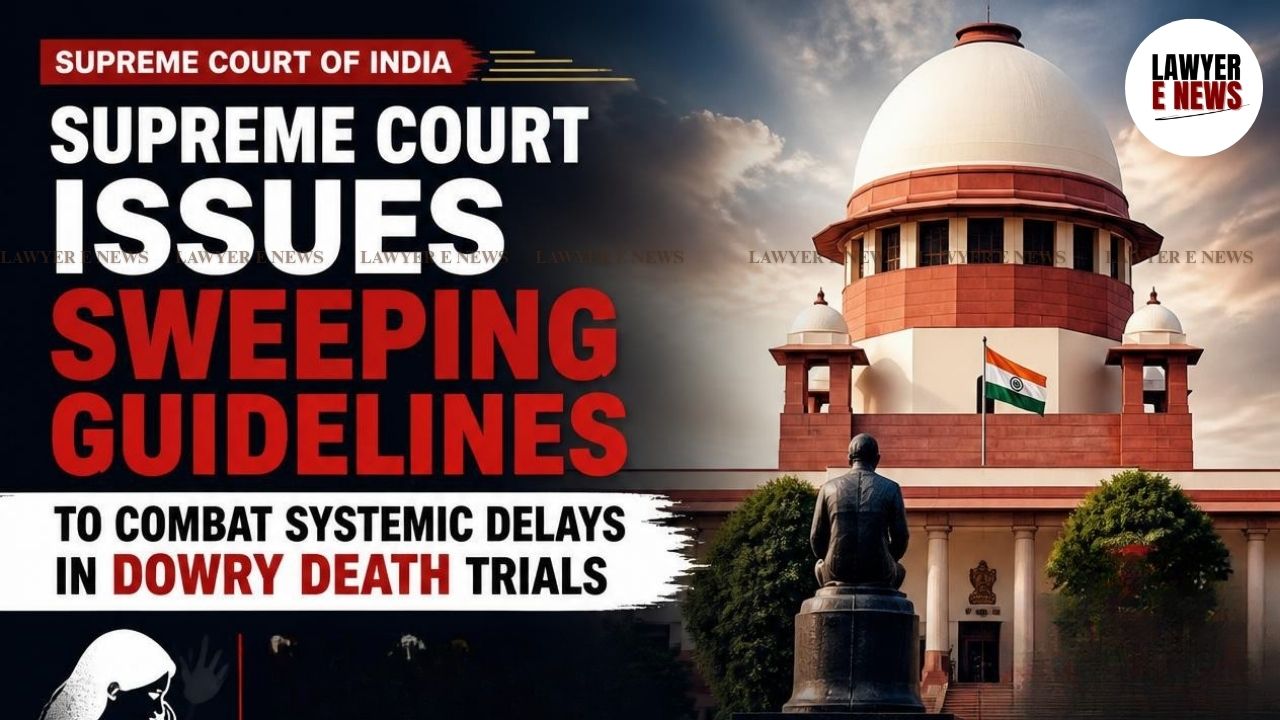
"The Acts remained dormant despite being on the statute book — Constitution of Welfare Boards is a sine qua non for levy of cess", In a judgment that decisively shapes the fiscal liabilities in infrastructure contracts involving the government, the Supreme Court on January 20, 2026, ruled in favour of contractors in a series of appeals concerning the levy and recovery of welfare cess under the BOCW regime, holding that contractors could not be saddled with retrospective cess liabilities in the absence of the statutory machinery mandated by the law itself.
Delivering the judgment in Prakash Atlanta (JV) v. National Highways Authority of India and five connected matters, a Bench comprising Justice Sanjay Kumar and Justice Alok Aradhe held that the BOCW Act, 1996 and the Cess Act, 1996, though formally notified, “remained dormant and inoperative” in the absence of effective implementation by the Central and State Governments.
"Failure of the State to implement the Act cannot be pushed as liability onto the contractor"
The controversy arose over whether cess collected under the Building and Other Construction Workers' Welfare Cess Act, 1996 could be imposed on contractors even when Welfare Boards — the statutory recipients of the cess — had not been constituted in the respective States at the time of execution of the contracts or submission of bids.
The Court was categorical:
“Though the BOCW Act and the Cess Act, along with the Rules framed thereunder, remained on the statute book for eons, they were not given actual effect owing to the complete absence of the required machinery.”
The Court traced the dismal history of State inaction and recalled how multiple directions issued by this Court in the National Campaign Committee cases had to be passed to compel the governments to constitute Boards, frame Rules, and begin meaningful implementation.
"Contractors cannot be expected to quote prices for a levy that didn’t legally exist at the time"
The heart of the legal debate was the interpretation of Clauses 14.3 and 70.8 in NHAI’s standard contracts — commonly referred to as the “subsequent legislation” clause — which permitted price adjustments for any new levy introduced after 28 days prior to the bid submission.
The Supreme Court found the arbitral tribunals were fully justified in holding that the BOCW and Cess Acts, despite being notified in 1996, did not qualify as “existing legislation” if no Board was constituted and no machinery was in place. The Court observed:
“The contractors could not have factored such cess component into their bid prices prior to a mechanism being put in place for its collection, as that would have led to unjust and unlawful enrichment on their part.”
The judgment particularly emphasized that the “liability to pay the cess could arise only after the States notified their Welfare Boards”, and the dates of such notifications varied across jurisdictions like Uttar Pradesh, Jharkhand, Gujarat, and Odisha. Hence, it was impossible for the contractors to anticipate and price for such obligations while bidding.
“What was dormant cannot be enforced”: Supreme Court rejects NHAI’s afterthought recovery
In the lead appeal, Prakash Atlanta (JV) challenged an attempt by NHAI to deduct cess amounts during execution proceedings years after its contract (entered in 2001) had been terminated in 2008. NHAI relied on a 2010 Government Order in Uttar Pradesh, which applied the cess retrospectively to all projects ongoing as on February 4, 2009.
The Court refused to endorse this, observing:
“It was only during the course of the execution proceedings in 2012 that NHAI attempted to adjust the amount allegedly payable by Prakash Atlanta (JV)… This clutching at straws so as to reduce its own liability by NHAI must necessarily be recognized for what it is worth.”
The Justices held that recovery of cess years after termination of contract, and long after arbitral proceedings had concluded, was both retrospective and arbitrary.
The Court held that such demands “could not be fastened on the contractor as a matter of fairness or legality,” and directed NHAI to refund the deducted amounts with interest.
“Judicial interference with arbitral awards is not an appellate review”
Crucially, the Court also used this occasion to restate the limited scope of judicial interference with arbitral awards, making it abundantly clear that:
“Once the view taken by the arbitral tribunal is found to be a plausible and possible one on facts and not an unreasonable one, it is not for the Courts to sit in appeal or substitute its view.”
Rejecting NHAI’s assertion that the arbitral awards were perverse or contrary to public policy, the Court reiterated that patent illegality must go to the root of the award, and in this case, there was none.
“Cess cannot be deducted at source if there’s no Board to receive it”
The Court dismissed NHAI’s reliance on Rule 4(3) of the Cess Rules, 1998, which allows deduction of cess from contractor bills in government projects, noting:
“Rule 5 of the Cess Rules mandates transfer of cess to the Welfare Board within 30 days of its collection. In the absence of a Board, the deduction itself becomes meaningless and legally unsustainable.”
The Bench warned that cess collected in such a vacuum would be credited to the Consolidated Fund, thereby transforming the levy from a “fee” to a “tax”, which would undermine its constitutional validity.
The Decision:
“The BOCW Act and the Cess Act were only law on paper — The Supreme Court gives them legal teeth by denying retrospective burden”
The Court concluded with a stern reminder to authorities that mere enactment does not constitute enforcement, and contractual burdens cannot be imposed on private parties in the absence of statutory implementation.
“The failure to effectively implement the BOCW Act and the Cess Act has to be laid squarely at the door of the authorities,” the Court held.
With this verdict, the Supreme Court has given clarity not just on the fiscal interpretation of "subsequent legislation" clauses, but also placed a necessary judicial check on retrospective administrative action that burdens contractors for governmental inertia.
Date of Decision: January 20, 2026
Case Title: Prakash Atlanta (JV) v. National Highways Authority of India & Ors.