-
by sayum
29 August 2026 9:28 AM







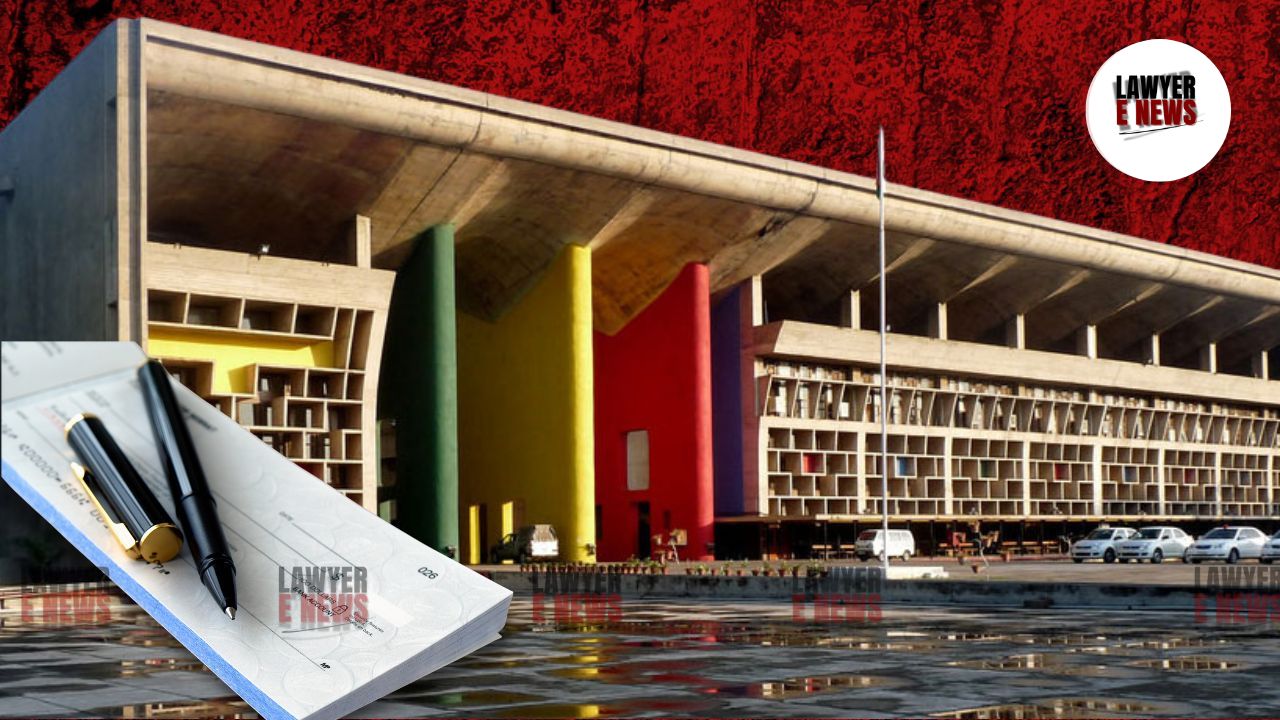
“Admitting Signature and Denying Liability Without Proof Can’t Defeat Section 139 Presumption” – Punjab & Haryana High Court upheld the conviction of the petitioner under Section 138 of the Negotiable Instruments Act, 1881, reaffirming that once the issuance of the cheque is admitted, the statutory presumption of a legally enforceable debt stands unless rebutted by cogent evidence.
Justice Subhas Mehla observed that “it is surprising and appealing that a person could give bulk of signed cheques to any person without any consideration”, dismissing the petitioner’s defence of having given 40-42 signed blank cheques during property dealings without any specific proof.
“Presumption Under Sections 118(a) and 139 NI Act Is Mandatory Once Signature Is Admitted”
The Court reaffirmed that Sections 118(a) and 139 of the NI Act place a mandatory legal presumption that the cheque was issued for consideration unless the contrary is proved.
“Mere denial of the accused is insufficient to discharge the presumption… The burden shifts to the accused to rebut the presumption of consideration.”
Referring to Bir Singh v. Mukesh Kumar, (2019) 4 SCC 197, the Court emphasized:
“Even a blank cheque leaf, voluntarily signed and handed over by the accused, which is towards some payment, would attract presumption under Section 139 of the NI Act.”
₹12 Lakh Friendly Loan Disputed Years Later
Rajiv Jawa, the complainant, had filed a complaint under Sections 138, 141, and 142 of the NI Act, alleging that the petitioner Ramesh Chand took a friendly loan of ₹12,00,000 on 15.06.2011 and issued a cheque dated 29.08.2014 for repayment. The cheque was dishonoured with the remark “Insufficient Funds,” and despite issuance of a legal notice dated 04.10.2014, no payment was made.
The trial court convicted Ramesh Chand on 06.08.2016 and sentenced him to six months’ simple imprisonment with compensation of ₹13,50,000 to be paid within one month. The appellate court upheld the conviction and sentence.
Defence of Bulk Blank Cheques Rejected for Want of Evidence
The petitioner’s primary defence was that the cheque was misused and part of 40-42 signed blank cheques allegedly left at the complainant’s office during property dealings. The High Court strongly rejected this explanation:
“The petitioner admitted signing the cheque but failed to give any plausible explanation as to why he gave a blank cheque of ₹12 lakh.”
“He could not specify a single transaction regarding any specific property… nor did he take any legal action for alleged misuse of cheques.”
The Court noted that while the petitioner tried to rely on discrepancies such as the absence of loan date in the legal notice or complainant’s ITRs showing limited income in 2011, none of these were sufficient to rebut the statutory presumption.
“Mere Cross-Examination on Source of Income Doesn’t Defeat Presumption” – High Court Affirms Concurrent Findings
The Court held that merely showing that the complainant’s income was ₹1.5 lakh to ₹4 lakh during the relevant years is not sufficient to defeat the presumption under Section 139:
“The petitioner failed to discharge the burden which is required under law. Mere denial is not acceptable.”
Despite allegations that the complainant filed multiple cases and that some were dismissed for want of income proof or source of funds, the Court emphasized that each case must stand on its own merits — and in this case, the cheque, issuance, and signature were admitted.
Absence from Hearings and Lack of Diligent Pursuit Noted
Justice Mehla noted that the petitioner had repeatedly failed to appear:
“It seems that the petitioner is not interested in pursuing this petition… Still, the petition is taken up for disposal on merits.”
The sentence had been suspended by the High Court in 2017, but the petitioner remained absent even on multiple listings in 2022 and 2023.
Revisional Scope Limited: No Palpable Error or Perversity in Conviction
Reiterating the limited scope under Section 397 Cr.P.C., the Court observed:
“The revisional jurisdiction can be exercised only when there is palpable error, non-compliance with law, or arbitrary exercise of judicial discretion.”
Citing Amit Kapoor v. Ramesh Chander, (2012) 9 SCC 460, the Court concluded there was no error or illegality in the concurrent findings of the trial and appellate courts.
Revision Petition Dismissed, Conviction Upheld
The High Court dismissed the revision petition and directed the trial court to ensure compliance:
“This Court does not find any merit in the petition which has not even been pursued by the petitioner in the right perspective.”
“Dismissed. A copy of this order be sent to concerned trial Court/Chief Judicial Magistrate, for compliance and appropriate action in accordance with law.”
Date of Decision: 4th September 2025