-
by sayum
27 August 2026 7:40 AM







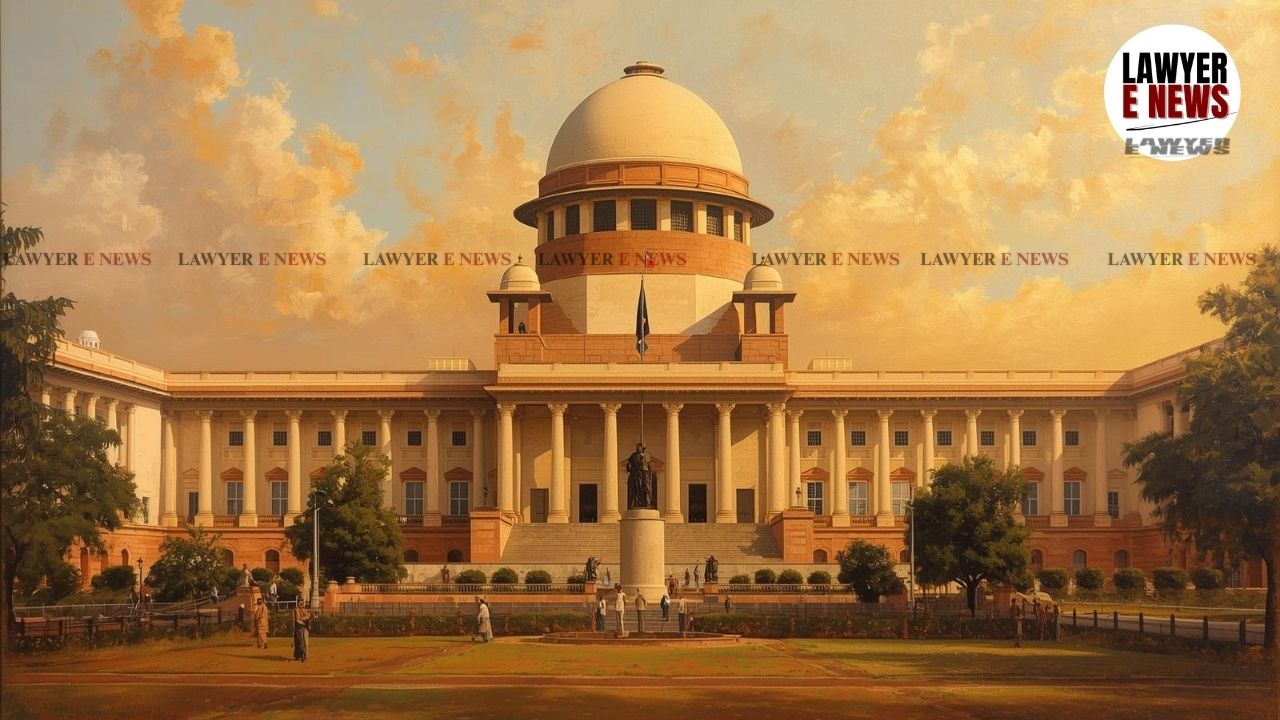
“Disputed facts and unexplained delays are fatal to writ jurisdiction under Article 226” – In a decisive judgment delivered on January 20, 2026, the Supreme Court of India in Raj Singh Gehlot & Ors. v. Amitabha Sen & Ors. overturned the Punjab and Haryana High Court’s controversial 2020 ruling that had quashed the Haryana Government’s de-licensing of land earmarked for the Ambience Mall project and directed a CBI investigation into the alleged collusion between the developers and state authorities.
Calling the High Court’s approach "legally untenable and procedurally flawed", a Bench of Justice J.B. Pardiwala and Justice Sandeep Mehta categorically held that “the High Court erred in entertaining a writ petition involving gravely disputed facts, filed after a decade-long delay, and decided it on conjecture without foundational pleadings or evidence.”
The Supreme Court restored the legality of the de-licensing process under the Haryana Development and Regulation of Urban Areas Act, 1975, upholding the validity of the 2021 administrative order permitting construction on the contested land.
“Fraud Cannot Be Imputed Without Pleadings and Proof” – Supreme Court rejects fraud allegations against developers
Setting aside the High Court’s findings of fraud and unjust enrichment, the apex court warned against judicial overreach in writ proceedings involving private commercial disputes masked as public interest. The Court noted that the Apartment Buyers’ Agreement dated 20.10.2001 clearly stated that the residential colony was to be developed over 10.98 acres, and that the buyers—including the main petitioner, a practicing advocate—“were fully aware of the project’s layout and cannot claim deception years later.”
The Court strongly observed, “The finding recorded by the High Court that the flat owners were made to sign on the dotted line is, ex facie, conjectural and unsupported by any pleadings or credible material... In the absence of foundational pleadings or evidence, a finding of fraud is wholly unjustified and unsustainable in law.”
Supreme Court Restores Legality of “De-Licensing” and Upholds Town Planning Authority’s Powers
The case hinged on whether the Haryana Government’s action of de-licensing 8 acres of land originally earmarked for residential use and re-licensing it for commercial development—ultimately leading to the construction of Ambience Mall—was legally valid.
The High Court had held the process to be a colourable exercise of power. However, the Supreme Court disagreed, relying on both statutory interpretation and legislative developments. It found that Section 3(3A), inserted by the 2020 Amendment to the Haryana Development and Regulation of Urban Areas Act, clearly validated the power of the government to “de-license” land, including retrospectively.
“The DTCP’s order dated 5th August, 2021 conclusively held that the plot on which the commercial complex stands is not part of Licence No. 19 of 1993 for residential purposes and was developed under separate commercial licences issued in 2001 and 2004,” the Court stated.
It went further to add that “the de-licensing and relicensing process was not only legally permissible but duly approved, supported by legal opinion, and validated by statutory amendment.”
Writ Petition Described as “Forum Shopping” With Oblique Motives
The Court took serious note of the fact that the petitioner, Amitabha Sen, had earlier represented the flat-owners’ association (ALARWA) in related litigation and had withdrawn a similar civil suit filed in 2010.
Highlighting the abuse of process, the Court remarked, “Successive institution of proceedings by the same set of interested flat owners before different forums demonstrates an intentional attempt at forum shopping, designed to harass the developer and derail approved plans under the guise of public interest.”
It noted that construction of Ambience Mall began in 2002 and was completed by 2007, while the writ petition was filed only in 2015.
“The writ petitioners, having watched the commercial development for years without protest, cannot now cry foul with delayed grievances framed as environmental or statutory violations. Delay alone is sufficient to deny relief under Article 226,” the Court said.
Supreme Court Disapproves of CBI Investigation Ordered Without Cogent Basis
The High Court’s 2020 ruling had also directed a CBI investigation into alleged collusion between the developers and state officials. However, the Supreme Court categorically disapproved of this action.
Calling the order premature, the Court said, “The High Court directed the CBI to register an FIR on unverified and inconclusive material. Such a direction was uncalled for and may prejudice the pending trial.”
It was further revealed that the CBI, after filing a chargesheet in December 2023, did not find any criminality in the licensing or de-licensing process. The only accusation made was that the developer failed to disclose the commercial license in the buyers’ agreement. The Court held that this isolated issue was still subject to adjudication in the criminal trial and could not justify the High Court’s sweeping conclusions.
Proceedings Before NGT Also Put on Hold
In connected appeals, the Court stayed proceedings before the National Green Tribunal, which had imposed an interim environmental compensation of ₹68.51 lakhs and was considering further penalties, including demolition of the commercial complex.
The Supreme Court ruled that “the issues before the NGT do not raise a substantial question relating to environment as defined under Section 14 of the NGT Act, 2010.”
Referring to its judgment in Auroville Foundation v. Navroz Kersasp Mody, the Court emphasized that “every land use or zoning violation is not an environmental issue. The NGT cannot interfere in matters already under the High Court’s scrutiny.”
The Tribunal’s direction to form a Joint Expert Committee recommending a fine of ₹138.83 crores and potential demolition was also kept in abeyance.
The Supreme Court allowed the civil appeals, set aside the High Court’s judgment dated July 10, 2020, and clarified that the pending Civil Writ Petition No. 6047 of 2025 before the High Court—challenging the DTCP’s 2021 order—shall proceed uninfluenced by the now-overturned judgment.
“None of the observations made by us in this judgment may be treated as prejudicing the disposal of the Civil Writ Petition No. 6047 of 2025,” the Court expressly held.
The ruling is a crucial precedent on the limitations of writ jurisdiction in matters involving commercial projects, especially where statutory powers are exercised transparently and validated legislatively.
Date of Decision: January 20, 2026