
-
by sayum
28 August 2026 2:11 PM







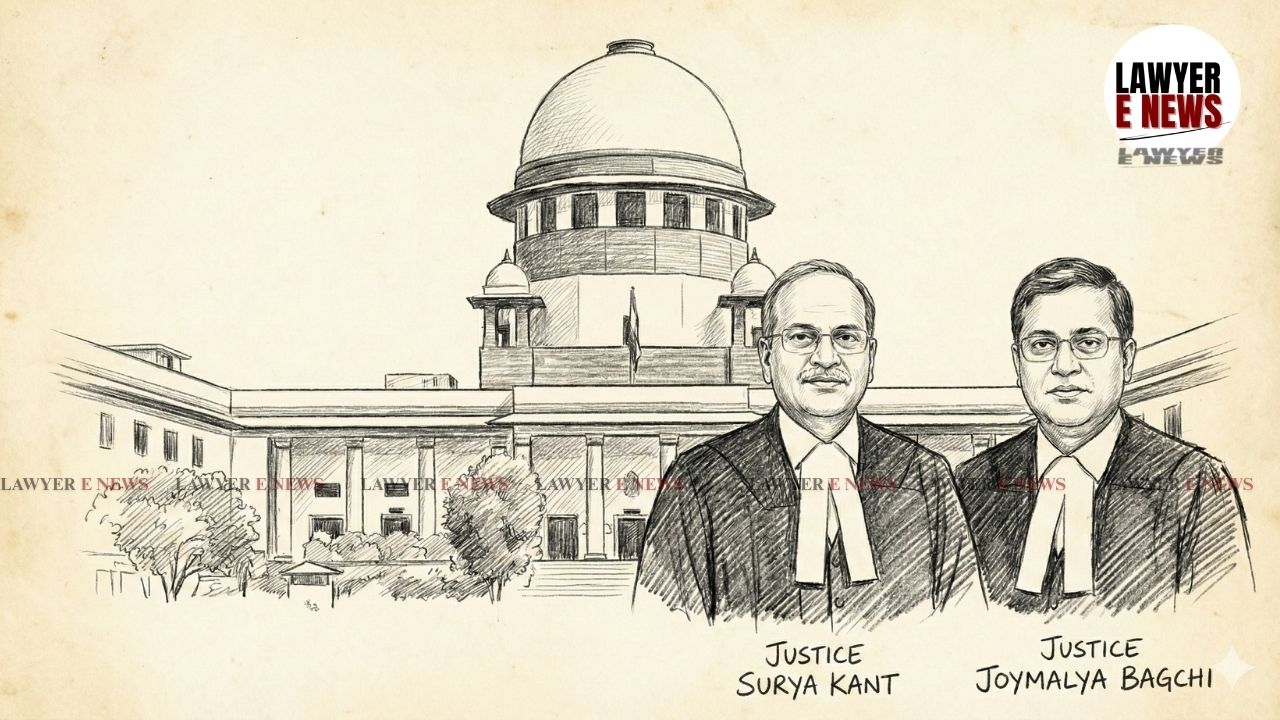
“Unless there is cogent evidence for willful desertion... the finding of marriage having been broken irretrievably is likely to have devastating effects” — Supreme Court of India setting aside the Uttarakhand High Court’s verdict that had granted a decree of divorce to the husband on the ground of cruelty. The Apex Court, speaking through a bench of Justices Surya Kant and Joymalya Bagchi, warned that courts cannot “jump to a conclusion” of irretrievable breakdown of marriage without first deciding “who out of the two is responsible for breaking the marital tie.”
The Court categorically held that the High Court had failed to consider “whether the appellant was thrown out of the matrimonial home or she herself voluntarily deserted the respondent” — a central issue to any finding of cruelty or desertion under Section 13 of the Hindu Marriage Act, 1955.
“It is imperative... to determine as to who out of the two is responsible for breaking the marital tie” — Supreme Court rebukes High Court for bypassing vital factual determinations
The marriage between Dr. Anita and Indresh Gopal Kohli was solemnised on May 20, 2009, and a male child was born on March 7, 2010. The relationship quickly soured. In 2010, the husband filed a divorce petition alleging cruelty, which he later withdrew. In 2013, he filed a second divorce petition under Section 13(1)(i)(b), claiming desertion.
The Family Court dismissed the second petition in 2018, but the Uttarakhand High Court reversed this decision and granted divorce in 2019 based solely on the husband’s oral claims of mental cruelty — a judgment that the Supreme Court has now declared legally deficient.
“The High Court has, for the reasons best known to it, not adverted to the appellant’s plea that she was thrown out of the matrimonial home and was forced to live separately,” observed the Apex Court.
It further questioned the High Court’s failure to examine whether “cruelty was committed by the respondent in not allowing the appellant to join the matrimonial home and/or by denying any maintenance, love, affection, and care to the minor child of the parties.”
“Finding of irretrievable breakdown without fixing responsibility is dangerous, especially for children” — Court demands deeper scrutiny from Family Courts and High Courts
Lamenting the trend of routinely granting divorces on the basis of long separation, the Bench observed, “Courts, in recent times, often observe that since the parties are living separately, the marriage should be taken to have broken irretrievably.”
However, the Court warned that such conclusions, if not grounded in solid evidence, “are likely to have devastating effects, especially on the children.”
It stressed that courts bear an “onerous duty” to undertake “deep analysis of the entire evidence on record, consider the social circumstances and the background of the parties, and various other factors” before reaching such a finding.
In this case, the Court categorically held: “We do not find that any such exercise has been undertaken by the High Court.”
“Withdrawn divorce petition cannot be used to support a second petition on same cause of action without scrutiny” — Legal implications overlooked by High Court, says Supreme Court
The Court also raised a fundamental legal question ignored by the High Court: whether the withdrawal of the first divorce petition filed on grounds of cruelty would bar a second petition based on the same facts.
“This issue goes to the root of matrimonial litigation,” the Bench observed, highlighting how courts must avoid allowing parties to “shop for favourable verdicts” without first satisfying the test of distinct cause of action.
Since the child has remained in the mother’s custody from the very beginning, the Court found the husband’s claims of desertion and cruelty suspicious, stating that the High Court had failed to weigh this crucial social and emotional factor.
Supreme Court remands matter to High Court for fresh hearing
In conclusion, the Supreme Court allowed the appeal in part, set aside the High Court’s decree of divorce, and remanded the case back for a fresh hearing on merits.
“The impugned judgment of the High Court is set aside and the matter is remitted to the High Court for a fresh consideration in accordance with law,” ordered the Court, directing both parties to appear before the High Court on November 24, 2025.
This decision reinforces a critical judicial principle: Divorce cannot be granted merely because parties live separately — it must be established who is at fault.
The Apex Court’s intervention has effectively reset the narrative, demanding a fuller, more sensitive evaluation of facts, law, and human consequences before severing matrimonial ties.
Date of Decision: November 14, 2025