
-
by sayum
28 July 2026 1:44 PM







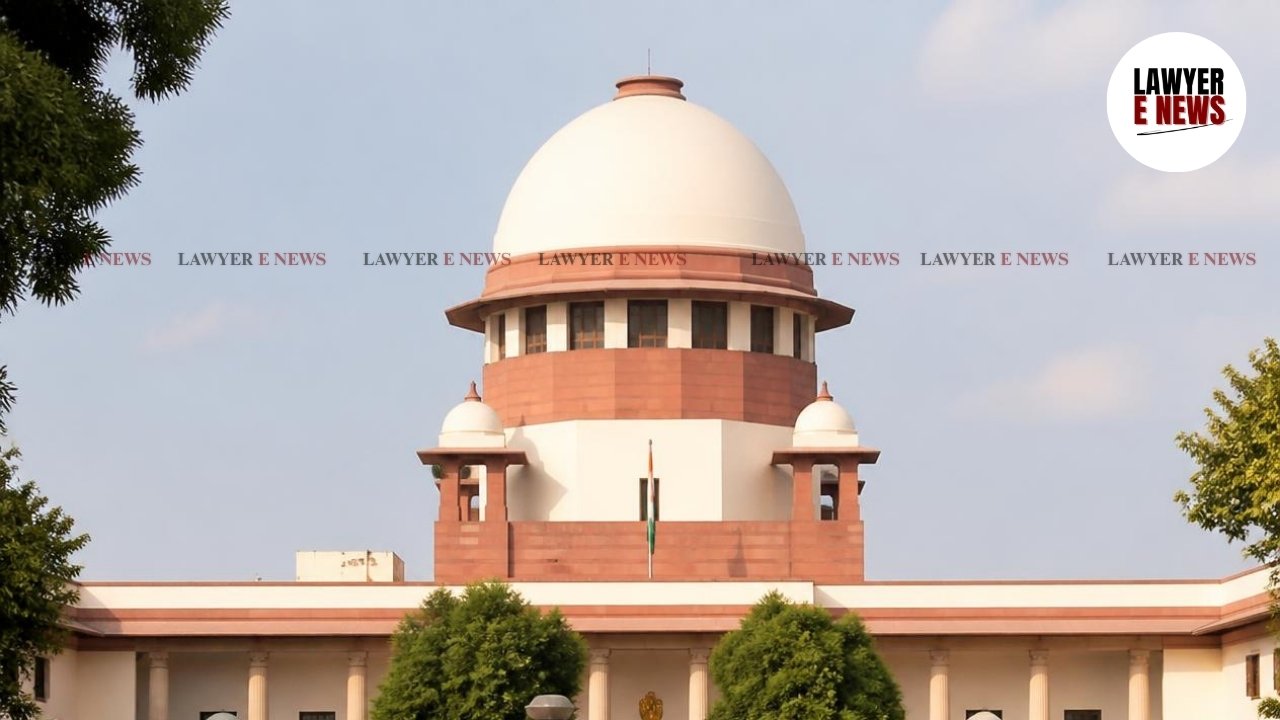
"Section 43-D(5) remains subordinate to Article 21 at all times and a constitutional court need not hold back bail to the accused in the garb of Section 43-D(5)," Supreme Court, in a landmark judgment dated May 18, 2026, has reaffirmed the primacy of the constitutional guarantee of personal liberty over the stringent bail restrictions under the Unlawful Activities (Prevention) Act.
A bench comprising Justice B.V. Nagarathna and Justice Ujjal Bhuyan observed that the principle of 'bail is the rule and jail is the exception' is not a mere slogan but a constitutional mandate that continues to operate even under special statutes like the UAPA.
The appellant, a former government employee and political activist, was arrested in June 2020 on allegations of narco-terrorism under the NDPS Act and UAPA. He had spent nearly six years in custody as an undertrial, with the prosecution citing over 350 witnesses while only 38 had been examined. After his bail was rejected by the Special NIA Court and the Jammu & Kashmir High Court, he approached the Supreme Court citing gross delay in trial.
The primary question before the court was whether the statutory rigors of Section 43-D(5) of the UAPA could override the fundamental right to a speedy trial under Article 21 of the Constitution. The court also examined the propriety of smaller benches allegedly "hollowing out" the ratio of a larger bench decision in Union of India v. K.A. Najeeb.
Judicial Discipline And Binding Nature Of Precedents
The Court expressed serious reservations regarding recent two-judge bench decisions in Gurwinder Singh v. State of Punjab and Gulfisha Fatima v. State, which had adopted a narrower reading of the three-judge bench decision in K.A. Najeeb. The bench emphasized that judicial discipline mandates that smaller benches must strictly follow the law declared by larger benches.
Court Reaffirms Binding Force Of K.A. Najeeb
The bench noted that a smaller bench cannot dilute, circumvent, or disregard the ratio of a larger bench, and any disagreement must strictly lead to a reference to a larger bench. The court held that Najeeb remains binding law entitled to the protection of stare decisis and cannot be ignored by trial courts or High Courts.
UAPA Bail Rigors 'Melt Down' In Cases Of Prolonged Incarceration
The court reiterated the "melt down" doctrine established in K.A. Najeeb, which suggests that statutory restrictions on bail lose their force when a trial is unlikely to conclude within a reasonable time. The bench observed that the presence of statutory restrictions like Section 43-D(5) per se does not oust the ability of constitutional courts to grant bail on grounds of violation of Part III.
Constitutional Courts To Lean In Favour Of Liberty
While acknowledging that the legislature may calibrate the application of liberty in cases of national security, the court held that these calibrations cannot invert the constitutional relationship between liberty and detention. Even under the UAPA, the court must lean in favor of constitutionalism and the rule of law, of which liberty is an intrinsic part.
Critique Of The 'Twin-Prong Test' Formulated In Gurwinder Singh
The Court specifically criticized the 'twin-prong test' formulated in the Gurwinder Singh case, stating that it flows neither from the text of Section 43-D(5) nor from the Najeeb precedent. The bench noted that if such a test were accepted, the state would only need to satisfy a low prima facie threshold to ensure years of pre-trial incarceration.
Prolonged Incarceration Cannot Be Converted Into Punishment
The Court emphasized that prolonged incarceration of an undertrial without reasonable progress of trial has the effect of converting pre-trial detention into punishment. The judges noted that the more serious the accusations are, the speedier the trial should be, rather than using the gravity of the offence as a justification for indefinite detention.
Low Conviction Rates Under UAPA A Relevant Factor
The Court took judicial notice of statistics provided to the Lok Sabha showing abysmal conviction rates under the UAPA, particularly in Jammu and Kashmir where the annual rate was less than 1%. The bench questioned whether detention should continue simply because charges are serious when there is a 99% possibility of acquittal at the end of a long trial.
Trial Courts Should Not Be Pressured With Time-Bound Limits
Referring to the Constitution Bench decision in High Court Bar Association, Allahabad v. State of U.P., the Court observed that superior courts should generally refrain from fixing time-bound schedules for trials. Such orders put undue pressure on trial courts already flooded with work and are not a practical remedy for a person seeking bail after long incarceration.
Appellant Entitled To Bail On Principle Of Parity And Delay
Granting bail to the appellant, the court noted that there was no recovery from his person and his alleged links to terrorist operatives were based on inadmissible confessions. Furthermore, since four other co-accused had already been granted bail, the court found no reason to deny the same benefit to the appellant who had undergone longer incarceration.
The Supreme Court concluded that the High Court and Special Court failed to exercise their discretion soundly by ignoring the constitutional mandate of Article 21. By setting aside the impugned order, the bench directed the immediate release of the appellant on bail, subject to terms fixed by the trial court.
Date of Decision: May 18, 2026