-
by sayum
01 November 2026 1:51 PM







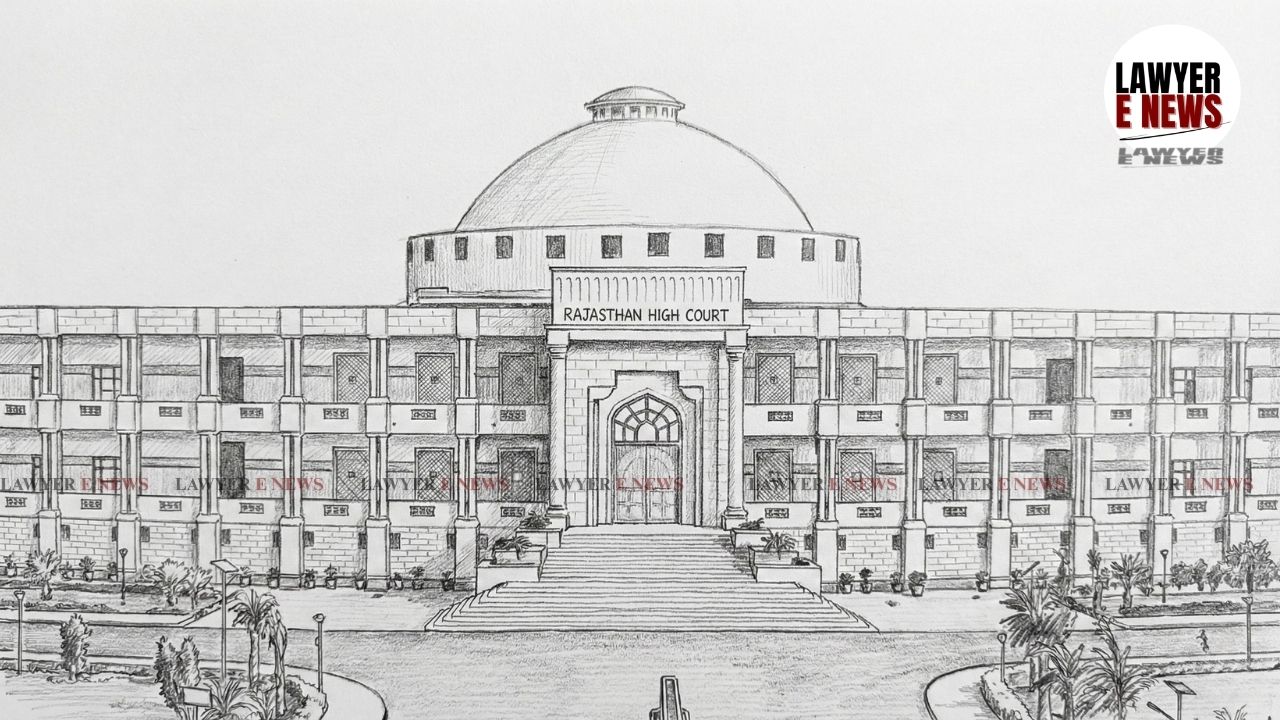
JAIPUR: Reaffirming that selection processes must strictly adhere to the statutory rules in force on the date of advertisement, the Rajasthan High Court on October 27, 2026, held that service rule amendments altering selection schemes midway cannot operate retrospectively to bind ongoing recruitment.
A Division Bench comprising Justice Inderjeet Singh and Justice Sandeep Taneja set aside a Single Judge verdict that had enforced a subsequent rule capping interview marks at 10% onto an already initiated recruitment drive for Assistant Professors.
The controversy stems from an advertisement issued on November 27, 2021, by the Rajasthan Public Service Commission (RPSC) inviting applications for 337 posts of Assistant Professor under the unamended Rule 19 of the Rajasthan Medical Service (Collegiate Branch) Rules, 1962. Pursuant to the Full Commission's decisions, RPSC allocated marks in a 40:20:40 ratio across the screening test, academic record, and viva voce. However, during the pendency of the selection, the State Government notified the Rajasthan Various Service (Second Amendment) Rules, 2022, on May 23, 2022, introducing a two-stage examination and capping interview weightage at 10%. Respondent Dr. Rachita Mathur successfully challenged the RPSC's marking criteria before a Single Judge, who retrospectively applied the 2022 amendment, prompting the State and the Commission to prefer intra-court appeals.
Whether an amendment to statutory service rules notified under the proviso to Article 309 of the Constitution during an ongoing selection process applies retrospectively to govern an advertisement issued prior to such amendment?
Whether the allocation of 40% marks to the interview segment by an expert recruiting body like the Public Service Commission is arbitrary and liable to be quashed under Article 14 of the Constitution?
Whether suppression of the dismissal of an earlier writ petition concerning the same recruitment and voluntary participation in the screening test without demur precludes a candidate from invoking Article 226 under the doctrines of unclean hands and estoppel?
Addressing the threshold issue of suppressio veri, the Division Bench observed that the candidate had deliberately concealed the dismissal of an earlier writ petition filed by her before the Principal Seat at Jodhpur seeking similar relief. The Court reiterated that Article 226 is an equitable and discretionary jurisdiction where full and candid disclosure is mandatory.
Suppression of prior litigation disentitles a litigant from invoking extraordinary writ jurisdiction
The Bench relied upon settled Apex Court precedents, noting that any person who attempts to pollute the stream of justice by withholding material developments is not entitled to any equitable relief.
"In view of the above, we are of the considered opinion that respondent No.1 did not approach the Court with clean hands by deliberately concealing the material fact in the writ petition, and for this reason alone, she is not entitled to any relief under the extraordinary and discretionary jurisdiction of this Court. Accordingly, the writ petition is liable to be dismissed on this ground alone."
Turning to the core question of retrospectivity, the Court ruled that the Single Judge committed a fundamental error by mischaracterizing the amendment to Rule 19 of the 1962 Rules as merely procedural. The Court noted that Rule 1(2) of the 2022 Amendment Rules expressly made them prospective from the date of publication in the Official Gazette.
Substantial changes to the recruitment scheme affect substantive rights and cannot be treated as mere procedural alterations
Examining the statutory modification, the Court pointed out that the unamended rule allowed recruitment primarily through interview preceded by an optional screening test, whereas the amended regime enforced a mandatory two-stage examination with an altered marking matrix. The Court held that altering the entire qualifying scheme affects substantive rights of candidates and cannot operate retrospectively.
Relying on the Supreme Court's ruling in Tej Prakash Pathak v. High Court of Rajasthan and Assam Public Service Commission v. Pranjal Kumar Sarma, the Court reiterated the settled legal canon that the rules existing when the selection begins govern the recruitment throughout.
"Extant Rules having statutory force are binding on the recruiting body both in terms of procedure and eligibility... recruitment is governed by the rules which are in force on the date of issuance of the advertisement and an amendment made subsequent to the beginning of the process will have no impact on that particular recruitment which is already under process, unless the amended rules are specifically given retrospective effect."
The Bench also rejected the challenge to the allocation of 40% marks to the viva voce examination. It observed that the Single Judge's reliance on Ajay Hasia v. Khalid Mujib Sehravardi was misplaced because that case dealt with academic admissions rather than recruitment of mature professionals to public employment.
Fixation of interview weightage is the exclusive prerogative of expert bodies and beyond judicial second-guessing absent mala fides
Citing Lila Dhar v. State of Rajasthan and Anzar Ahmad v. State of Bihar, the High Court emphasized that for specialized posts like medical faculty, evaluating personality and professional suitability via interview is crucial. Absent any oblique motive or proved arbitrariness, courts cannot sit in appeal over criteria uniformly applied by an expert constitutional body.
"The competitive examination may be based exclusively on written examination or it may be exclusively on interview or it may be a mixture of both. It is entirely for the Government to decide what kind of competitive examination would be appropriate in a given case... There cannot be any hard and fast rule regarding the precise weight to be given to the viva voce test as against the written examination... It is essentially a matter for determination by experts."
The Court further held the writ petition to be barred by the doctrine of estoppel and hit by delay and laches. The candidate had sat for the screening test on May 6, 2022, without any reservation or protest and approached the High Court nearly two and a half years after the original advertisement without tendering any plausible justification for the delay.
The Division Bench allowed both special appeals filed by the State of Rajasthan and the RPSC, quashed and set aside the Single Judge judgment dated January 10, 2025, and dismissed the writ petition.
Date of Decision: October 27, 2026