-
by sayum
26 August 2026 8:37 AM







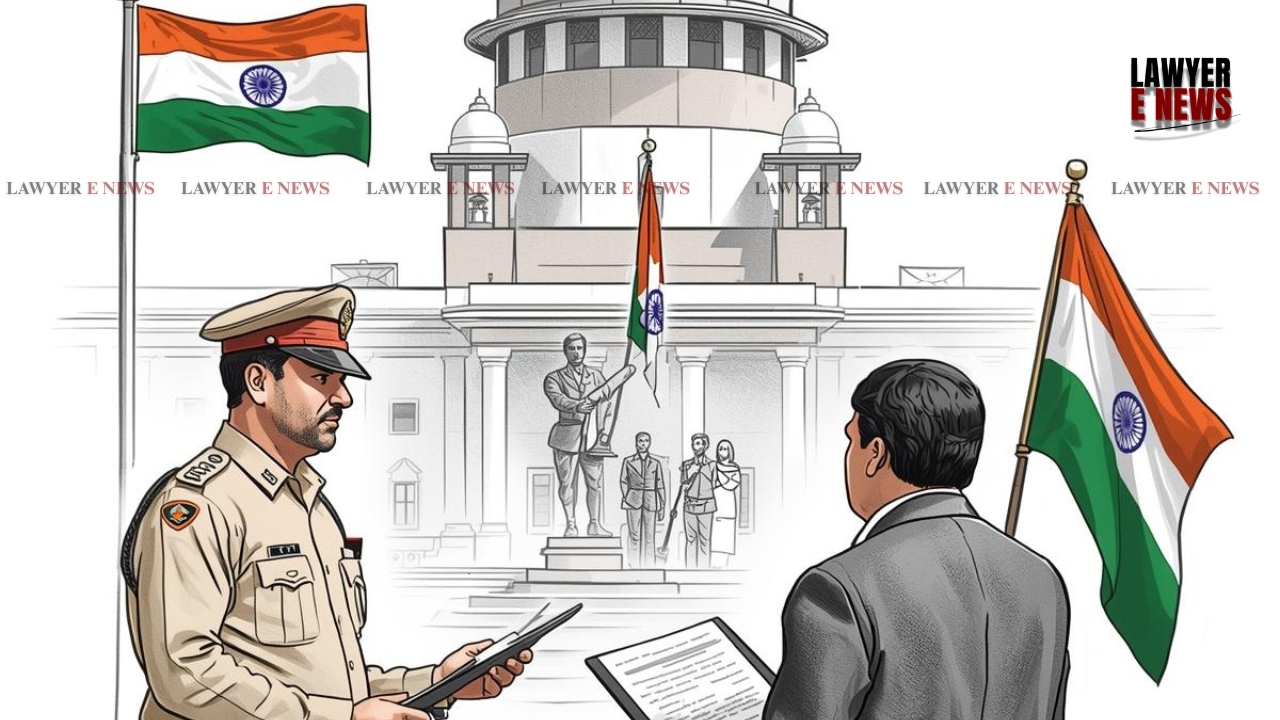
"Article 22(1) Is Not a Ritual — Grounds of Arrest Must Be Furnished in Writing, In Language Known to Arrestee or Arrest Is Void": Today, In a pathbreaking constitutional pronouncement delivered on November 6, 2025, the Supreme Court of India decisively ruled that no arrest can be considered legal unless the grounds of arrest are furnished in writing and in a language understood by the accused. The Court held that oral communication of grounds, even if explained at the time of arrest, does not fulfill the constitutional requirement under Article 22(1).
The judgment was passed in Mihir Rajesh Shah v. State of Maharashtra and Another, where a bench comprising Chief Justice B.R. Gavai and Justice Augustine George Masih declared that "communication of arrest grounds is not a procedural nicety but a substantive constitutional right woven into the fabric of personal liberty under Article 21."
"State Cannot Detain Without Due Process — Arrest Is Illegal If Accused Is Not Told In Writing Why He Is Deprived of Liberty": Supreme Court
The Court categorically held that any failure to inform the arrested person in writing, and in a language he or she understands, renders both the arrest and subsequent remand unconstitutional and illegal. The Court went further to specify that even in exigent or exceptional cases, the written grounds must be supplied no later than two hours before production before the Magistrate for remand.
Refusing to dilute the core constitutional guarantees, the Court observed:
"The requirement to communicate the grounds of arrest or the grounds of detention in writing to a person arrested... is sacrosanct and cannot be breached under any situation. Non-compliance... would lead to the custody or the detention being rendered illegal." [Para 29]
The Constitutional Battle: Right to Know Why You're Being Arrested
The controversy arose in the context of a tragic road accident in Mumbai involving the accused, Mihir Rajesh Shah, whose BMW collided with a scooter, leading to the death of a woman. While the facts of the case were serious, Shah challenged the legality of his arrest on a constitutional ground — that he was not furnished the grounds of arrest in writing, nor in a language he could understand. The Bombay High Court rejected his plea despite acknowledging the procedural lapse, finding that he was "conscious of the reasons."
But the Supreme Court was unmoved by this argument and firmly reminded the State and the courts that “awareness” of allegations cannot be a substitute for the constitutional guarantee under Article 22(1). The Court stated:
"Communication, in this context, must mean bringing home to the detenue effective knowledge of the facts and circumstances on which the order of detention is based." [Para 42, Harikisan v. State of Maharashtra relied upon]
Court Declares That "Written Grounds of Arrest Must Be Given in Every Case, Without Exception"
Responding to the claim that such procedural duties apply only to offences under statutes like UAPA or PMLA, the Court clarified:
"The constitutional obligation under Article 22 is not statute-specific and it is grounded in fundamental right of life and personal liberty under Article 21... making it applicable to all offences including those under the IPC 1860 (now BNS 2023)." [Para 39]
In doing so, the Court harmonized the jurisprudence from Pankaj Bansal, Prabir Purkayastha and Vihaan Kumar, which had established the necessity of written grounds under special statutes, and extended the rule to cover all arrests, whether under general or special criminal laws.
"The Right to Legal Aid Begins Before Remand — The Arrestee Must Know What to Defend Against": Apex Court Emphasizes Pre-Remand Rights
The Court underscored that the true essence of Article 22(1) is to empower the accused to consult a lawyer, oppose remand and seek bail effectively, which cannot happen unless the arrested person is given the grounds of arrest in writing, in a comprehensible form.
Referring to Suhas Chakma v. Union of India and the NALSA Guidelines on Early Access to Justice, the Court noted:
"The purpose of securing legal assistance before remand is not merely symbolic... If the accused is not represented through a Counsel, he/she should be made aware that he/she is entitled for legal aid." [Para 35]
Further relying on Ashok v. State of U.P., the Court reaffirmed that free legal aid must begin at the remand stage, not after.
Exigent Circumstances Recognized, But Strict Timeline for Written Grounds Prescribed
Acknowledging that in cases of flagrant offences committed in the presence of police, it may not be immediately possible to supply written grounds of arrest, the Court laid down a strict outer limit:
"In exceptional circumstances... it shall be sufficient for the police officer... to orally convey the same... Later, a written copy of grounds of arrest must be supplied... and in no event later than two hours prior to production... for remand." [Para 52]
Any failure to do so, the Court warned, will invalidate both the arrest and the remand.
"Arrest Is Not Just a Legal Event – It Causes Stigma, Trauma, and Irreversible Damage": Court Urges Caution
In a significant societal reflection, the Court acknowledged the emotional and reputational impact of arrests, stating:
"The arrest of an individual invariably impacts not only the person arrested himself, but also the persons associated with him, i.e., family, friends, relatives... The stigma attached to arrest undermines a person’s social dignity and results into consequences that reverberate beyond the individual." [Para 28]
The Court relied on its earlier decisions in Arnesh Kumar and Joginder Kumar, reiterating that arrest must never be a routine step and must always be justified by necessity and law — not mere suspicion or administrative convenience.
Concluding this landmark ruling, the Court unambiguously declared:
“The obligation to inform the grounds of arrest to the arrestee is not just a mere procedural formality, instead it flows from the fundamental right of personal liberty.” [Para 38]
Accordingly, the Supreme Court held:
The arrest and remand of Mihir Rajesh Shah, without the supply of written grounds in a language understood by him, was violative of Article 22(1) and Article 21, and hence unconstitutional.
The Court, however, limited the relief in the specific appeal (Criminal Appeal No. 2195 of 2025), stating that it was taken up only to settle the legal issue. In the connected appeals and SLPs, interim bail was continued, with the prosecution granted liberty to seek remand again, only after compliance with the written communication requirement.
This ruling from the Supreme Court is not merely a procedural reform. It shifts the centre of arrest jurisprudence in India from state convenience to individual dignity. By transforming Article 22(1) from a dormant clause into an active shield, the Court has reaffirmed that liberty is not conditional upon the seriousness of the offence, and that rights begin from the moment of arrest — not after it.
It marks a decisive break from decades of mechanical arrest practices and offers a constitutional roadmap that restores human dignity at the first moment of State coercion.
Date of Decision: November 6, 2025