-
by sayum
28 August 2026 10:07 AM







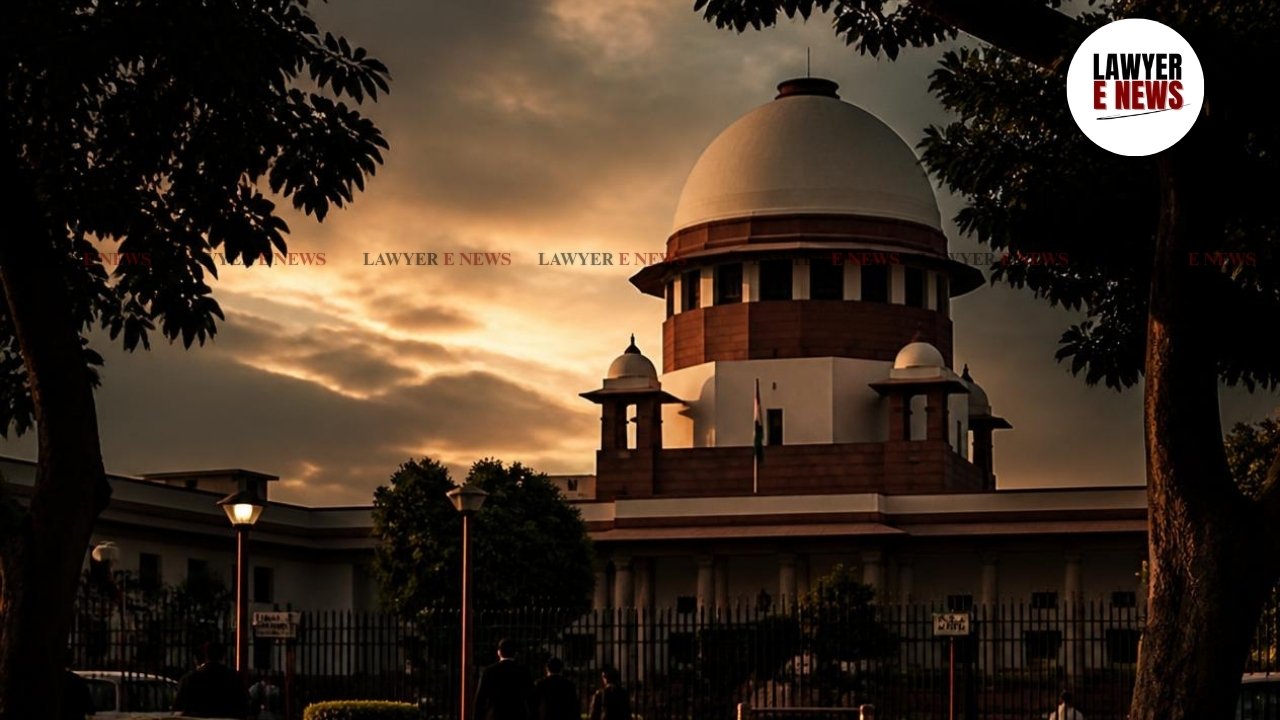
"Whenever an objection is raised during evidence-taking stage regarding the admissibility of any material or item of oral evidence the trial court can make a note of such objection and mark the objected document tentatively as an exhibit in the case (or record the objected part of the oral evidence) subject to such objections to be decided at the last stage in the final judgment." Supreme Court, in a significant ruling dated August 07, 2026, affirmed that documents and averments in a proof affidavit generally cannot be eschewed at the threshold in testamentary proceedings, emphasizing the need to avoid the "archaic practice" of halting trials over admissibility objections.
A bench of Justices Sanjay Karol and Nongmeikapam Kotiswar Singh observed that evidence, both oral and documentary, should not be shut down at the initial stage, reiterating that mere marking of an exhibit does not amount to proof of its contents.
The dispute arose from a probate suit (T.O.S. No. 12 of 2021) filed by the respondent, Tmt. P. Ponni, seeking probate of a will. The appellants, S. Sangeetha & Ors., filed a written statement and subsequently moved an application to eschew the proof affidavit, averments, and certain documents as irrelevant to the testamentary proceedings. Both a Single Judge of the Madras High Court and a Division Bench dismissed the application and subsequent appeal, with the High Court imposing costs of ₹10,000 on the appellants.
The primary question before the court was whether documents and averments filed in a proof affidavit could be rejected or "eschewed" at the initial stage of testamentary proceedings. The court was also called upon to determine the appropriate procedure for dealing with objections to the admissibility of evidence during trial.
No Reason to Interfere with Lower Courts' Reasoning
The Supreme Court found no reason to interfere with the meticulous reasoning of the Single Judge and the Division Bench of the Madras High Court. The lower courts had correctly distinguished between the marking of a will and its ultimate proof.
Rejection of Irrelevant or Inadmissible Documents Under Order XIII Rule 3 CPC
The Court noted that the Single Judge had rightly eschewed certain documents, specifically xerox copies, when no explanation was provided for the non-availability of their originals. This power is explicitly granted to courts under Order XIII Rule 3 of the Civil Procedure Code, 1908 (CPC), which allows for the rejection of irrelevant or inadmissible documents at any stage.
Other Documents Not Prima Facie Inadmissible
Regarding other documents and contentions relating to pendency of other suits and transfer of properties concerning the same family structure, the Court held that these could not be rejected at the threshold. It emphasized that objections to such documents were not of a nature that rendered them prima facie inadmissible in law or irrelevant to the properties involved in the probate suit.
Handling Objections to Admissibility of Evidence: The Bipin Shantilal Panchal Principle
The Court reiterated the established procedure for dealing with objections to the admissibility of evidence, drawing upon the observations of a three-Judge Bench in Bipin Shantilal Panchal v. State of Gujarat.
Archaic Practice of Stopping Trials Overruled
The bench highlighted that the "archaic practice" of courts stopping further proceedings to pass orders on every objection raised during the evidence-collecting stage leads to unnecessary prolongation of trials. Such practices, recognized as hindrances, must be recast.
Tentative Marking and Final Decision
The Court affirmed that a more efficient substitute practice is for the trial court to make a note of such objections, mark the objected document tentatively as an exhibit, and decide on the objections at the last stage in the final judgment. The only exception mentioned is for objections relating to deficiency of stamp duty.
"We are of the firm opinion that mere admission of a document in evidence does not amount to its proof. In other words, mere marking of exhibit on a document does not dispense with its proof, which is required to be done in accordance with law."
Mere Marking Not Proof of Contents
Crucially, the Supreme Court re-emphasized that mere admission of a document in evidence does not amount to its proof, citing its earlier Division Bench decision in LIC v. Ram Pal Singh Bisen.
Contents Must Be Proved in Accordance with Law
The Court underscored that the mere marking of an exhibit does not dispense with the requirement of proving its contents in accordance with law, either by primary or secondary evidence. Admission of documents may signify admission of contents but not their truth. This principle was also reiterated in Sait Tarajee Khimchand v. Yelamarti Satyam, Narbada Devi Gupta v. Birendra Kumar Jaiswal, and Vijay v. Union of India and Ors.
No Reason to Eschew Documents at This Stage
Therefore, the Court concluded that while the contents of marked/exhibited documents would eventually need to be proved in accordance with law, there was no reason to eschew them at the initial stage.
Final Directions
The Supreme Court dismissed the appeal and upheld the Madras High Court's impugned judgment. It clarified that the testamentary proceedings in T.O.S. No. 12 of 2021 should proceed uninfluenced by the observations made in the present order. The stay of proceedings previously granted by the Court was also vacated.
The Supreme Court's ruling reinforces the principles of efficient trial management and proper evidence handling, particularly in the context of admissibility objections. By upholding the Madras High Court's decision, it ensures that relevant documents and averments are not prematurely excluded from consideration in testamentary proceedings, while simultaneously clarifying that their mere exhibition does not suffice as proof of their truth, which must be established through due process of law.
Date of Decision: August 07, 2026