
-
by sayum
28 August 2026 2:11 PM







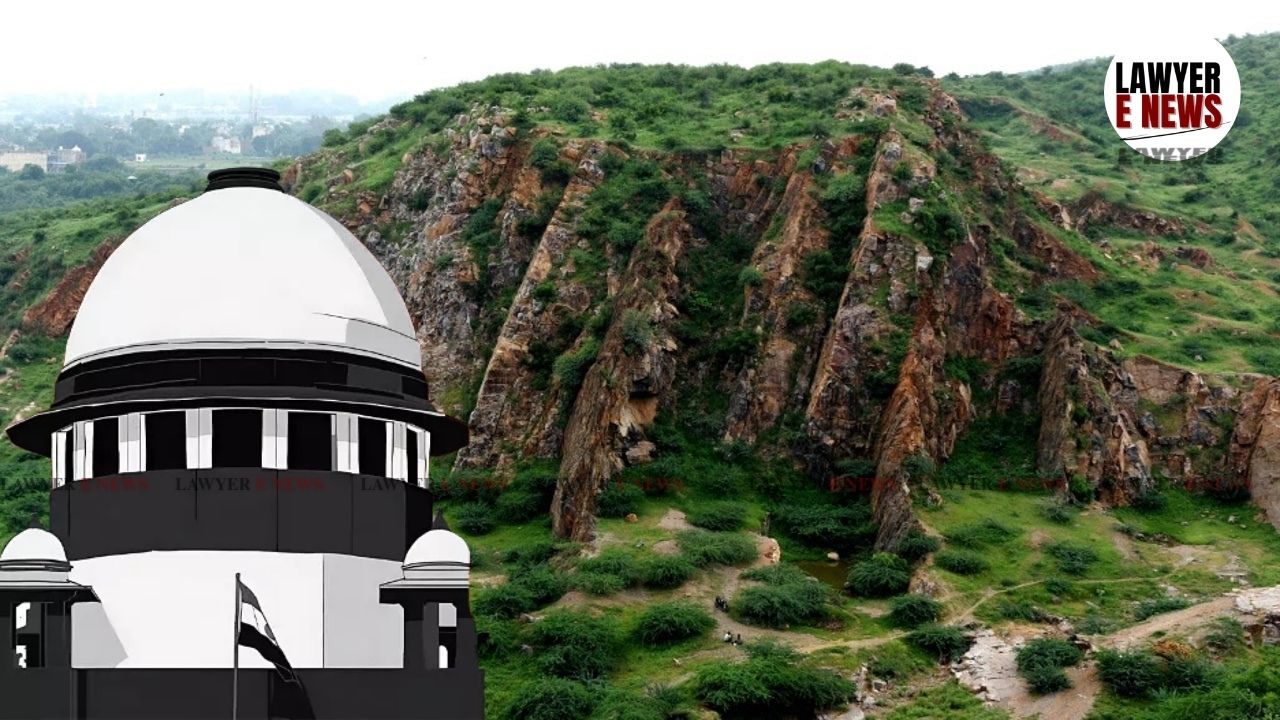
“No New Mining in Aravalis Without Sustainable Mining Blueprint”: Supreme Court Accepts Uniform Definition, Directs National Management Plan for Geo-Ecological Safeguarding. In a landmark judgment in T.N. Godavarman Thirumulpad v. Union of India & Others, the Supreme Court of India, led by Chief Justice B.R. Gavai, with Justices K. Vinod Chandran and N.V. Anjaria, issued far-reaching directions to regulate mining in the ecologically fragile Aravali Hills and Ranges, which span the states of Delhi, Haryana, Rajasthan, and Gujarat.
Observing that “ecological degradation is not a permissible trade-off for economic extraction,” the Court mandated that no new mining leases or renewals shall be granted in the Aravalis until a scientific and geo-referenced Management Plan for Sustainable Mining (MPSM) is completed by the MoEF&CC through the Indian Council of Forestry Research and Education (ICFRE). The ruling sets a critical precedent for environmentally responsible development, grounded in constitutional and international obligations.
The Court declared that the Aravalis function as a ‘green barrier’ against desertification, holding back the eastward advance of the Thar Desert. It found that without uniform regulation, the range had suffered extensive environmental loss due to illegal and excessive mining.
"Scientific Mining Must Replace Exploitative Extraction": Court Adopts Elevation-Based Definition for Aravalis
The genesis of the dispute lay in the conflicting definitions of the Aravalis used by different state governments. The Court noted that “one of the major issues with regard to illegal mining was on account of different definitions of Aravali Hills/Ranges, as adopted by the different States.” The absence of a standard allowed regulatory arbitrage, with various authorities carving out exceptions to permit unchecked mining.
Responding to the problem, the Court had, in earlier hearings, constituted a multi-member expert committee comprising representatives from the Forest Survey of India, Geological Survey of India, and state forest departments. The Court has now accepted the Committee’s operational definition, which identifies Aravali Hills as any landform with an elevation of 100 metres or more from the local relief, and classifies Aravali Ranges as two or more such hills within 500 metres of each other.
Rejecting criticism that this would permit the destruction of lower-elevation formations, the Bench ruled that “a uniform and scientific definition is necessary to bring coherence to environmental governance.” The Court emphasized that the definition, combined with an upcoming MPSM, would ensure that ecological priorities are not undermined.
"No Mining in Core Ecological Zones, Even Under Lease": Supreme Court Orders Immediate Restrictions on Inviolate Areas
The Court enforced an absolute prohibition on mining in core/inviolate zones, including protected areas, tiger reserves, notified wetlands, aquifer recharge zones, and areas with government-funded plantations. It made clear that only critical, strategic, and atomic minerals, under express provisions of the MMDR Act, would be exempted — and even then, subject to judicial oversight.
The Court said: “We accept the recommendations with regard to the prohibition of mining in core/inviolate areas with exception as carved out in paragraph 7.3.1 of the Committee’s Report.”
The ruling harmonizes India’s domestic environmental laws—including the Environment (Protection) Act, 1986, and the Wild Life (Protection) Act, 1972—with its international commitments under the United Nations Convention to Combat Desertification (UNCCD). The Court affirmed that under Article 5 of the UNCCD, “India is required to strengthen the existing laws, enact new laws as may be needed, and undertake long-term policy measures and action programmes to combat desertification.”
“Until There Is a Scientific Mining Plan, There Will Be No New Mining”: Court Halts All New Leases in Aravalis
In a strong but balanced directive, the Court ruled that no new mining leases shall be granted until the Management Plan for Sustainable Mining (MPSM) is prepared and finalized. This plan must be based on geo-referenced ecological assessments, mapping conservation-priority zones, permissible mining areas, ecological carrying capacity, and post-mining restoration protocols.
Referencing the successful Saranda model, the Court emphasized that “it would be appropriate that such a study be carried out taking into consideration the geological importance of the Aravali mountain ranges.” The Court also made it clear that the continuity and ecological integrity of the Aravali Ranges must be maintained, even if separate MPSMs are prepared for each district.
Notably, while halting new leases, the Court refused to impose a blanket ban on existing legal mining operations. It relied on its previous decision in State of Bihar v. Pawan Kumar, noting that “a total ban on mining is not conducive even to the interest of the environment, inasmuch as it gives scope for illegal mining.” However, the Court warned that “all existing mining operations must strictly comply with the environmental safeguards prescribed in Paragraph 8 of the Committee Report.”
“Mines That Reach Groundwater Must Be Shut”: Court Orders Ecological Monitoring, Closure of Non-Compliant Leases
In a series of powerful ecological directives, the Court mandated that:
The Court stressed: “Regular biennial evaluation of the cumulative impacts of existing and proposed mining activities in the entire Aravalli region should be ensured to prevent exceeding the ecosystem's carrying capacity.”
Further, the Court directed all state governments involved to identify and reclaim abandoned mines, creating site-specific rehabilitation plans.
“Environmental Justice Cannot Wait”: Apex Court Praises Amicus, Directs MoEF&CC to Lead India’s Desertification Resistance
The Bench concluded the judgment by paying tribute to Mr. K. Parameshwar, Amicus Curiae, for his “tireless efforts in preserving the ecological soul of the nation.” It also recorded appreciation for the legal teams of the Union and States, particularly highlighting the contributions of Ms. Aishwarya Bhati, ASG, and state counsels.
The Court made it clear that this judgment marks a pivot in India’s environmental jurisprudence. “The Aravalis are not just a geological formation — they are an ecological imperative. Desertification, aquifer loss, and biodiversity collapse are not risks we can gamble with for short-term mineral gains.”
The Supreme Court passed the following operative directions:
“We accept the operational definition of the Aravali Hills and Ranges as per the Committee Report. We prohibit any mining in core/inviolate zones. We direct the MoEF&CC to prepare a comprehensive MPSM through ICFRE. Until this plan is finalized, no new mining leases or renewals shall be granted. Existing mining operations may continue strictly in compliance with ecological safeguards as laid down.”
Date of Decision: November 20, 2025





