-
by sayum
25 August 2026 11:12 PM







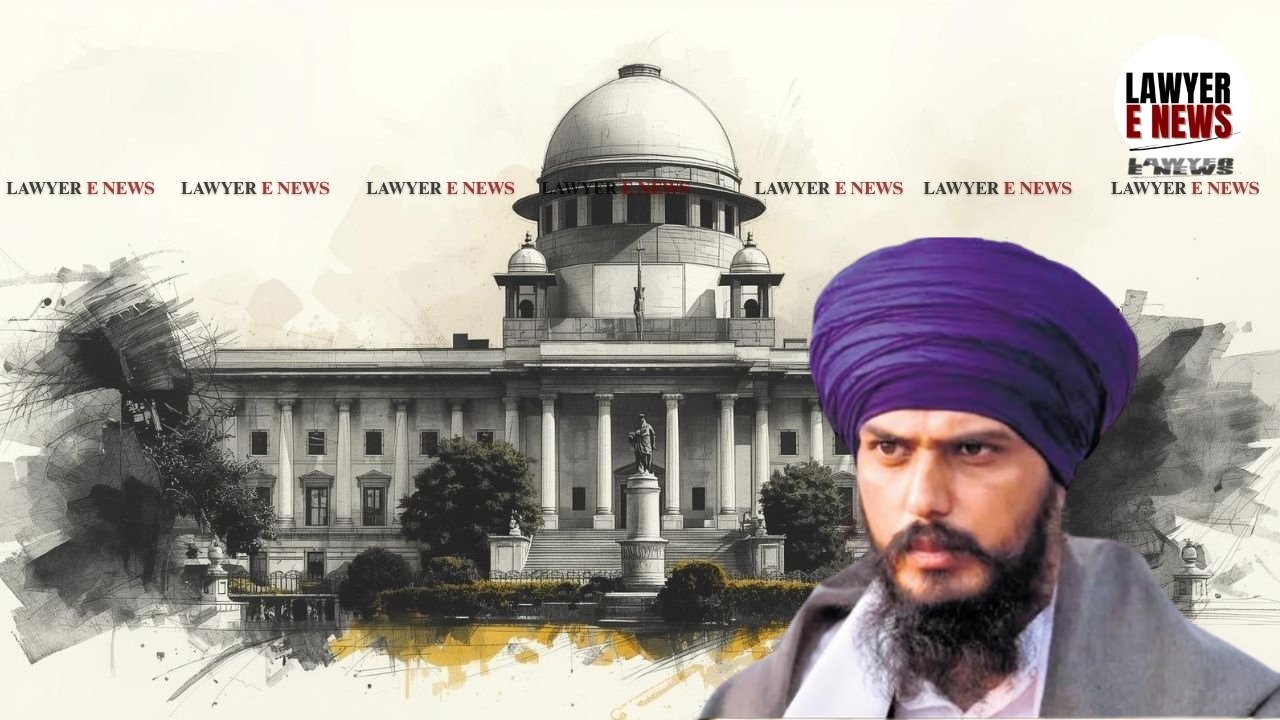
“We are permitting you to go before the High Court and requesting the High Court to dispose of it preferably within a period of six weeks,” observed the Supreme Court while declining to entertain the NSA challenge filed by Punjab MP Amritpal Singh. Today, the Supreme Court of India refused to entertain a writ petition filed by Amritpal Singh, Member of Parliament from Punjab, challenging his third preventive detention under the National Security Act, 1980. The Bench comprising Justice Aravind Kumar and Justice NV Anjaria granted Singh liberty to approach the Punjab and Haryana High Court, with a direction that the High Court preferably dispose of the matter within six weeks.
This decision signals the Court's continued restraint in entertaining writ petitions under Article 32 where statutory remedies before the High Court remain unexhausted.
Detention Under NSA Must Be Challenged in High Court First, Says Supreme Court
The matter was mentioned by Senior Advocate Colin Gonsalves before the vacation bench. As soon as the petition was brought up, Justice Aravind Kumar remarked that the petitioner should first approach the High Court for relief.
When Gonsalves urged the Bench to take cognizance of the continued detention, stating, “He’s been under detention for two and a half years based only on a single FIR where chargesheet has already been filed,” Justice Kumar maintained that the matter must first be dealt with by the High Court, which has the necessary jurisdiction and procedural mechanisms under the NSA framework.
Gonsalves attempted to draw a parallel with the Sonam Wangchuk NSA case, which the Supreme Court had recently entertained directly. However, Justice Kumar clarified that “Wangchuk's matter involved detention in a different state, which warranted our intervention. This case stands on a different footing.”
The initial position of the Bench was to list the matter for hearing only in January or February 2026, prompting Gonsalves to urge that such delay would further prejudice Singh. Responding to this, the Bench agreed to request the Punjab and Haryana High Court to take up the matter expeditiously, preferably within six weeks of filing.
Court Passes Matter Over to Allow Union's Appearance; Later Reiterates Position
During the first call of the case, no counsel from the Union of India was present, prompting the Court to pass over the matter temporarily. Later, Additional Solicitor General SV Raju appeared and was informed of the Court’s decision.
Justice Kumar reiterated the Court’s position:
“This matter, we are not entertaining but we are permitting to go before the High Court, and we are requesting the High Court to dispose of it preferably within a period of six weeks.”
In response to the Court’s direction, ASG Raju expressed concern over the six-week time limit, noting that sufficient time is needed for filing replies and counters. On the other hand, Gonsalves insisted that only a month should be enough, given the already protracted detention.
Justice Kumar, while not formally extending the time limit, acknowledged the pressure this direction might put on the High Court, observing:
“We are putting a lot of pressure on High Court judges.”
Amritpal Singh, a controversial public figure from Punjab, has been detained under the National Security Act, 1980, not once but thrice, raising concerns about procedural fairness, judicial oversight, and the scope of preventive detention.
The NSA allows for detention without charge for up to 12 months to prevent an individual from acting in any manner prejudicial to national security or public order. Singh’s detention has been legally contentious, especially since it reportedly stems from a single FIR where investigation has concluded and charges have been filed.
However, as per the standard jurisprudence laid down in A.K. Roy v. Union of India (1982) and other cases, challenges to preventive detention orders under the NSA must generally be first routed through the respective High Court under Article 226, unless there are exceptional circumstances justifying direct approach to the Supreme Court under Article 32.
The Supreme Court declined to exercise jurisdiction under Article 32 in Amritpal Singh’s plea against his NSA detention, emphasizing the need to approach the High Court first. While expressing concern over the duration of the detention, the Court refrained from making any findings on the merits of the case and instead requested the Punjab and Haryana High Court to dispose of the matter within six weeks, setting a timeline for expedited judicial scrutiny.
This ruling reiterates the procedural discipline followed by the apex court in NSA cases and underscores the principle that High Courts are the primary fora for fact-intensive habeas corpus petitions arising under preventive detention laws.
Date of Decision: November 10, 2025