-
by sayum
23 October 2026 1:16 PM







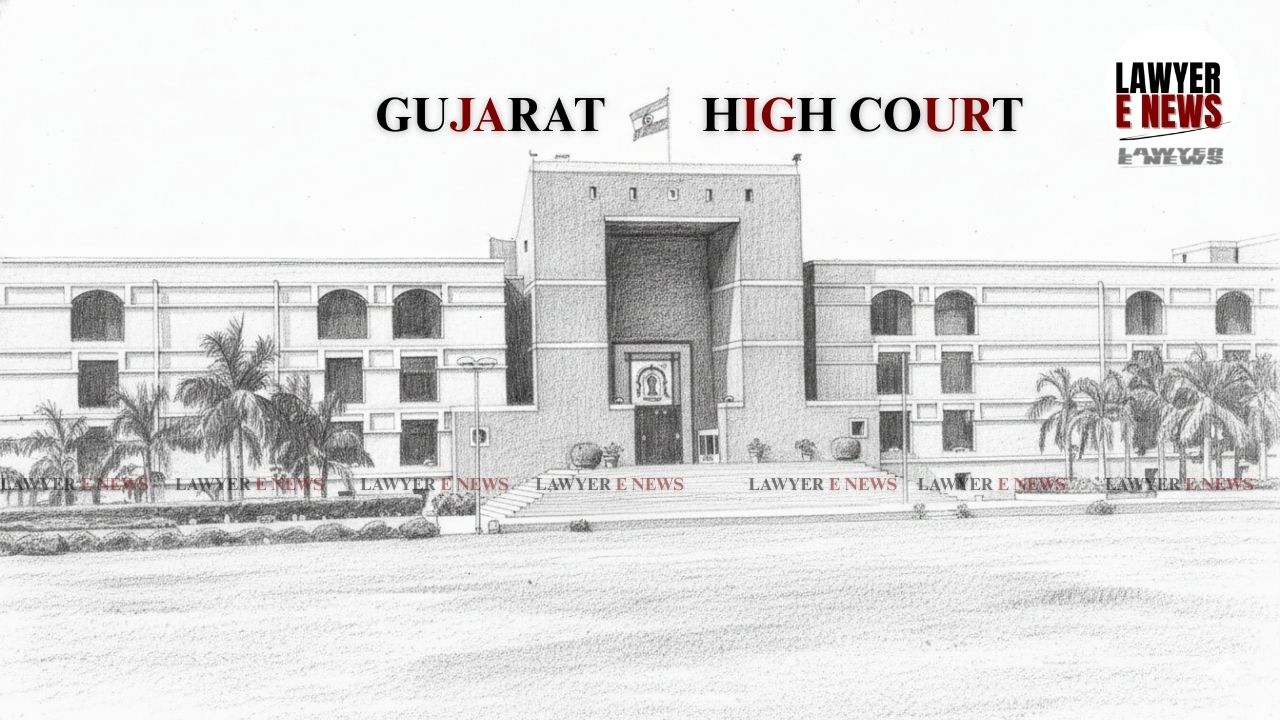
"An appellate court, however, must bear in mind that in case of acquittal, there is double presumption in favour of the accused. Firstly, the presumption of innocence is available to him under the fundamental principle of criminal jurisprudence... Secondly, the accused having secured his acquittal, the presumption of his innocence is further reinforced, reaffirmed and strengthened by the trial court." Gujarat High Court, in a judgment delivered by Justice Hemant M. Prachchhak on 23 September 2026, has reaffirmed that appellate courts should not interfere with an order of acquittal unless the trial court’s reasoning is perverse or suffers from a manifest error of law.
Emphasizing the "double presumption of innocence" that enures to the benefit of an acquitted accused, the Court held that if two reasonable conclusions are possible on the basis of the evidence, the appellate court must not substitute its own view for that of the trial court.
The case arose from an appeal filed by the State of Gujarat under Section 378(1)(3) of the CrPC, challenging the 2009 acquittal of the respondents by an Additional Sessions Judge in an Atrocity Case. The prosecution alleged that the respondents had harassed a minor girl, attempted to abduct her, and subsequently used caste-based abusive language against her family in public, invoking provisions of the IPC and Section 3(1)(11) of the Scheduled Castes and Scheduled Tribes (Prevention of Atrocities) Act.
The primary issues before the High Court were whether the Trial Court committed any error of law or fact in its appraisal of evidence and whether the judgment of acquittal was perverse or suffered from any illegality warranting interference in the appellate jurisdiction.
Evidence Lacked Credibility and Consistency
The Court observed that the prosecution’s case was severely weakened after the complainant, examined as PW-1, turned hostile and failed to support the allegations regarding the initial incident. Furthermore, the Court noted that the testimony of other prosecution witnesses contained material contradictions regarding the subsequent scuffle and the alleged use of casteist slurs.
Court Notes Unexplained Delay in FIR
A critical factor in the Court's dismissal of the appeal was the inordinate and unexplained delay in lodging the FIR. The incident allegedly occurred on 26 December 2007, but the complaint was only registered on 14 March 2008. The Court found that the lack of any satisfactory explanation for this delay rendered the prosecution's version untrustworthy.
Strict Interpretation of SC/ST Act Provisions
The Court highlighted that for an offence under the Atrocities Act to be established, the prosecution must prove that the intentional insult or intimidation was specifically targeted at the victim due to their caste identity. Relying on the Supreme Court’s ruling in Shajan Skaria v. State of Kerala, the Court emphasized that humiliation under the Act is inextricably linked to the caste status of the victim and cannot be assumed in every case of verbal abuse.
Absence of 'Public View' Requirement
The Bench further pointed out that for offences under the Atrocities Act to be made out, the alleged abuses must occur in a "place within public view." Referring to the principles laid down in Hitesh Verma v. State of Uttarakhand and Sohanvir v. State of U.P., the Court observed that where incidents occur within private premises or without the presence of the general public, the essential ingredients of the statutory offence are not satisfied.
Appellate Jurisdiction Limitations
Refining the scope of its powers, the Court held that the appellate court’s role is not to perform a routine re-evaluation of evidence but to identify firm and weighty grounds for discarding the trial court’s findings. Since the trial court had provided cogent, well-reasoned findings that were not perverse, the High Court declined to disturb the acquittal.
The High Court ultimately dismissed the appeal, holding that the prosecution had miserably failed to prove the charges beyond reasonable doubt. Finding the trial court’s judgment to be legally sustainable, the Court confirmed the acquittal and directed the cancellation of the respondents' bail bonds.
Date of Decision: 23 September 2026