
-
by sayum
26 August 2026 1:49 PM







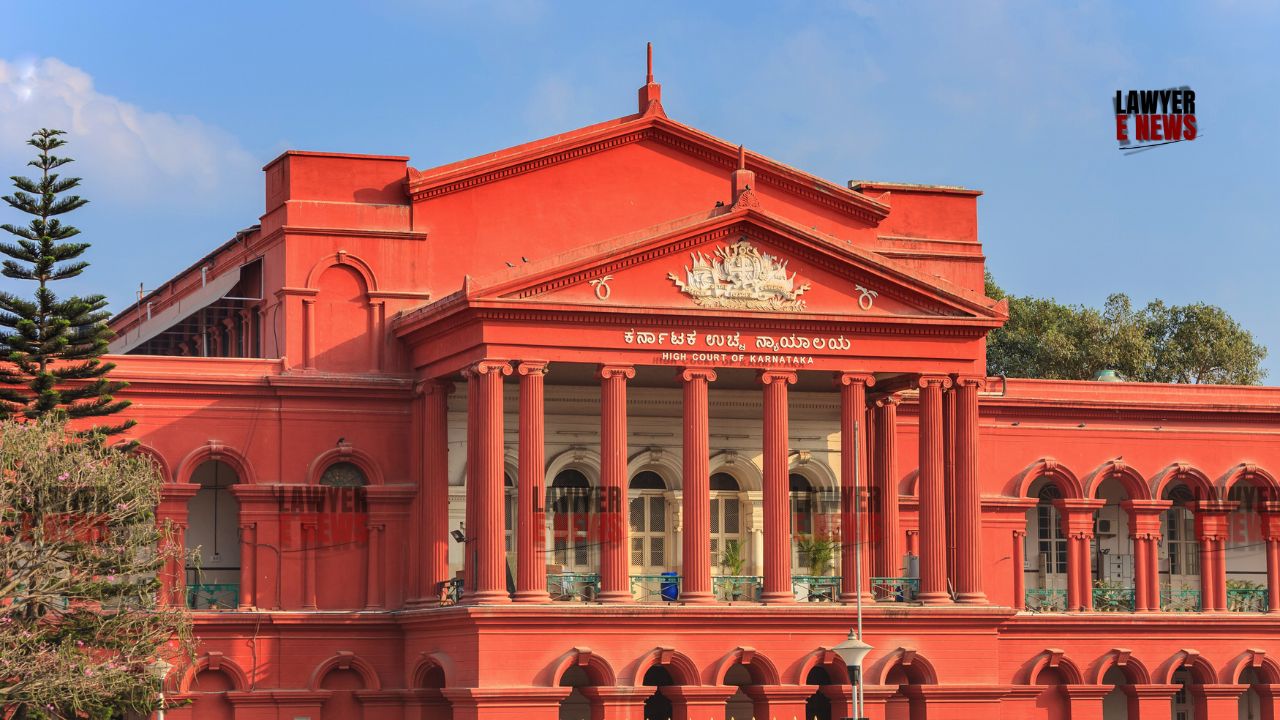
“A Lease Already Declared Invalid By Courts Cannot Claim The Benefit Of Later Amendments”, Karnataka High Court delivered an important ruling on quarry leases in M/s Vivek Exports v. State of Karnataka & Another and M/s KUM Internationals v. State of Karnataka.
A Division Bench comprising Chief Justice Vibhu Bakhru and Justice C.M. Poonacha held that statutory extensions under mining rules apply only to valid and subsisting leases, and therefore a quarry lease that has already been declared invalid by courts cannot be revived through subsequent amendments to the law.
The Court consequently dismissed the petition filed by Vivek Exports seeking extension of its quarry lease, while allowing the competing claim of KUM Internationals for grant of the quarry lease.
“Judicial Finality Cannot Be Reopened Through Fresh Claims”
The dispute related to quarrying rights for black granite over land in Survey No.184 of Jyothigondanapura Village, Chamarajanagar District.
The area had originally been granted as a quarry lease in 1978 to Zia-Ul-Haq, who later became a partner in Vivek Exports. After multiple renewals and legal disputes, a lease known as Quarry Lease No.439 was granted in 2001.
However, that lease had been granted pursuant to a Government Order dated 18 June 1991 which relaxed Rule 3A of the Karnataka Minor Mineral Concession Rules, 1969. This Government Order was subsequently quashed by the High Court, and the decision was affirmed by the Supreme Court in Alankar Granites Industries v. P.G.R. Scindia (1996) 7 SCC 416.
Later, in 2011, the Karnataka High Court had specifically held that:
“The renewal of the lease granted in favour of Vivek Exports was implicitly invalid and was not a subsisting valid lease.”
The challenge to this finding was dismissed by the Supreme Court in 2014, thereby giving the judgment finality.
The Division Bench therefore observed that the invalidity of the lease had already been conclusively determined, and the petitioner could not attempt to reopen the issue in fresh proceedings.
“Statutory Extension Presupposes A Valid Lease”
Vivek Exports attempted to rely on later amendments to the Karnataka Minor Mineral Concession Rules.
The petitioner argued that under Rule 8A(2) of the KMMC (Amendment) Rules, 2016, quarry leases could be extended up to 30 years, and that the KMMC (Amendment) Rules, 2023 further deemed certain quarry leases to be valid for 50 years.
Rejecting this argument, the High Court held that such provisions could apply only where a valid lease already exists.
The Court explained:
“The benefit of statutory extension presupposes the existence of a valid and subsisting lease. Where the lease itself has been declared invalid by earlier judicial orders that have attained finality, the benefit of statutory extension cannot be invoked.”
Thus, the endorsement issued by the Director of Mines and Geology rejecting the extension request of Vivek Exports was held to be justified.
“Delay Of Seven Years Is Fatal In Writ Jurisdiction”
Another factor weighed heavily against the petitioner. The rejection order was issued on 22 January 2016, but the writ petition was filed only in February 2023, after nearly seven years.
The Court noted that the explanation offered by the petitioner — illness of the Managing Director and misunderstanding regarding the status of the lease — was unsupported by evidence.
The Bench held that:
“Inordinate delay without satisfactory explanation is by itself sufficient ground to decline relief in writ jurisdiction.”
Accordingly, the petition filed by Vivek Exports was dismissed both on merits and on the ground of delay and laches.
“Authorities Cannot Reject Applications Due To Their Own Failure To Obtain NOCs”
The Court then examined the competing claim filed by KUM Internationals, which had applied in 2008 for a quarry lease over the same land.
The application was initially rejected on the ground that the land overlapped with the existing lease of Vivek Exports. However, once the High Court declared that lease invalid, earlier proceedings had already directed authorities to reconsider KUM’s application.
Despite these directions, the authorities again rejected the application, claiming that necessary No Objection Certificates from other departments had not been received before the 2016 amendments to the KMMC Rules.
The High Court rejected this reasoning, pointing out that under Rule 8(5) of the KMMC Rules, the responsibility for seeking such clearances primarily rested with the Senior Geologist and the concerned authorities.
The Court observed:
“The applicant can at best facilitate the process, but the responsibility of requesting and securing No Objection Certificates lies with the authorities themselves.”
Therefore, the State could not reject the application on the ground of its own failure to obtain the required reports.
“Amendment Of 2023 Revived Eligibility Of Pending Lease Applications”
The Court also took note of the legislative developments governing mining leases.
While the KMMC (Amendment) Rules, 2016 had rendered several pending applications ineligible, the KMMC (Amendment) Rules, 2023 later restored eligibility for applications filed prior to the 2016 amendment.
Since KUM’s application had been pending since 2010, the Court held that it remained eligible for consideration under the amended legal framework.
Considering the earlier judicial directions, the pending application, and the legislative changes, the Court concluded that KUM was entitled to the quarry lease over the notified area of five acres.
The Karnataka High Court ultimately dismissed the writ petition filed by Vivek Exports, holding that the petitioner could not seek extension of a lease that had already been declared invalid.
At the same time, the Court allowed the writ petition filed by KUM Internationals, quashed the endorsement rejecting its application, and directed the authorities to issue the required notification and execute the quarry lease deed within four weeks.
The ruling underscores a crucial principle of mining law and administrative law:
“Statutory extensions or amendments cannot revive rights flowing from an invalid lease that has already been nullified by judicial decisions.”





