-
by sayum
26 August 2026 9:49 AM







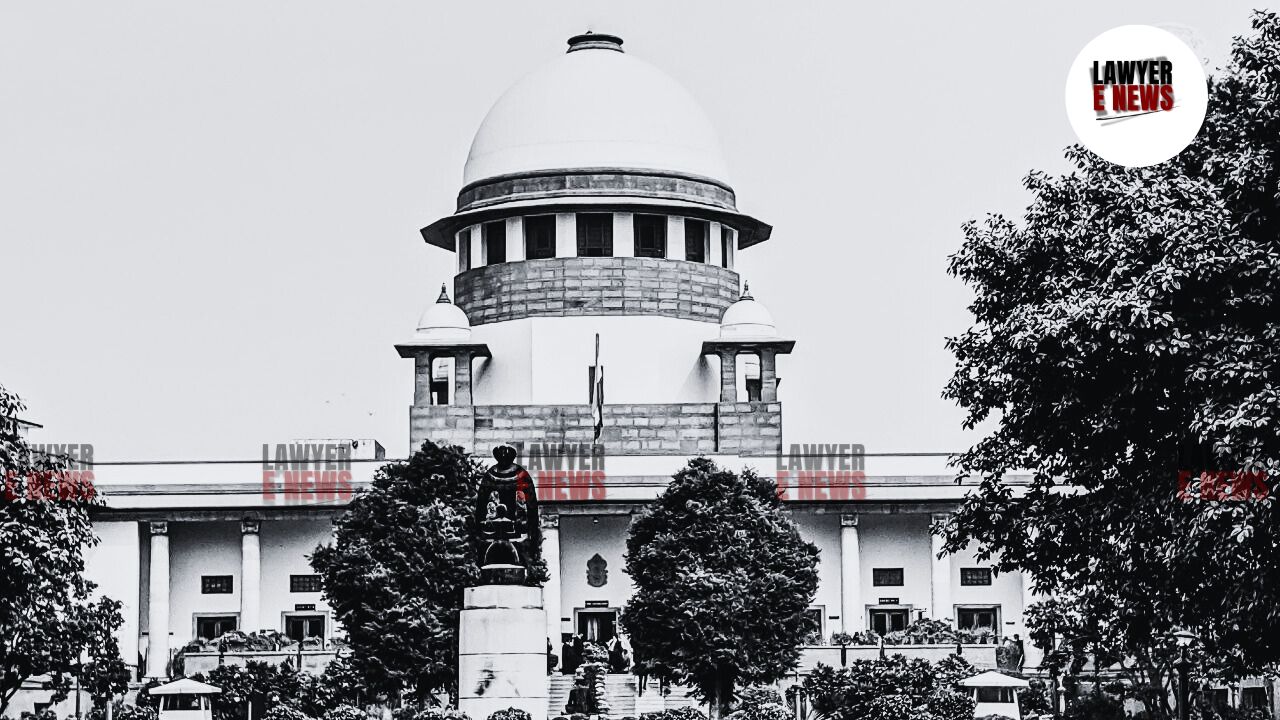
“Chapter VI Has Overriding Effect—No Permit Can Be Granted to Private Operators on a Notified Route, Even if Overlapped by Inter-State Route” – In a decisive ruling delivered on November 4, 2025, the Supreme Court of India categorically held that an inter-State reciprocal transport agreement (IS-RT Agreement) under Section 88 of the Motor Vehicles Act, 1988, cannot override approved schemes framed under Chapter VI. The Court, speaking through Justice Dipankar Datta and Justice Augustine George Masih, dismissed all claims by private operators seeking to ply on inter-State routes that overlapped with notified intra-State routes in Uttar Pradesh.
Holding that the directions of the Madhya Pradesh High Court, which mandated the issuance and countersignature of permits, were “contrary to settled legal position,” the Court allowed the appeals filed by U.P. State Road Transport Corporation (UPSRTC) and dismissed a writ petition filed directly under Article 32 by certain private operators.
The Court answered the core legal question as follows:
“Whether a stage carriage permit can be granted to a private operator on an inter-State route in terms of an IS-RT Agreement when a portion of such inter-State route is common to a notified intra-State route under an approved scheme? The answer, unequivocally, is no.”
“No Private Operator Can Claim Permit Merely Because of an IS-RT Agreement—Such Agreement is Not a Law”: Supreme Court Declares Chapter VI Paramount
The Court firmly reiterated that an inter-State transport agreement under Section 88 is not ‘law’ within the meaning of the Motor Vehicles Act. Rather, it is a contractual arrangement between States, and hence subordinate to the overriding provisions of Chapter VI.
Justice Datta wrote:
“An IS-RT Agreement, by its very nature, is an agreement between two States but not a law under the relevant MV Act. Approved schemes and notified routes…override Section 88 agreements by virtue of Section 98.”
This legal proposition, rooted in a long line of precedents, reaffirmed that private operators cannot legally operate on any notified route—whether fully or partially overlapping—even if they hold permits under an IS-RT Agreement.
The judgment declared, “The consistent view of this Court has been that an IS-RT Agreement cannot prevail over a notified scheme under Chapter VI. The statutory command of Section 98 is clear and unambiguous.”
“Even a Few Kilometres of Overlap is Enough to Bar Private Operators from Notified Routes”: Apex Court Follows Constitution Bench in Adarsh Travels
Rejecting the argument that a short overlap or lack of express prohibition should allow operation on inter-State routes, the Court relied heavily on the Constitution Bench judgment in Adarsh Travels Bus Services v. State of U.P. (1985) 4 SCC 557.
Quoting from the Constitution Bench, the Court noted:
“If there is a prohibition to operate on a notified route or routes, no licences can be granted to any private operator whose route traverses or overlaps any part or whole of that notified route.”
The Court further clarified the distinction between overlapping and intersection, a nuanced but critical issue in transport jurisprudence:
“An intersection cannot be said to be traversing the same line… but even a short overlap constitutes a violation if the scheme is exclusionary.”
Consequently, all arguments by permit-holding private operators that they should be allowed to operate simply because the inter-State route is only partly common to a notified route were summarily rejected.
“There Is No Conclusive Evidence That MPSRTC Has Been Wound Up—Schedule B Routes Cannot Be Converted into Schedule A Without Proof”
Private operators based in Madhya Pradesh had claimed rights to operate on Schedule B routes—previously reserved for the Madhya Pradesh State Road Transport Corporation (MPSRTC)—on the ground that MPSRTC had been wound up. The IS-RT Agreement provided that once MPSRTC ceased operations, these routes could be treated as open to private operators.
The Court, however, found no clinching evidence:
“Based on the materials placed on record, the private operators urge us to accept that MPSRTC has been wound up. However, there is no clinching evidence to that effect… the materials at best hint at the process being underway.”
Accordingly, it held that no legal rights could accrue to private operators unless winding-up of MPSRTC was conclusively established, and no obligation could be fastened on the UPSRTC or the State of Uttar Pradesh to countersign such permits.
“We Deplore the Lack of Coordination Between Two States—Public Interest is the First Casualty”: Supreme Court Calls for Cooperative Dialogue
In a sharp but constructive observation, the Court lamented the administrative failure of the States of Madhya Pradesh and Uttar Pradesh to coordinate transport policies in the public interest.
“Much was expected of the States of UP and MP as well as the UPSRTC to protect the interest of the passengers and commuters, which unfortunately has not fructified… public interest is rendered a casualty.”
Acknowledging that transport schemes must evolve with infrastructural and technological advances, the Court urged the two States to “meet within three months” to consider modifying the IS-RT Agreement in line with public needs.
“If indeed MPSRTC has been wound up… appropriate decision may be taken to include the routes in Schedule B of the IS-RT Agreement into Schedule A… and measures taken to give effect to such inclusion.”
While the Court declined to direct any change in law or policy, it encouraged a proactive federal approach, consistent with the observations in Adarsh Travels and T.V. Nataraj, aimed at minimizing inconvenience to passengers.
High Court Orders Set Aside, Writ Petition Dismissed, States Directed to Confer and Act in Public Interest
Concluding its judgment, the Supreme Court ordered as follows:
“The judgment and order of the High Court under challenge in Civil Appeal No. 10522 of 2025 stand set aside. The connected civil appeals also stand allowed. Writ Petition No. 748 of 2024 stands dismissed.”
The Court reiterated that no permits can be granted or countersigned for any inter-State route which even partially overlaps a notified intra-State route unless the statutory scheme permits such operation.
“Public Road Transport Cannot Be Reduced to a Tug of War Between Bureaucracy and Private Interests”: Court Underscores Purpose of Chapter VI
In an expansive closing reflection on transport policy in India, the Court emphasized the role of State Road Transport Undertakings (SRTUs) and public infrastructure.
“Digitalisation has been a game-changer… With the introduction of modern vehicles and e-buses, operators of stage carriage services have been providing comfort and convenience comparable to services abroad.”
However, the Court reminded both States that the statutory and constitutional goal is public convenience—not competitive profit.
“Subjecting the travelling public to inconvenience would amount to disservice by the States… The interest of passengers and commuters ought to be of prime concern.”
Date of Decision: November 4, 2025