-
by sayum
12 August 2026 1:53 PM







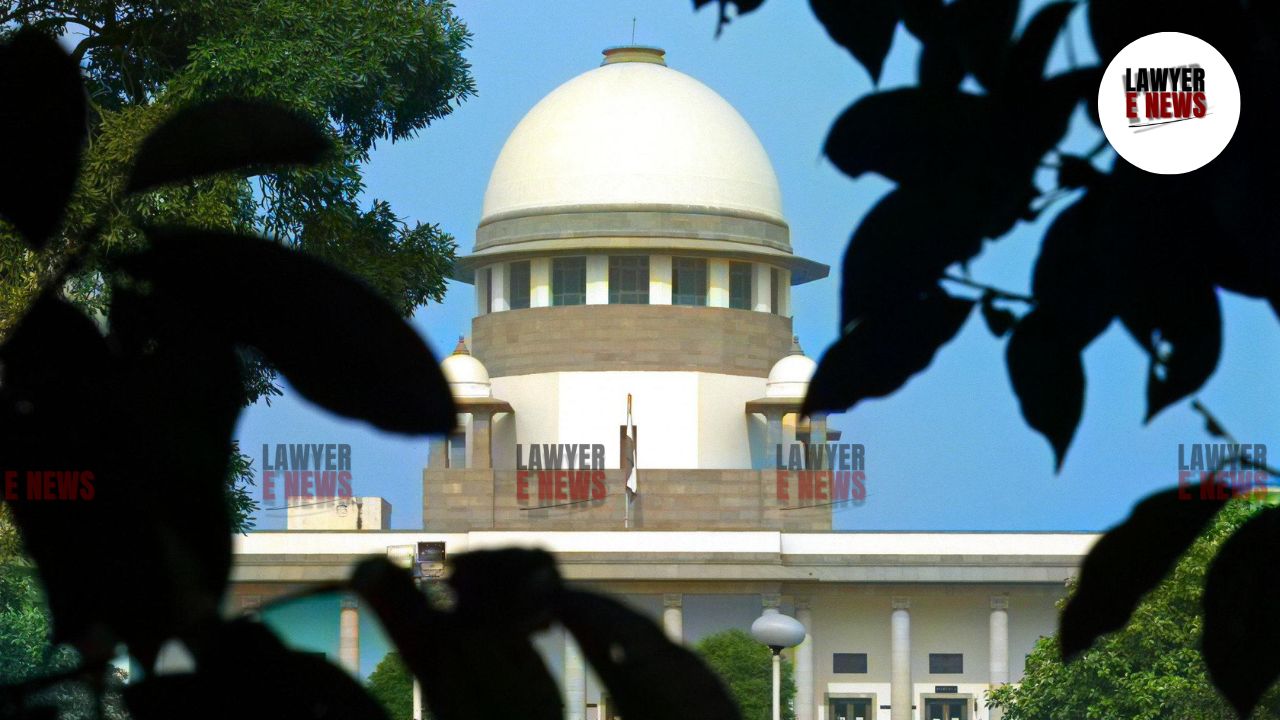
Technicalities Cannot Override Justice When a Student Has Invested Years in Education – In a ruling that underscores the importance of balancing legal technicalities with equitable considerations, the Supreme Court of India has reinstated the admission of an Ayurvedic medical student who was denied a degree due to an initial eligibility issue, despite completing almost the entire course and part of his internship.
Delivering the judgment in Zaid Sheikh v. State of Madhya Pradesh & Others, Justice Sanjay Kumar observed: "An act of the Court should not prejudice anyone. The student’s labor of six years cannot be discarded simply due to a technicality that he himself rectified during the course of his education."
The Court set aside the Madhya Pradesh High Court’s 2014 judgment, which had upheld the cancellation of Zaid Sheikh’s admission to the Bachelor of Ayurvedic Medicine and Surgery (B.A.M.S.) program. It directed that he be allowed to complete his course, finish his internship, and receive his degree.
Zaid Sheikh, the appellant, had completed his 10+2 education in 2008 from the Madhya Pradesh Sanskrit Board. That same year, he appeared for the Pre-Ayurvedic, Homeopathic, and Unani Entrance Test and secured admission to the B.A.M.S. course at Smt. Dhairya Prabha Devi Sojatia Ayurvedic Medical College, Neemthur.
However, his educational journey was soon thrown into turmoil. The college was de-recognized, and its students were transferred to Shaskiya Swasashi Dhanwantari Ayurvedic Medical College, Ujjain, in 2012. While other students continued their studies seamlessly, Sheikh was denied the transfer on the grounds that he had not passed English as a subject in his original 10+2 examination, a requirement under the Madhya Pradesh Ayurveda/Unani/Homeopathy Undergraduate Entrance Examination Rules, 2008.
In October 2012, Sheikh challenged his exclusion by filing Writ Petition No. 10267 of 2012 before the Madhya Pradesh High Court. Based on an interim order dated October 30, 2012, he was allowed to attend classes provisionally, while the matter remained sub judice.
The Principal of Shaskiya Swasashi Dhanwantari Ayurvedic Medical College issued an Allotment Letter on September 19, 2012, stating: "The candidate must either provide proof of passing Class 12 English or will be provisionally admitted on the condition that he clears English separately."
Acting upon this condition, Sheikh reappeared for the Class 12 examination in March 2013, this time including English as a subject, and passed with 70 marks. Additionally, he also appeared for the Senior Secondary Examination conducted by the National Institute of Open Schooling (NIOS) in 2014, where he again cleared English, along with Physics, Chemistry, Biology, and Hindi.
Despite rectifying his eligibility and completing almost the entire B.A.M.S. course, Sheikh’s writ petition was dismissed by the High Court on June 18, 2014. His review petition was also rejected on August 1, 2014, with the Court stating that there was "no error apparent on the face of the record."
The Supreme Court, however, found this approach unjust, stating: "When a student has been allowed to pursue his education under judicial orders and has fulfilled the necessary eligibility requirements in the process, the Court must not disregard the practical realities of his situation."
Rejecting the High Court’s rigid interpretation of admission rules, the Supreme Court ruled in favor of Sheikh, holding that the peculiar facts of the case merited equitable relief.
Justice Kumar emphasized that legal technicalities should not be used to destroy a student’s future, observing: "The appellant was initially admitted in violation of admission rules, but the authorities themselves later provided him the opportunity to rectify this. He did so in good faith and completed almost the entire course. In such circumstances, the High Court should have exercised judicial compassion rather than adopting a mechanical approach."
Addressing the High Court’s reliance on the principle that eligibility conditions must be met at the time of admission, the Supreme Court clarified: "While basic eligibility requirements are non-negotiable, the present case is unique. The student acted upon an official allotment letter that allowed him to qualify English subsequently. Denying him his degree at this stage serves no purpose other than sheer injustice."
The Court further reiterated the fundamental principle of justice, stating: "An act of the Court should not harm an individual. The appellant did everything in his power to comply with the requirements. After investing six years in medical education, denying him a degree now would be legally incorrect and morally indefensible."
Setting aside the High Court’s orders, the Supreme Court ruled: "The appellant shall be permitted to complete his course and internship at Shaskiya Swasashi Dhanwantari Ayurvedic Medical College, Ujjain. The concerned authorities shall issue him his B.A.M.S. degree in accordance with due procedure."
By granting Zaid Sheikh the right to complete his studies, the Supreme Court ensured that a student’s future was not sacrificed on the altar of legal formalism.
The Supreme Court’s ruling in Zaid Sheikh’s case is a landmark affirmation that courts must adopt a pragmatic approach in matters concerning students’ education. The judgment sets a precedent for how the judiciary should handle cases where a student corrects an initial technical deficiency and fulfills all academic requirements.
Justice Augustine George Masih, concurring with the decision, concluded with a powerful remark: "Education is not merely a privilege but a right that must not be extinguished due to rigid technicalities. The law must serve justice, not obstruct it."
With this verdict, Zaid Sheikh’s six-year struggle for justice finally reached its rightful conclusion. The ruling serves as a beacon of hope for students facing similar bureaucratic roadblocks and reinforces the principle that justice must be tempered with fairness, especially when the stakes involve a person’s entire future.
Date of Decision: March 18, 2025