
-
by sayum
26 August 2026 1:49 PM







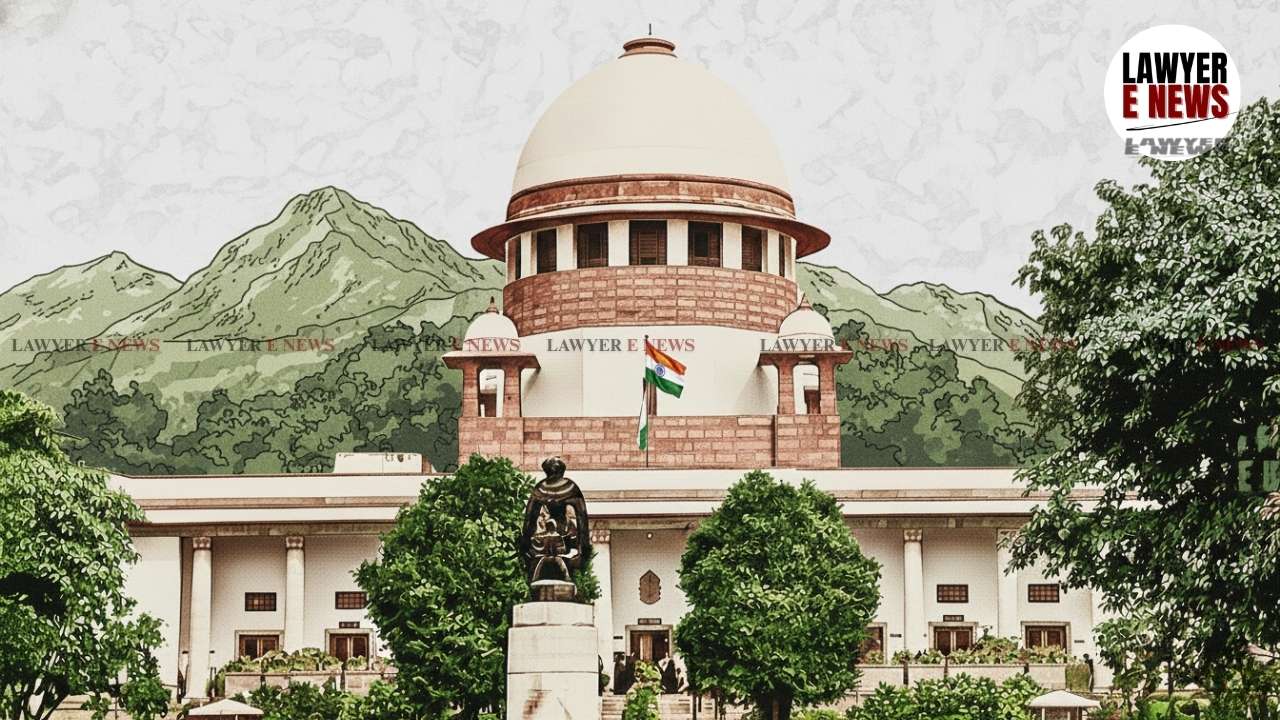
“Before irreversible ecological damage is done, there is a pressing need for ‘impartial, independent expert opinion’ to evaluate the flawed elevation-based definition of the Aravallis”, Three-judge Bench of the Supreme Court of India, led by the Hon’ble Chief Justice and comprising Justices J.K. Maheshwari and Augustine George Masih, delivered a significant interim order in Suo Motu Writ Petition (Civil) No. 10 of 2025, staying the implementation of its own earlier judgment dated November 20, 2025, concerning the uniform definition of the Aravalli Hills and Ranges. The Court directed a complete freeze on all new or renewed mining leases in the Aravalli region, exercising its powers under Articles 32 and 142 of the Constitution.
At the heart of the judgment lies a constitutional and environmental imperative: ensuring that the definition adopted for one of India’s most fragile ecological systems—the Aravallis—is both scientifically robust and ecologically inclusive. The Court observed that the adopted definition, based primarily on a minimum elevation of 100 metres and a proximity threshold of 500 metres between hills, “prima facie suffers from ambiguity” and may in fact permit environmental degradation through “regulatory gaps.”
Court Flags Potential “Ecological Disintegration” from Narrowed Definition
The suo motu proceedings stemmed from concerns that the Court’s own November 2025 judgment, which had accepted an Expert Committee's definition of the Aravallis and endorsed restrictions on mining therein, lacked clarity on several ecological and legal dimensions. In that earlier ruling, the Court had directed that until a Mining Plan for Sustainable Mining (MPSM) was finalized by the Ministry of Environment, Forest and Climate Change (MoEF&CC), no new mining leases would be permitted within the defined Aravalli zones.
However, in response to a spate of Interlocutory Applications, Miscellaneous Applications and increasing environmentalist criticism, the Court revisited its prior approval. It observed:
“While we have no scientific reasons justifying any ex-facie acceptance of the same, nor any cogent evidence or expert testimony to substantiate these individual contentions, nevertheless, it seems prima facie that both the Committee's Report and the judgment of this Court have omitted to expressly clarify certain critical issues.”
One of the most pressing concerns was whether the proximity criterion—restricting the definition of the ‘Aravalli Range’ to hills within 500 metres of each other—undermines ecological continuity by leaving vast tracts of environmentally sensitive areas unprotected. The Court remarked:
“Whether the definition… restricted exclusively to the 500-meter area between two or more Aravalli Hills, creates a structural paradox… thereby facilitating the continuation of unregulated mining… must be scrutinized independently.”
Massive Public Outcry, Environmentalist Concerns Acknowledged
Notably, the Bench took serious note of the public debate and environmentalist concerns, acknowledging that the new criteria might leave significant portions of the Aravallis—particularly lower hillocks—outside the protection net.
The Court was categorical in its response to concerns that only 1,048 out of 12,081 hills in Rajasthan qualify under the 100-metre elevation criterion, stating that “such a definition may inversely broaden the scope of ‘non-Aravalli’ areas” and may result in “ecological disintegration and fragmentation of the landscape.”
It further clarified that “in the absence of comprehensive scientific validation and spatial mapping, premature implementation would irreversibly compromise the ecological integrity of the Aravalli range.”
High-Powered Expert Committee to Re-evaluate Entire Definition and Impact
Calling for a course correction, the Court directed the constitution of a High-Powered Expert Committee to conduct an exhaustive reassessment. The Committee is tasked with conducting a holistic scientific and ecological review of the newly adopted definition, particularly focusing on:
The Court emphasized:
“Such a step is essential to resolve critical ambiguities and to provide definitive guidance on… whether regulated mining would be permissible in the ‘gaps’… and whether such gaps would risk fragmentation.”
Absolute Interim Ban on New or Renewed Mining Leases
Most significantly, invoking its extraordinary jurisdiction under Articles 32 and 142 of the Constitution, the Court stayed its own judgment dated 20.11.2025, and ordered that until the new Expert Committee submits its report and further directions are issued, no new mining lease or renewal of old leases in the Aravalli Hills and Ranges shall be permitted.
Crucially, the Court reaffirmed reliance on the Forest Survey of India (FSI) Report dated 25.08.2010, which is broader and more inclusive, as the operative reference point for the interim ban. The order categorically stated:
“No permission shall be granted for mining, whether it is for new mining leases or renewal of old mining leases, in the ‘Aravalli Hills and Ranges’ as defined in the FSI Report dated 25.08.2010 without prior permission from this Court.”
A Pause for Precision Before Permanent Policy
This judgment underscores the Supreme Court’s evolving approach to environmental governance—balancing judicial consistency with scientific scrutiny. The Court's recognition of its own prior judgment’s limitations and willingness to course-correct by inviting a broader panel of scientific expertise marks a rare but vital moment of judicial introspection.
In its final word, the Bench emphasized that no irreversible administrative or ecological actions should be taken based on the current definition, holding:
“This stay shall remain in effect until the present proceedings reach a state of logical finality.”
By halting potentially flawed policy implementation, the Court has opted to prioritize precaution over expediency, recognizing that in environmental matters, “ambiguity is the enemy of sustainability.”
Date of Decision: 29 December 2025





