
-
by sayum
26 August 2026 1:49 PM







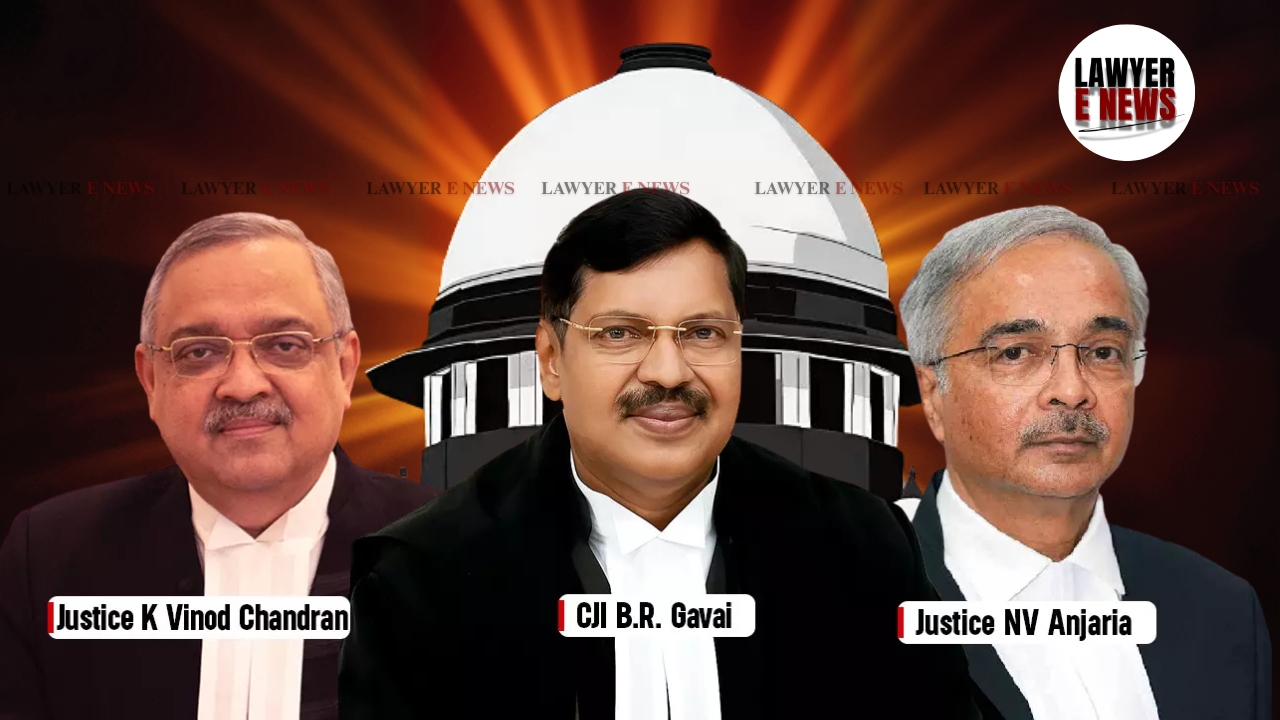
“Protection Under Section 132 BSA Ends Where Crime Begins – But Exception Clauses Cannot Be Misused to Harass Advocates”, In a nuanced and balanced judgment on the boundaries of professional privilege, the Supreme Court of India on October 31, 2025, clarified that Advocates are not immune from criminal liability, and cannot shield themselves behind Section 132 of the Bhartiya Sakshya Adhiniyam, 2023 (BSA) when involved in illegal acts. However, the Court warned against the misuse of such exceptions by investigating agencies to issue indiscriminate summons or breach confidentiality in the name of investigation.
The three-judge Bench led by Chief Justice B.R. Gavai, along with Justice K. Vinod Chandran and Justice N.V. Anjaria, ruled:
“The immunity under Section 132 does not protect an Advocate involved in a crime. Communications made in furtherance of an illegal purpose, or facts observed indicating fraud or crime during the engagement, are not protected.”
At the same time, the Court made it absolutely clear that such exceptions must not be presumed or vaguely asserted, and cannot be used as a backdoor to compel lawyers to violate professional secrecy or compromise client trust.
“Exception Clauses Are Not Carte Blanche for State Overreach”: Court Orders That Exceptions Under Section 132 Must Be Explicit and Judicially Reviewed
While acknowledging that communications made for an unlawful purpose are not privileged, the Supreme Court emphasized that this exception cannot become a tool for blanket summons against Advocates.
“The invocation of the exception must not be mechanical. It must be substantiated by prima facie material, and judicial scrutiny is necessary before privilege is pierced.”
The Court mandated that any authority seeking to override privilege under Section 132 must first articulate a concrete basis showing that the communication was made in furtherance of a crime or fraud, and such claim must be tested before a court.
Without this filter, the Court warned, investigating agencies could “weaponise the exception” to bypass the privilege altogether.
Privilege Ends Where Conspiracy Begins—But the Burden Lies on the Investigator, Not the Lawyer
The Court noted that Section 132(2) of the BSA clearly excludes protection in cases where:
The Advocate knows the communication was made for an illegal purpose, or
The Advocate becomes aware, during the course of professional engagement, of facts showing the client has committed or is committing a crime or fraud.
However, the onus lies with the investigating agency to demonstrate that these conditions exist. The Court clarified:
“The privilege does not protect crime, but nor does the possibility of crime dilute privilege. Suspicion is not proof, and inference is not entitlement.”
Hence, mere association with a client later found to be guilty does not strip the Advocate of protection unless the lawyer is demonstrably complicit.
Fishing Expeditions in the Name of ‘Exception’ Are Constitutionally Impermissible
The judgment comes in response to a disturbing pattern where Advocates were summoned during high-stakes criminal probes, with agencies invoking vague allegations that “the communication may relate to a conspiracy”.
The Court came down heavily on this trend:
“Exception clauses under Section 132 are not to be used as a cloak for fishing inquiries. The privilege is not a privilege of the profession, but of the client and of the constitutional right to fair legal defence.”
Investigators must show, on affidavit, the specific facts that justify piercing the privilege, and must seek a judicial order before any further steps are taken.
Judicial Review Is the First Line of Defence Against Investigative Overreach
The Supreme Court directed that all future attempts to invoke the exception to Section 132 must be placed before a judicial authority, either under Section 94 or Section 528 of the Bhartiya Nagarik Suraksha Sanhita, 2023 (BNSS), depending on whether production or challenge is involved.
No Advocate, the Court held, can be compelled to:
Reveal client communications, or
Disclose observations made during the course of representation
unless a court has first satisfied itself that the exception is made out in fact and law.
“A judicial determination is not a formality. It is the constitutional buffer between privilege and persecution.”
A Clear Line Between Accountability and Intimidation
This decision ensures that the legal profession is not converted into an investigative shortcut, while also reaffirming that no one—including a lawyer—is above the law.
The Supreme Court has struck a delicate but essential balance:
Legal privilege cannot be used to shield criminal acts, but
Exception clauses under Section 132 BSA cannot be used to justify intimidation, intrusion, or indiscriminate summons.
It reaffirms the lawyer’s constitutional role—not as a gatekeeper of illegality, but as a facilitator of justice who cannot function under fear of being targeted for doing their duty.
Date of Decision: October 31, 2025





