-
by sayum
13 October 2026 6:59 AM







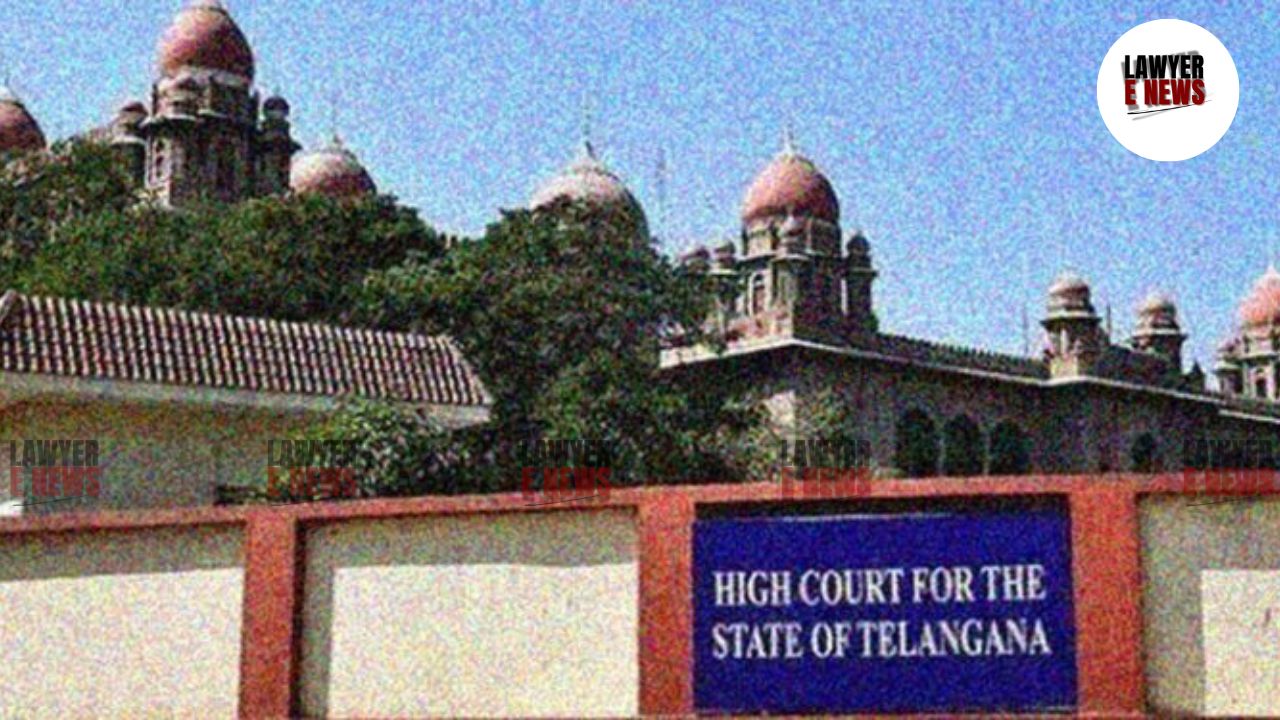
"The legal position remains unequivocal that the limited exception recognised in Ex-Capt. Harish Uppal’s case does not authorise a Bar Association or its office-bearers to prevent an advocate from attending his professional duties or to subject such advocate to any adverse consequence for disregarding a boycott call," Telangana High Court.
Telangana High Court, in a significant ruling, held that advocates have no right to resort to strikes or boycott court proceedings and that any resolution calling for such action constitutes a prima facie act of contempt.
A bench of Justice Laxmi Narayana Alishetty observed that while the legal fraternity may express solidarity in rare circumstances, such protests must never obstruct the administration of justice or violate the fundamental rights of advocates choosing to perform their professional duties.
The petition was filed by an advocate, appearing as a party-in-person, seeking to punish the office-bearers of the Metropolitan Criminal Court Bar Association, Nampally, for passing a resolution to boycott court work on June 16, 2025. The petitioner alleged that he was obstructed, intimidated, and physically assaulted by members of the Bar for refusing to participate in the boycott while attempting to attend to his professional obligations.
The primary question before the court was whether the resolution calling for a boycott of court work violated the guidelines laid down by the Supreme Court of India in Ex-Capt. Harish Uppal v. Union of India. The court was also called upon to determine whether the alleged acts of obstruction and physical assault against an advocate who refused to join the boycott constituted a punishable contempt of court.
Reiteration Of Settled Legal Position
The court emphatically reiterated that lawyers have no right to strike or give calls for boycotts, as such actions directly undermine the authority of the judiciary. Referring to the precedents in Ex-Capt. Harish Uppal, Common Cause, and Krishnakant Tamrakar, the court underscored that the functioning of courts cannot be stalled by protests.
No Absolute Immunity For Bar Associations
The court noted that while a limited exception exists for the "rarest of rare" cases involving the dignity of the Bar or Bench, it is strictly conditional. The President of the Bar must consult the concerned Chief Justice or District Judge, whose decision is final and binding on the Bar.
"The respondents cannot seek to justify every act undertaken pursuant to the resolution merely on the ground that the protest was confined to one day or was claimed to be in solidarity with an advocate."
No Tolerance For Coercion Or Violence
The bench clarified that even if a protest were to fall within the narrow exception of a one-day symbolic gesture, this does not grant immunity for acts of coercion or assault. The court observed that the physical assault on an advocate for choosing to appear in court is a grave violation of the directions issued by the Supreme Court and cannot be justified under the guise of an Association's resolution.
Nature Of Contempt Jurisdiction
Addressing the maintainability of the case, the court noted that the petitioner sought to initiate proceedings against the office-bearers collectively. Relying on Dr. U.N. Bora v. Assam Roller Flour Mills Association, the court held that contempt is quasi-criminal in nature and requires proof of a specific overt act by each respondent.
"In the absence of specific material establishing an overt act or conscious participation, contempt liability cannot be imposed merely on account of his position as an Executive Committee Member of the Bar Association."
Absence Of Individualized Liability
The court observed that in the present case, the petitioner failed to attribute specific acts of obstruction to all office-bearers, except for Respondent No. 5. Furthermore, the court noted that the occurrence had already triggered separate criminal proceedings, including FIRs for assault and wrongful restraint, which are the proper forums to resolve disputed questions of fact.
Refusal To Engage In Parallel Adjudication
The bench held that the court would not be justified in conducting a parallel adjudication in summary contempt proceedings when criminal trials are already underway. Consequently, while the court dismissed the contempt case due to the lack of sufficient material to fix individual liability, it issued a stern warning that this decision should not be seen as condoning the acts of violence.
Future Directions For Bar Associations
The court concluded by observing that office-bearers must exercise extreme restraint while organizing protests. Any future call for a strike must strictly adhere to the guidelines laid down by the Supreme Court, ensuring that no advocate or litigant is ever obstructed from accessing the court or pursuing their legal remedies.
Date of Decision: 21 September 2026