-
by sayum
25 August 2026 6:19 AM







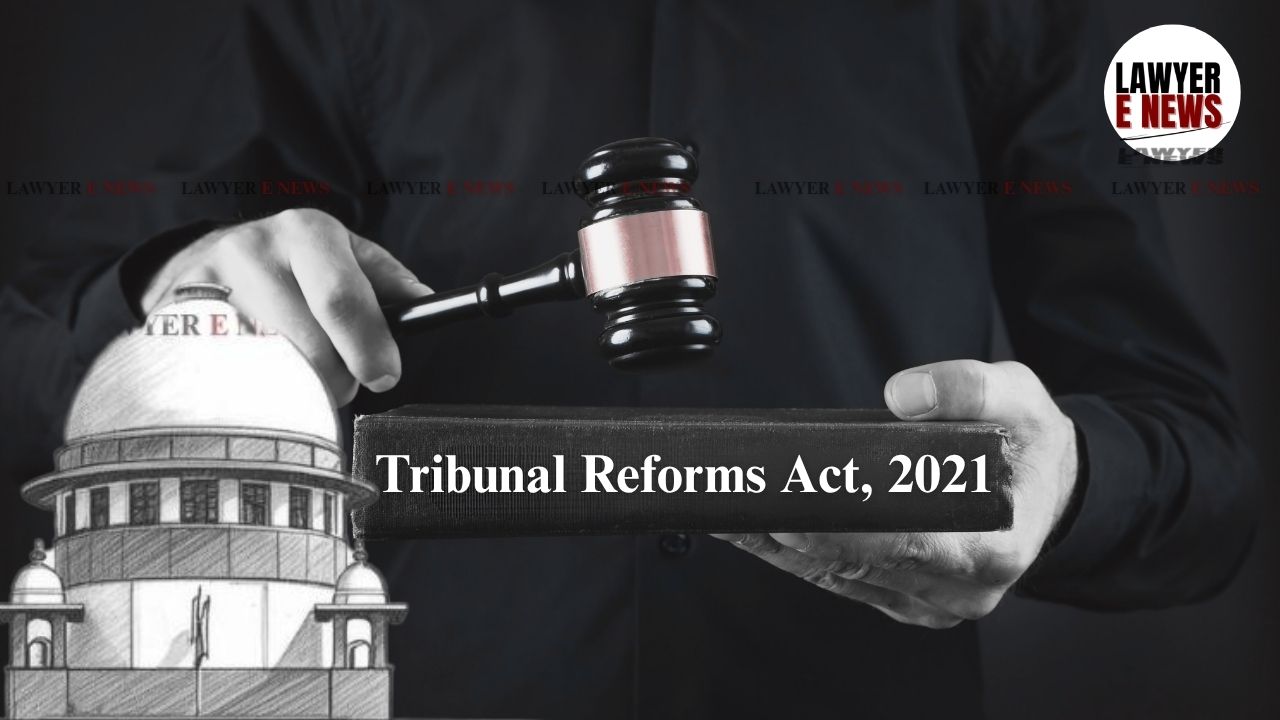
“Old Wine in a New Bottle Does Not Cure the Constitutional Defect”, On 19th November 2025, the Supreme Court of India, in a landmark constitutional verdict delivered in Madras Bar Association v. Union of India, held that the Tribunal Reforms Act, 2021 was unconstitutional to the extent it revived provisions already struck down in earlier judicial pronouncements. A Bench led by Chief Justice B.R. Gavai and Justice K. Vinod Chandran emphatically ruled that Parliament cannot enact in substance what the Court has previously declared invalid, without curing the identified defects.
Holding the impugned provisions as violative of Articles 14, 21 and the basic structure, the Court reiterated the binding force of precedent under Article 141, and strongly condemned the reintroduction of previously invalidated provisions on tribunal appointments and tenure.
“The Constitution Is What the Court Says It Is”: Reenactment Without Reform Is Legislative Defiance
The Court’s principal observation set the tone of its reasoning: “The law is what the Court says it is. The only way the legislature could nullify the said decision of this Court is by curing the defect... There is no such attempt made except to repeat the provision.”
The Supreme Court noted that the Tribunal Reforms Act, 2021 did not attempt to address or rectify the constitutional defects highlighted in Madras Bar Association (MBA) IV and MBA V, but instead repackaged the very same provisions under a new statutory banner.
It was observed that this “legislative resurrection” without any modification was a direct challenge to judicial authority and undermined the core of constitutional supremacy. The Court firmly held that such a tactic was not just impermissible, but also unconstitutional.
“A Legislature Cannot Do Indirectly What It Is Barred From Doing Directly”: Age Limit and Tenure Clauses Declared Invalid Again
One of the most contentious provisions of the 2021 Act was the minimum age requirement of 50 years for appointments to tribunals. The Court held that this clause, earlier struck down for being arbitrary and exclusionary, had been reinserted without justification.
Chief Justice Gavai observed that “The prescription of 50 years as a minimum eligibility criterion is without any rationale... It is discriminatory and arbitrary.” The provision was declared violative of Article 14, as it effectively excluded a large number of meritorious professionals, especially in specialist tribunals like taxation and technology.
On the four-year fixed tenure, the Court reiterated its earlier position in MBA IV that short tenures compromise judicial independence and create excessive executive influence. The Act’s insistence on this tenure limit, without reflecting on the Court’s earlier concerns, was declared unconstitutional yet again.
“Executive’s Discretion Cannot Trump Judicial Direction”: Search Committee and HRA Provisions Also Struck Down
Another major ground of challenge was the provision requiring the Search-cum-Selection Committee (SCSC) to recommend two names per vacancy to the executive, instead of one. This clause, the Court noted, had been previously invalidated in MBA IV, as it allowed the executive to exercise discretion over judicial appointments, thereby compromising the independence of tribunals.
Reintroducing the same clause, without any substantive change, was seen as a blatant attempt to “reassert executive control through the backdoor.” The Court ruled: “Such reenactment amounts to nullifying judicial directions, which is constitutionally impermissible.”
Further, the Court struck down provisions that tied tribunal members' House Rent Allowance (HRA) to civil servant standards, rather than judicial norms. It held that equating tribunal members to bureaucrats undermines the judicial character of their office.
“Old Wine in a New Bottle”: Tribunal Reforms Act is Nothing But a Cosmetic Facade
Justice Vinod Chandran in his concurring opinion delivered a sharp indictment of the legislative approach: “The Tribunal Reforms Act, 2021 is a replica of the struck down Ordinance; old wine in a new bottle, the wine whets not the judicial palette, but the bottle merely dazzles.”
The Court emphasized that a mere change in nomenclature or packaging cannot cure a previously declared unconstitutional provision. For the legislature to enact valid law post-judicial invalidation, it must address the defects identified by the Court — not circumvent them through cosmetic relabeling.
“Parliament Must Respect Constitutional Boundaries”: Supreme Court Asserts Judicial Independence as Part of Basic Structure
The Union of India had argued that Parliament is supreme in its legislative domain, and that judicial directions on policy or structure cannot bind legislative action. The Court rejected this argument emphatically, holding that judicial independence and separation of powers are not abstract ideals, but enforceable constitutional principles.
The judgment reaffirmed that judicial review, and the interpretation of the Constitution, is the exclusive domain of the judiciary. It is not open to Parliament to override final judicial decisions merely by legislating again in the same terms.
The Court relied on the doctrine laid down in Keshavananda Bharati and Minerva Mills, noting that "an attempt to override binding law by legislative fiat is itself unconstitutional."
Justice Ravindra Bhat’s earlier opinion in MBA V was quoted to reiterate: “Structural principles like judicial independence and separation of powers are not vague notions; they are deeply embedded in our constitutional architecture and must guide legislative action.”
Court Issues Directions to Ensure Tribunal Functioning Is Not Paralyzed
While striking down the impugned provisions of the 2021 Act, the Court ensured that the functioning of tribunals does not collapse in the interim. It held that all appointments made under interim orders, including in Kudrat Sandhu and related cases, shall remain valid.
The Court clarified that appointments of tribunal members made prior to the enactment of the 2021 Act shall be governed by the pre-existing law, and that those appointees will not be affected by the now-struck-down provisions.
It directed the Union Government to establish a National Tribunals Commission within four months, and until a constitutionally compliant law is enacted, the directions laid down in MBA IV and MBA V will continue to govern all tribunal-related appointments and service conditions.
“To Pervert the Constitution, You Need Not Amend It — Changing Its Working Is Enough”: A Warning Against Legislative Defiance
Quoting Dr. B.R. Ambedkar, the Court concluded with a powerful reminder: “It is perfectly possible to pervert the Constitution, without changing its form, by merely changing the form of administration.” The Bench underscored that true fidelity to the Constitution lies in respecting its spirit, not just its text.
This judgment stands as a ringing endorsement of judicial supremacy, and a firm rebuke to legislative attempts to dilute or bypass constitutional checks. The Court has reinforced that constitutional structure is not a negotiable terrain, and any act that violates the rule of law, even if done legislatively, will not withstand judicial scrutiny.
Date of Decision: 19 November 2025