-
by sayum
25 August 2026 9:55 AM







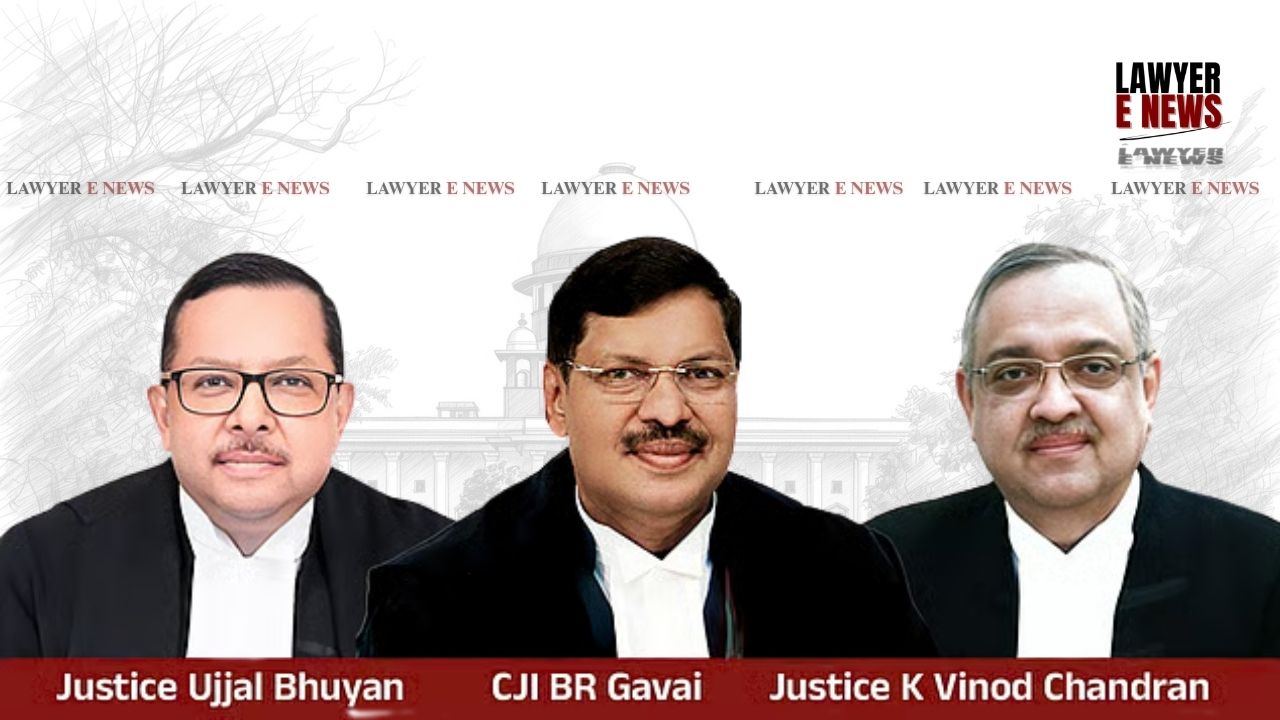
“Judicial discipline and judicial propriety have been breached. The subsequent coordinate Bench took a completely divergent view… and did not follow the binding precedent” – Justice Bhuyan . In its much-anticipated decision delivered on November 18, 2025, in the review petition Confederation of Real Estate Developers of India (CREDAI) v. Vanashakti & Anr., the Supreme Court not only reopened the issue of post-facto environmental clearances, but also ignited a deeper jurisprudential debate about judicial discipline and the binding nature of coordinate bench decisions.
Justice Ujjal Bhuyan, in a strongly worded dissenting opinion, denounced three earlier Supreme Court decisions—Electrosteel Steels Ltd., Pahwa Plastics, and D. Swamy—as having been rendered per incuriam, that is, in ignorance of binding precedent, and therefore not possessing the force of law.
“Later Decisions Ignored Binding Precedent And Are Per Incuriam”: Justice Bhuyan Invokes Doctrine To Deny Review
Justice Bhuyan categorically held that the Supreme Court’s decisions in Electrosteel, Pahwa Plastics, and D. Swamy failed to consider the binding rulings in Common Cause v. Union of India and Alembic Pharmaceuticals Ltd. v. Rohit Prajapati. According to him, this failure stripped the later rulings of precedential value.
He declared:
“There is no concept called ex post facto environmental clearance in environmental jurisprudence. It cannot be countenanced. It is an anathema… The latter judgments in Electrosteel, Pahwa and D. Swamy are clearly hit by the principle of per incuriam. A per incuriam judgment is not binding on a subsequent coordinate bench.”
Justice Bhuyan emphasized that judicial discipline requires coordinate benches to follow binding precedent, and if a departure is necessary, it must be done by referring the matter to a larger bench. In failing to do so, the later judgments, in his view, violated the doctrine of stare decisis, and their ratio could not be relied upon in the review petition.
“One Coordinate Bench Cannot Overrule Another”: Dissent Highlights Breakdown In Precedential Hierarchy
Justice Bhuyan pointed out that Common Cause and Alembic were not only earlier in time but also delivered after full consideration of environmental law under the Environment (Protection) Act, 1986 and the EIA Notifications of 1994 and 2006. These cases had laid down that prior environmental clearance was mandatory, and any attempt to regularize illegal projects post-facto was impermissible.
Yet, in Electrosteel and Pahwa, the Court allowed relaxation and permitted ex post facto ECs in certain cases involving economic hardship or public interest concerns—without even examining the binding nature of Common Cause and Alembic.
Justice Bhuyan underlined:
“A decision rendered per incuriam is not binding. The coordinate bench in Vanashakti rightly followed Common Cause and Alembic.”
He made it clear that binding precedent cannot be diluted through silence or omission, and the Court cannot let judicial indiscipline proliferate merely because administrative or economic convenience may be served.
Justice Chandran Counters: Later Decisions Aimed to Balance Principles, Not Overrule Them
Justice K. Vinod Chandran, who concurred with Chief Justice D.Y. Chandrachud in allowing the review, offered a nuanced rebuttal to Justice Bhuyan’s invocation of per incuriam. While acknowledging that the later judgments did not fully analyze Common Cause and Alembic, he argued that they did not expressly diverge from those decisions, but rather applied a balanced approach in light of the facts of each case.
He observed:
“Electrosteel, Pahwa & D. Swamy cannot per se be held to take a divergent view from Common Cause and Alembic… There was a possibility of reconciliation.”
Justice Chandran further noted that if indeed there was a conflict between two lines of coordinate bench decisions, a reference to a larger bench should have been made, which was not done in Vanashakti. He invoked the ruling in National Insurance Co. Ltd. v. Pranay Sethi to argue that judicial coherence must be maintained, but not at the cost of practical justice.
“Per Incuriam Cannot Justify Avoidance Of Review”: Majority Reopens Matter, Leaves Precedential Conflict For Full Hearing
The majority opinion, though not elaborated in detail by the Chief Justice, implicitly accepted that the precedential landscape was unclear, and that the Vanashakti judgment did not adequately consider Electrosteel, Pahwa, or D. Swamy. As such, it held that a review was warranted, not because those judgments were necessarily correct, but because they had not been addressed—a procedural lapse meriting correction.
Justice Chandran emphasized that denying review on the ground that certain judgments were per incuriam, without even mentioning or engaging with them, would be an error:
“It is one thing to find Electrosteel, Pahwa and D. Swamy per incuriam in the original proceeding, which would have restrained a review on that ground; but quite another to reject the prayer for review on the ground that though not noticed or referred to, those decisions are per incuriam.”
Thus, the majority allowed the review and restored the original proceedings, leaving the task of reconciling or referring conflicting precedents to a regular bench.
“Doctrine of Precedent Is Not Merely A Ritual – It Is A Pillar Of Rule Of Law”: Judgment Signals Judicial Introspection
The split verdict has triggered intense judicial introspection about the integrity of the precedent system in Indian constitutional law. Justice Bhuyan’s insistence on adherence to the ratio in Common Cause and Alembic reflects a classical view of judicial hierarchy, while Justice Chandran’s reasoning leans toward flexibility in adjudication where competing public interests are at stake.
The case now reopens not only the validity of the ex post facto EC regime, but also demands clarity from the Supreme Court on how conflicting decisions from coordinate benches should be handled, and whether exceptions granted under Article 142 dilute or affirm legal doctrines.
Review Allowed, Precedent Unresolved, Larger Bench Likely
The Supreme Court’s November 18, 2025 decision leaves open the critical legal question—can the government permit environmental violations to be cured post-facto, and under what conditions, if at all?
As the writ petitions and appeals stand restored, all eyes will now be on the regular bench that will have to confront not only the constitutional validity of the 2017 Notification and 2021 OM, but also resolve the judicial conflict among decisions of equal strength—possibly paving the way for a reference to a Constitution Bench.
Date of Decision: November 18, 2025