-
by sayum
05 August 2026 6:43 AM







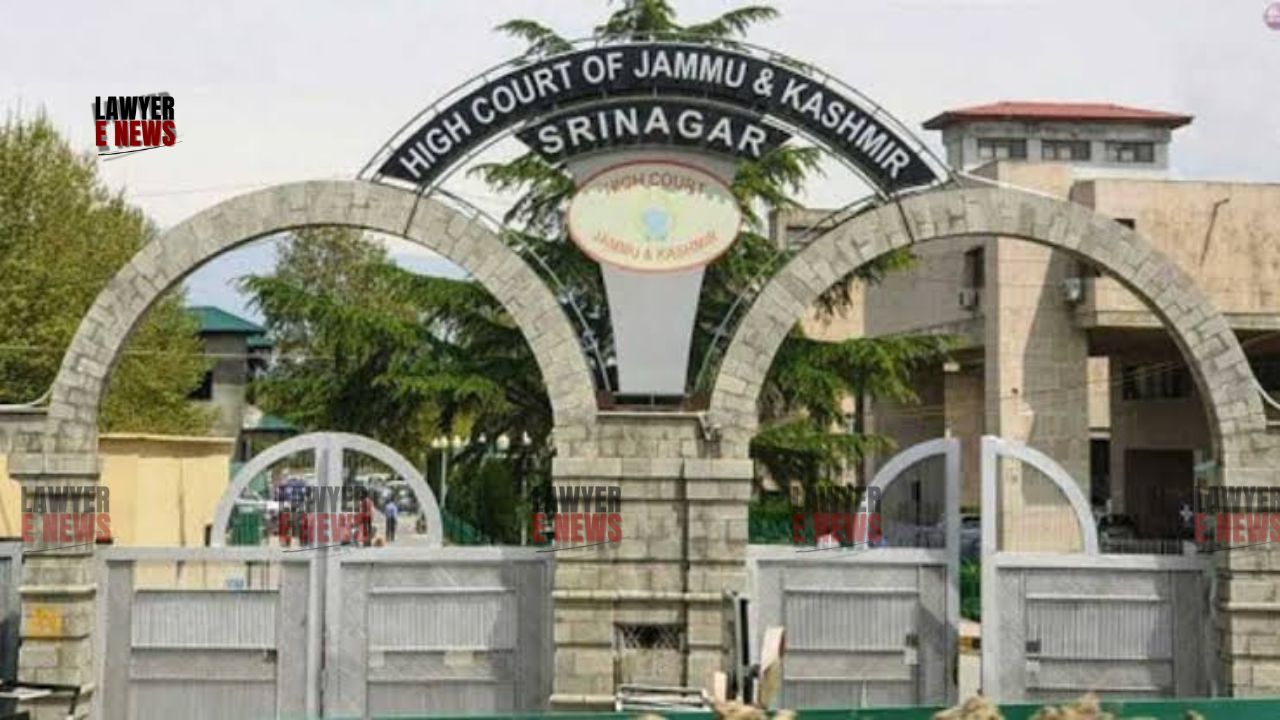
“He Cited Domestic Problems, Not Militant Threat—Resignation Was Voluntary and Accepted Lawfully”, In a firm reiteration of administrative finality and the sanctity of voluntary resignations, the High Court of Jammu & Kashmir and Ladakh at Srinagar dismissed a writ petition filed by a former Constable of J&K Police who sought reinstatement after claiming that his 2018 resignation was coerced by militants. Division Bench comprising Justices Sanjeev Kumar and Vinod Chatterji Koul held that the petitioner’s claim of coercion was “an afterthought” unsupported by any contemporaneous evidence.
The Court observed, “The story projected by the petitioner that he and his family were under threat from the militants to resign is an afterthought and concocted after the acceptance of the resignation.”
Bilal Ahmad Yatoo was appointed as a Constable in the J&K Police in 2016 and posted to STC Talwara for training. During training, he absented himself twice and was awarded ‘censure’ as a minor punishment. After completing training, instead of reporting for regular duties, he sought earned leave—only part of which was sanctioned. Within two months of active duty, Yatoo submitted his resignation on July 11, 2018, citing domestic issues in a supporting affidavit.
The resignation was accepted by the Commandant on the same day. Years later, Yatoo approached the Central Administrative Tribunal, Srinagar Bench, seeking to set aside his resignation, claiming it was made under militant coercion. The Tribunal dismissed his plea as meritless, and Yatoo challenged the Tribunal’s decision before the High Court.
The petitioner’s primary contentions were twofold: that the resignation was coerced by militants and not voluntary; and that the resignation should have been treated as a mere “intention to resign” under Section 10 of the Police Act, 1983, requiring a two-month notice period.
The Court found both arguments unconvincing. “We could not find any document, communication or representation on record made by the petitioner prior to submission of the resignation which would indicate that the petitioner had informed his superiors about the threat which he and his family members were facing from the militants,” the Bench noted.
On the second contention, the Court cited Section 10 of the Act but clarified that the law does not bar immediate acceptance if the competent authority so decides. “Nothing prevents the Superintendent to accept resignation forthwith,” the Bench ruled.
Rejecting the petitioner’s attempt to use Section 10 as a procedural safeguard, the Court emphasized:
“There was no requirement of treating his resignation as his ‘intention to resign’ and wait for two months period to expire before its acceptance.”
Calling the writ petition devoid of merit, the Court upheld both the acceptance of resignation and the Tribunal’s decision. It observed that Yatoo’s record showed little dedication to duty, with repeated absenteeism and a short stint before resignation. “It seems that the petitioner was never interested to serve as Constable in the J&K Police,” the Court remarked.
This judgment underlines that resignation backed by affidavit and accepted without protest cannot later be withdrawn on vague and belated claims. Courts will not entertain speculative defenses unsupported by evidence, especially when public service and security institutions are involved.
Date of Decision: May 9, 2025