-
by sayum
28 August 2026 2:11 PM








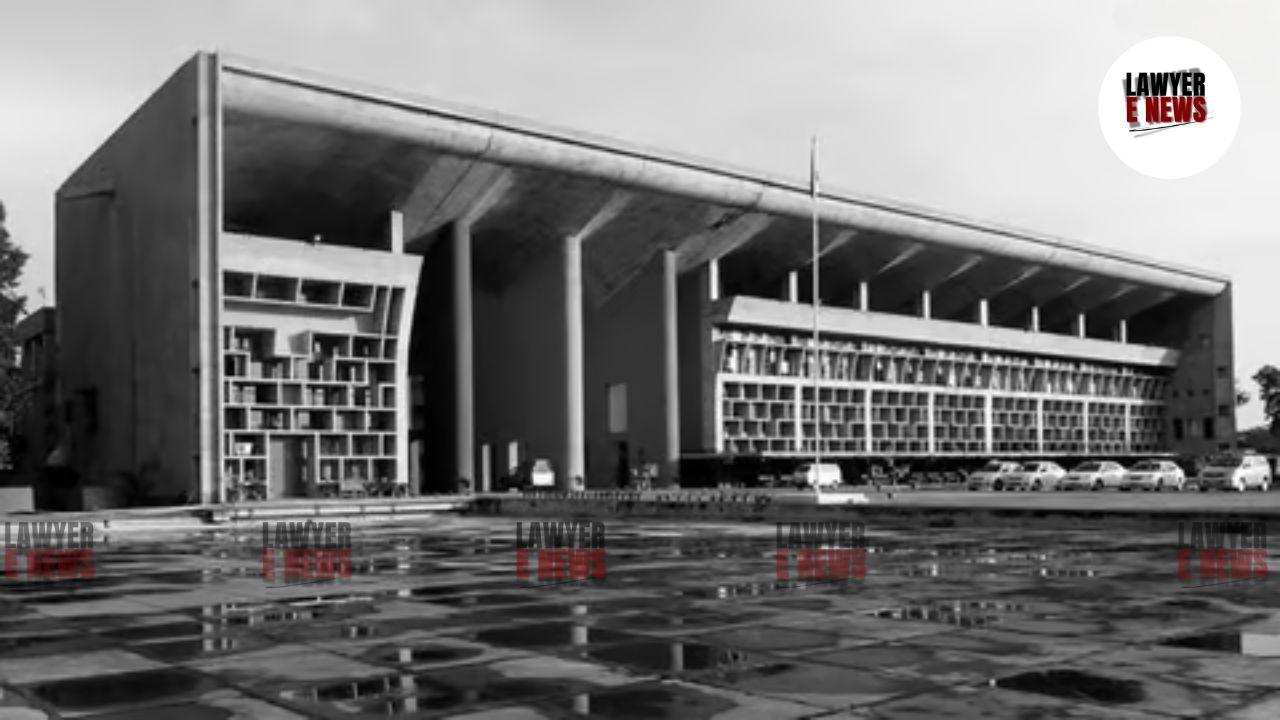
Punjab and Haryana High Court, in a judgment, has held that once an accused admits their signature on a cheque, the statutory presumption under Section 139 of the Negotiable Instruments Act regarding the existence of a legally enforceable debt is automatically triggered.
A bench of Justice Sumeet Goel observed that in the absence of any jurisdictional error or patent perversity, a Revisional Court cannot act as an appellate court to re-appreciate evidence and upset concurrent findings of conviction.
The court dismissed a revision petition filed by a man convicted in a cheque bounce case, emphasizing that a "naive argument" questioning the necessity of issuing a cheque does not discharge the burden of proof placed on the accused. The bench noted that the petitioner failed to lead any cogent evidence to substantiate his plea that the cheque was merely a blank security document.
The matter originated from a complaint filed by one respondent No. 2, alleging that the petitioner, Narender Kumar, had borrowed a total of ₹3,70,000 in two installments during 2015-16 for his wife’s delivery and child’s medical treatment. To discharge this liability, the petitioner issued a cheque which was subsequently dishonoured with the remarks "Funds Insufficient."
Following the dishonour and failure to pay despite a legal notice, the Judicial Magistrate First Class, Sirsa, convicted the petitioner under Section 138 of the NI Act on July 25, 2022. This conviction and the resulting sentence were upheld by the Additional Sessions Judge, Sirsa, on March 10, 2025, leading to the present revision petition before the High Court.
The primary question before the court was whether the petitioner had successfully rebutted the statutory presumption under Section 139 of the NI Act after admitting his signatures on the cheque. The court also examined the scope of its interference under revisional jurisdiction against concurrent findings of conviction by the trial and appellate courts.
Admission Of Signatures Attracts Section 139 Presumption
The court noted that the petitioner did not dispute his signatures on the cheque or the written agreement (Ex.C-3) acknowledging the debt. The bench observed that under Section 139 of the Negotiable Instruments Act, a legal presumption exists in favour of the holder of the cheque that the same was issued in discharge of a legal liability.
The court held that once the signature is admitted, the burden shifts entirely to the petitioner to prove that the cheque was issued without any legal liability. It remarked that instead of asking the court to question the complainant’s version, it was for the accused to explain the circumstances under which the cheque was issued.
"Accused must lead cogent evidence to substantiate the plea that a cheque was issued only for security purposes."
Validity Of Blank Signed Cheques
Addressing the petitioner's contention that he had only handed over a blank signed cheque which was later misused, the court relied on the Supreme Court precedent in Bir Singh v. Mukesh Kumar (2019). The bench reiterated that if a cheque is voluntarily signed and handed over to a payee, the payee is authorized to fill in the amount and other particulars.
Such an act does not invalidate the cheque, and the onus remains on the accused to prove through evidence that the document was not intended to discharge a debt. The court found that the petitioner’s claim of the cheque being a security document was a "bald and vague plea" unsupported by any evidence.
"A blank signed cheque voluntarily handed over towards payment allows the payee to fill particulars and does not invalidate the instrument."
Rejection Of Settlement Claims Based On Cross-Examination
The petitioner had argued that the matter was settled for a reduced amount of ₹1,00,000, citing the cross-examination of the complainant’s lawyer (CW-2). However, the High Court concurred with the lower courts in rejecting this argument. It noted that CW-2 was only examined to prove the issuance of the statutory legal notice.
The bench observed that an advocate's statement regarding a settlement in cross-examination cannot be relied upon when he had not mentioned it in his examination-in-chief and when no such suggestion was put to the complainant (CW-3) himself. The court termed the petitioner’s reliance on this testimony as "much ado about nothing."
Limited Scope Of Revisional Jurisdiction
The court emphasized the restrictive nature of revisional powers, citing the Supreme Court’s ruling in Sanjabij Tari v. Kishore S. Borcar (2025). It held that the High Court should not upset concurrent factual findings unless there is a manifest illegality or a gross miscarriage of justice.
Justice Goel noted that the petitioner failed to point out any jurisdictional error or perversity in the findings returned by the courts below. The court stated that it is not the role of the Revisional Court to re-analyse evidence that has already been appraised by two lower courts.
"High Court does not, in the absence of perversity, upset concurrent factual findings or re-interpret evidence on record."
The High Court concluded that the petitioner miserably failed to raise any probable defence to rebut the statutory presumption. Finding no merit in the challenge, the court dismissed the revision petition and affirmed the judgments of conviction and the orders of sentence passed by the Sirsa courts.
Date of Decision: May 25, 2026