-
by sayum
24 August 2026 3:22 PM







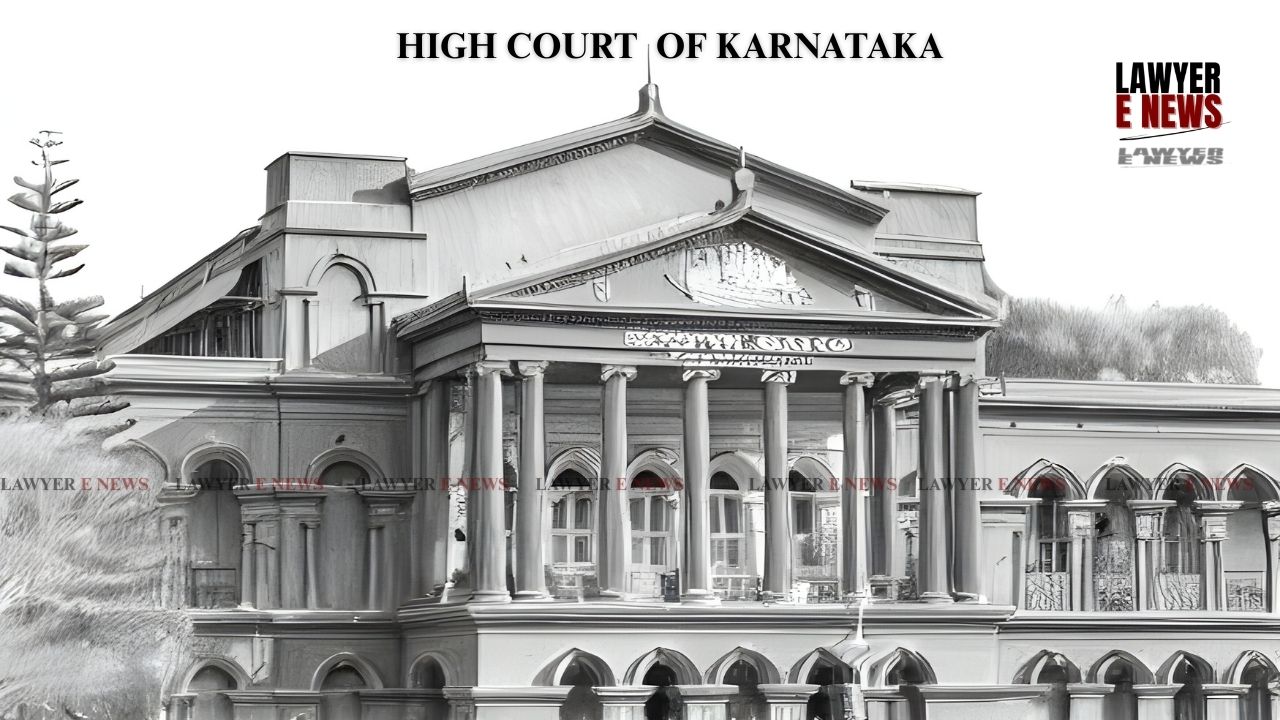
"Notwithstanding the pendency of conciliation proceedings, an aggrieved party can approach the Industrial Tribunal for limited relief where the opposite party proposes to commence or continue a strike or lock-out in violation of the statutory prohibition contained in Section 62 of the Code, 2020." Karnataka High Court, in a significant ruling, held that an industrial establishment cannot maintain a writ petition against a recognized workers' trade union to restrain an allegedly illegal strike, as the union does not discharge public duties.
A bench of Justice Anant Ramanath Hegde observed that employers instead have a statutory remedy to directly approach the Industrial Tribunal under the Industrial Relations Code, 2020, to enforce the strict prohibition against strikes during the pendency of conciliation proceedings.
The petitioner, Bosch Automotive Electronics India Pvt Ltd, approached the High Court challenging a strike notice issued by the respondent workers' union on February 23, 2026. The union intended to commence a strike from March 9, 2026, over a charter of demands, despite the commencement and pendency of conciliation proceedings before the Conciliation Officer. The company filed the present writ petition contending that the proposed strike was strictly prohibited under Section 62(1)(d) of the Industrial Relations Code, 2020, and sought an injunction against the union.
The primary question before the court was whether a writ petition is maintainable against a workers' union to restrain a strike during pending conciliation proceedings. The court was also called upon to determine whether an aggrieved party can approach the Industrial Tribunal under the Industrial Relations Code, 2020, to challenge the legality of a proposed strike while conciliation is still pending.
Trade Union Does Not Discharge Public Duties
The court first examined whether a writ petition could be issued against a private trade union. Relying on Supreme Court precedents, particularly S. Shobha vs. Muthoot Finance Ltd., the bench noted that a writ under Article 226 is maintainable against a private body only if it discharges a public duty or public function. The court observed that a trade union, despite being registered and recognized under the Code, 2020, does not fall within the definition of 'State' or an instrumentality of the State under Article 12 of the Constitution.
Statutory Obligations Not Equated With Public Duty
Addressing the company's argument that the union was bound by statutory duties under the Code, the court clarified that mere statutory obligations governing strikes do not transform into public functions. The bench noted that the union is neither a statutory authority nor a body substantially funded by the State, and therefore cannot be subjected to extraordinary writ jurisdiction for merely calling a strike.
"Despite its registration and recognition, a workers’ Union or Trade Unions and Negotiating Unions or Negotiating Councils do not partake the character of an instrumentality of the State."
Bar On Civil Court Jurisdiction Under IR Code
Having established that the writ petition was not maintainable, the court analyzed the alternative statutory remedies available to the employer. The bench examined Section 97 of the Industrial Relations Code, 2020, which explicitly bars the jurisdiction of civil courts in respect of matters covered by the Code and prohibits them from granting injunctions. Consequently, the employer could not approach a civil court to restrain the proposed strike governed by the provisions of the new Code.
Tribunal's Jurisdiction During Pending Conciliation
The court then delved into a crucial interpretation of Sections 44, 53, and 62 of the IR Code. The employer had argued that Section 53(6) postpones the adjudication of industrial disputes by the Tribunal until conciliation fails, supposedly leaving them remediless if a strike is called during its pendency. The court rejected this absolute interpretation, drawing a sharp distinction between the substantive industrial dispute and the specific issue of an illegal strike.
Limited Adjudicatory Power Over Illegal Strikes
Justice Hegde emphasised that Section 44(7)(c) of the Code expressly places the "illegality or otherwise of a strike or lockout" within the jurisdiction of the Industrial Tribunal. The bench reasoned that while the Tribunal cannot adjudicate the underlying merits of the dispute during conciliation, it possesses a limited, specialised jurisdiction to enforce the statutory prohibition against strikes mandated by Section 62(1)(d).
"A specialised Industrial Tribunal, upon which the Code expressly confers jurisdiction to adjudicate the illegality or otherwise of strikes and lock-outs, cannot be held to be powerless to grant appropriate relief for enforcement of the statutory prohibition merely because conciliation proceedings concerning the underlying industrial dispute have not formally concluded."
Harmonious Construction Of Statutory Rights
The court held that reading Section 53(6) as a complete bar to the Tribunal's intervention would create an unintended legislative vacuum, rendering the strict prohibitions in Section 62 meaningless. The Tribunal, the bench explained, can intervene merely to ascertain whether there is a proposed or continuing strike during the pendency of conciliation proceedings and pass appropriate protective orders without touching the substantive dispute.
Jurisdiction Co-extensive With Statutory Prohibition
The court clarified that this limited jurisdiction of the Tribunal is only available during the specific period of prohibition contemplated under the Code. Any protective order passed by the Tribunal would operate only to the extent necessary to give effect to the prohibition continuing for seven days after the conclusion of conciliation proceedings, and not beyond that statutory limit.
Existing Labour Courts Can Exercise Jurisdiction
Addressing concerns about the non-constitution of new Tribunals under the 2020 Code, the court referred to the amended Section 104. The bench noted that to avoid a vacuum in the adjudication process, existing Labour Courts and Industrial Tribunals constituted under the Industrial Disputes Act, 1947, retain jurisdiction to entertain disputes arising under the new Code until the new statutory Tribunals are properly constituted.
The High Court dismissed the writ petition as not maintainable. However, the court granted liberty to the petitioner-company to approach the competent Industrial Tribunal under the Industrial Relations Code, 2020, to seek relief regarding the alleged violation of Section 62(1)(d), provided the statutory prohibition against the strike remains operative.
Date of Decision: 24 July 2026