
-
by sayum
19 August 2026 9:34 AM







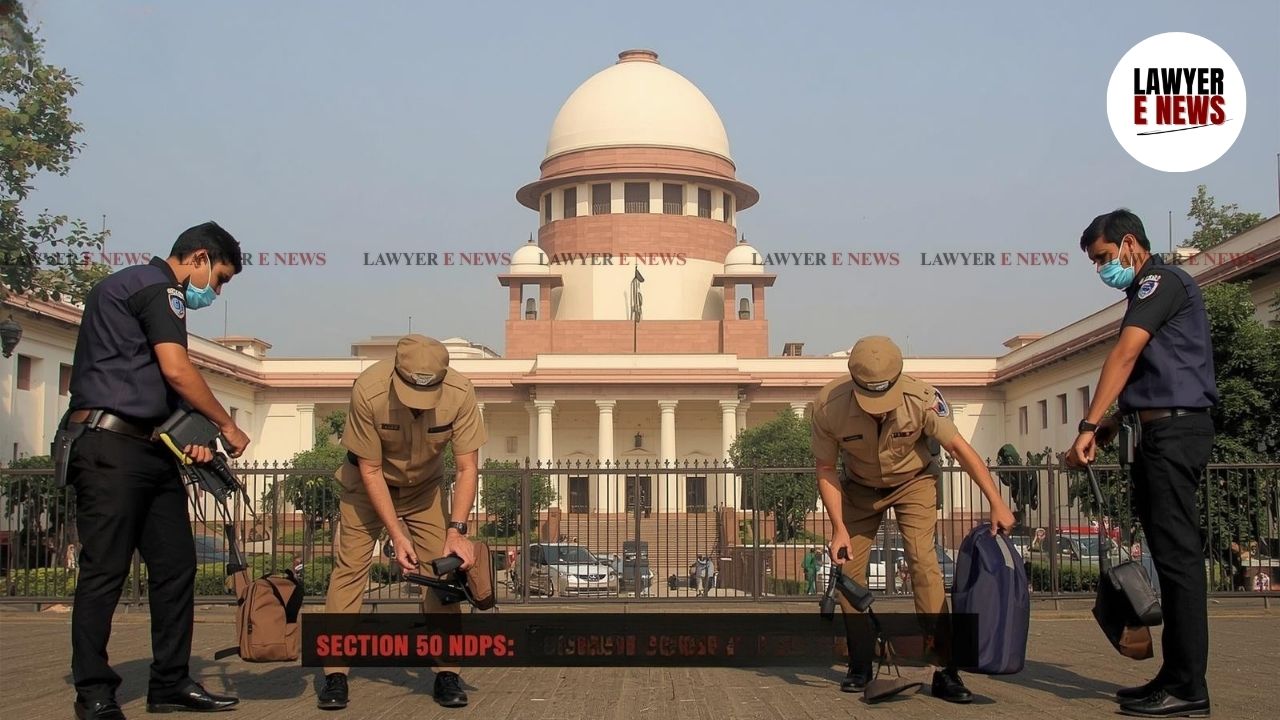
"If The Bag Carried By A Person Is Searched And His Person Is Also Searched, Section 50 Of The NDPS Act Will Have Application — There Is No Escape From This Mandate", In a ruling that draws a precise and enforceable line for investigating agencies operating under the Narcotic Drugs and Psychotropic Substances Act, 1985, the Supreme Court on March 16, 2026, upheld the acquittal of an accused charged with possession of 11 kg 50 grams of charas, firmly holding that once police conduct both a bag search and a personal search of a suspect, the mandatory protections of Section 50 are fully triggered — and any departure from its strict requirements renders the entire recovery legally unsustainable.
Justice Pankaj Mithal and Justice Prasanna B. Varale dismissed the State of Himachal Pradesh's appeal, finding that the prosecution had itself established through its own records that both searches had been conducted, leaving no room to escape the rigours of Section 50.
Does Section 50 Apply to Bag Searches or Only to Personal Searches?
The State's principal argument before the Supreme Court was that Section 50 of the NDPS Act is attracted only when a personal search of the accused is conducted and has no application where the contraband is recovered from a bag being carried by the accused. Since the charas was found in the bag and not on the person of Surat Singh directly, the State contended that the Section 50 safeguards were irrelevant and the recovery should be treated as a valid chance recovery unaffected by any procedural infirmity.
This argument, though frequently raised by prosecuting agencies, found no favour with the Court.
Scope of Section 50
The bench relied squarely on the authoritative pronouncement in State of Rajasthan v. Parmanand (2014) 5 SCC 345, where the Supreme Court had settled the precise contours of Section 50's applicability with clarity that admits of no ambiguity. The rule that emerged from that judgment is straightforward and binary in its operation.
"If merely a bag carried by a person is searched without there being any search of his person, Section 50 of the NDPS Act will have no application. But if the bag carried by him is searched and his person is also searched, Section 50 of the NDPS Act will have application."
The Court applied this test to the facts of the present case and found that the prosecution's own documents sealed the matter against it. The consent memo and the personal search memo — both exhibits produced by the prosecution — unambiguously established that the Investigating Officer had conducted not merely a bag search but also a personal search of Surat Singh. The dual nature of the search was not disputed. The moment both searches were carried out simultaneously, Section 50 became fully and mandatorily operative.
Why The Distinction Matters: The Purpose Behind Section 50
The Court's insistence on this distinction is rooted in the extraordinary severity of the NDPS Act's penal consequences. A conviction for possession of a commercial quantity of charas under Section 20 carries a minimum sentence of ten years' rigorous imprisonment. Given the magnitude of the punishment, the legislature deliberately embedded procedural safeguards into the Act to ensure that no person is convicted on the basis of a search conducted without being made aware of his legal rights.
Section 50 confers upon every person subjected to search under the NDPS Act the right to demand that the search be conducted in the presence of a Gazetted Officer or a Magistrate — independent authorities whose presence acts as a check against planted evidence and false implication. This right is meaningless if it is communicated incorrectly, incompletely, or accompanied by a third option that the law does not sanction.
In the present case, the Investigating Officer had offered Surat Singh three choices: search before a Magistrate, search before a Gazetted Officer, or search by the Investigating Officer himself in the presence of witnesses. The third option does not exist in Section 50. Its introduction into the consent memo did not merely dilute the accused's informed consent — it destroyed it entirely.
"The accused has to be apprised of his legal right to be searched either before the Gazetted Officer or before the Magistrate. There is no third option to be searched before the Police Officer. The consent obtained from the accused was not in conformity with Section 50 of the Act and has vitiated the entire trial."
On Substantial Compliance: Firmly Rejected
The State implicitly urged that even if the procedure was not perfectly followed, the recovery was genuine and the conviction ought to be sustained. The Court rejected any resort to the doctrine of substantial compliance in the context of Section 50, reiterating the position settled by the Constitution Bench in Vijaysinh Chandubha Jadeja and affirmed in Suresh v. State of Madhya Pradesh (2013): "The concept of substantial compliance is not acceptable. Compliance with Section 50(1) is mandatory and requires strict observance. Failure to comply with the provision would render the recovery of the illicit article suspect and vitiate the conviction."
The Court emphasised that this is not a technicality that can be waived or cured by subsequent evidence. It goes to the very root of the prosecution's case. Where the search is vitiated, the recovery built upon it is vitiated, and no presumption under Section 54 of the NDPS Act — which shifts the burden of proof onto the accused — can be raised on the foundation of a legally invalid recovery.
Decision
The Supreme Court's ruling on this point is of direct and practical importance for every NDPS prosecution across the country. It lays down an unambiguous operational rule for police officers: the moment you search both the bag and the body of a suspect, Section 50 applies in full force. There is no middle path, no hybrid procedure, and no third option that can be inserted into a consent memo to make an otherwise non-compliant search appear lawful. Investigating officers who wish to ensure that their recoveries withstand judicial scrutiny must strictly follow the two-option mandate of Section 50 — and any deviation, however minor it may appear at the time of search, carries the consequence of the entire trial being set at naught.
Date of Decision: March 16, 2026