-
by sayum
24 August 2026 3:22 PM








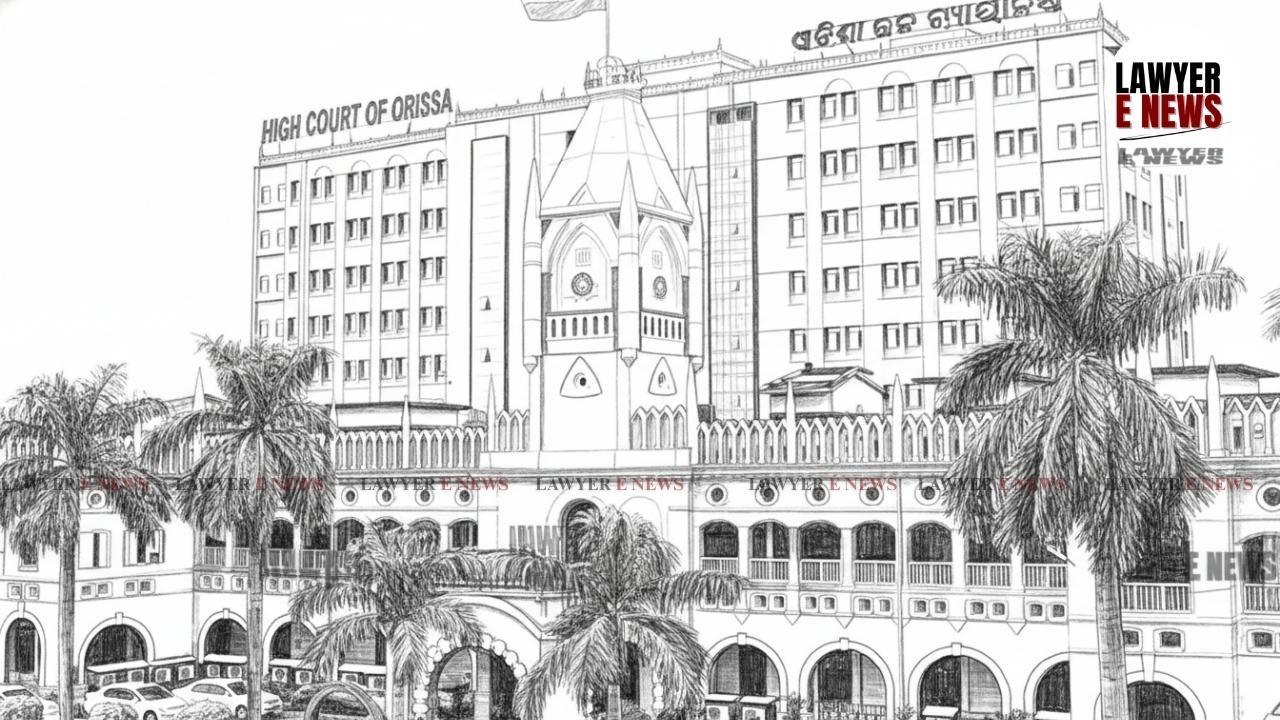
Orissa High Court, in a significant ruling dated July 15, 2026, held that a vehicle seized for alleged transportation of cattle in violation of the Prevention of Cruelty to Animals Act, 1960 cannot be left to decay in open police spaces, and should be released provisionally if the owner can prima facie establish identity through registration and insurance documents.
A single-judge bench of Justice V. Narasingh observed that keeping vehicles exposed to weather elements serves no judicial purpose when safeguards can be implemented.
The petitioner approached the High Court challenging an order dated May 19, 2026, passed by the Gram Nyayadhikari-cum-Judicial Magistrate First Class, Bisra. The lower court had rejected the petitioner's application under Section 503 of the Bharatiya Nagarik Suraksha Sanhita, 2023 (BNSS) for the interim release of his seized vehicle. The vehicle had been impounded by local police on allegations of transporting seven bullocks in violation of cruelty laws.
The primary question before the High Court was whether the interim release of the vehicle could be denied solely on the ground that its Engine and Chassis numbers could not be clearly verified on-site by the transport authorities. The court was also called upon to determine the appropriate terms and conditions, including security deposits and animal maintenance costs, for the release of the vehicle under the Prevention of Cruelty to Animals (Care and Maintenance of Case Property Animals) Rules, 2017.
Prima Facie Ownership Can Be Proved Through Insurance And Registration Documents
The State had opposed the release of the vehicle, citing a report from the Junior Motor Vehicle Inspector which stated that the Engine and Chassis numbers could not be clearly ascertained, making verification on the VAHAN portal impossible. Refuting this, the petitioner relied on the registration certificate, insurance policy, and a police report showing a QR code and sticker on the vehicle corresponding to its registration number.
Justice V. Narasingh found merit in the petitioner’s arguments, stating that the petitioner had successfully established the identity of the vehicle on a prima facie basis. The bench took note of the insurance policy, which showed an Insured Declared Value of Rs. 8,65,431, alongside the registration documents.
Vehicles Should Not Be Kept Idling In Police Stations To Rot
Relying on the landmark Supreme Court decision in Sunderbhai Ambalal Desai v. State of Gujarat and the High Court's ruling in Ashis Ranjan Mohanty v. State of Odisha, the Court reiterated that interim release applications must not be rejected mechanically.
The Court emphasized that keeping the vehicle in police custody indefinitely serves no practical purpose and only results in its physical deterioration.
"...no useful purpose would be served in exposing the vehicle to the vagaries of nature and it is directed that the Petitioner on furnishing unencumbered property security to the tune of Rs.5,00,000/- (Rupees Five Lakh) and in the light of the provisions as contained in the Rules, 2017, on his depositing a sum of Rs.1,00,000/- (Rupees One Lakh), the vehicle in question shall be released."
Vehicle Owner Liable For Maintenance Cost Of Seized Animals Under 2017 Rules
Addressing the care of the rescued animals, the Court analyzed Rule 5 of the Prevention of Cruelty to Animals (Care and Maintenance of Case Property Animals) Rules, 2017. The State submitted that seven bullocks were handed over to a social worker for interim safe-keeping, incurring an expenditure of Rs. 2,97,000 for their maintenance.
The Court rounded off the animal welfare expenditure to Rs. 3,00,000 and held the petitioner liable for 50 percent of the total cost, amounting to Rs. 1,50,000. It ordered the petitioner to deposit Rs. 1,00,000 upfront, with the remaining Rs. 50,000 to be paid in five monthly instalments of Rs. 10,000 each.
District Legal Services Authority To Monitor Welfare Of Rescued Cattle
To ensure the ongoing welfare and proper identification of the rescued cattle, the Court directed the concerned District Legal Services Authority (DLSA) to conduct periodic visits.
The DLSA must visit the facility where the animals are kept at least once a month and submit a report to the trial court regarding their well-being. The Court warned that any violation of the 2017 Rules would trigger immediate corrective measures and prosecution.
The High Court set aside the lower court's order and allowed the criminal revision petition, directing the release of the vehicle subject to the specified financial and security conditions. This ruling reinforces the principle that judicial custody of vehicles should be avoided to prevent asset depreciation, while balancing animal welfare costs.
Date of Decision: 15 July 2026