-
by sayum
26 August 2026 6:42 AM







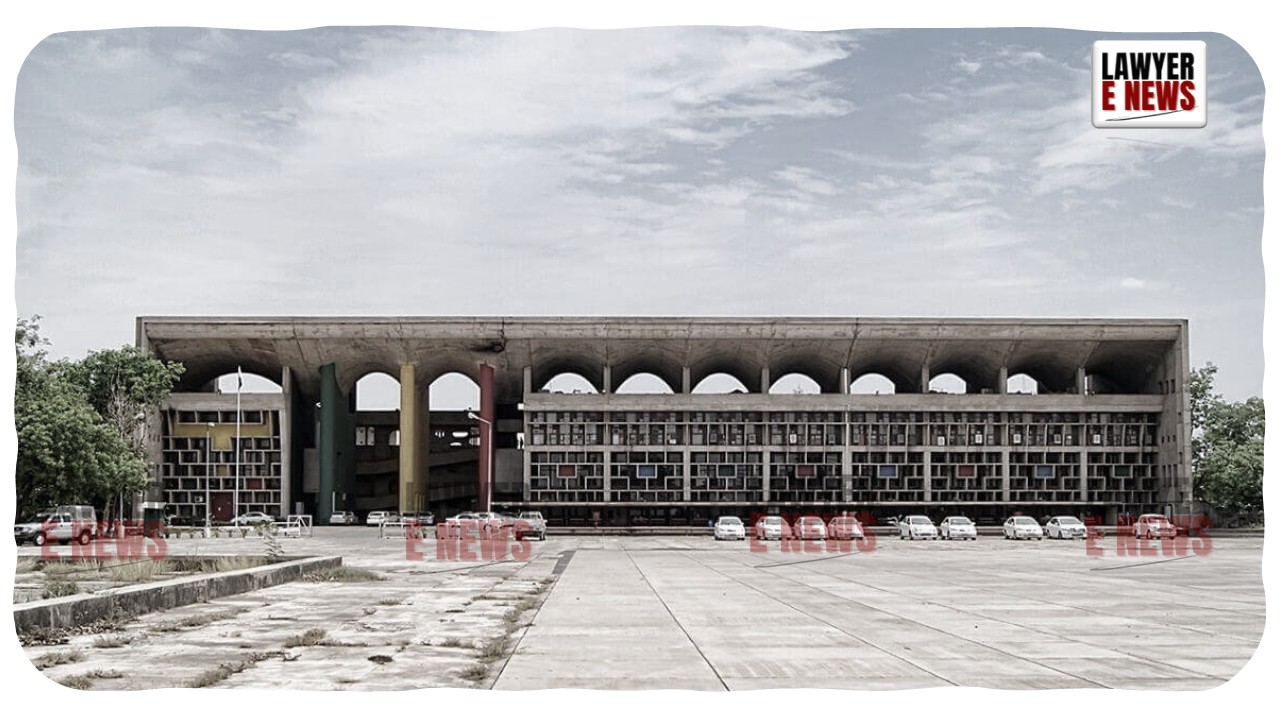
“Agreement conferred valuable immovable rights and imposed ₹20,000 penalty clause — registration was mandatory under Section 17(1)(b) of Registration Act” –In a significant ruling that clarifies the interplay between easementary rights and registration requirements under Indian property law, the Punjab and Haryana High Court dismissed a second appeal filed by a landowner who sought a mandatory injunction and ₹40,000 in damages based on an unregistered agreement for a right of way.
Justice Harkesh Manuja held that the agreement, dated 13.03.1988, created and extinguished valuable rights in immovable property, and since it included a ₹20,000 compensation clause, its value crossed the statutory threshold under Section 17(1)(b) of the Registration Act, 1908 — making registration compulsory. The unregistered document was therefore inadmissible in evidence, and no rights could be enforced under it.
“Creation of right of way with quantifiable value triggers registration requirement”
The appellant, Mohinder Singh, had approached the courts seeking a mandatory injunction directing the removal of alleged encroachments over a passage (rasta) marked in a site plan attached to an unregistered agreement signed between himself, co-plaintiff Iqbal Singh, and respondent Jaswant Kaur.
However, both the trial court (07.04.2005) and the first appellate court (30.10.2007) held that the agreement was inadmissible due to non-registration, and further found that it had never been acted upon. The High Court affirmed both findings, stating:“The agreement dated 13.03.1988 (Ex. P1) conferred mutual rights of passage over immovable land, and imposed a ₹20,000 compensation clause in case of breach. Therefore, it created rights of measurable value in immovable property, satisfying both conditions under Section 17(1)(b) of the Act.”
Citing Mithilesh Kumar v. Manohar Lal, (1996) 4 SCC 251, the Court emphasized that both creation/extinguishment of rights and valuation over ₹100 are required for compulsory registration. The ₹20,000 compensation clause served as a valuation indicator.
“Right of way is immovable property under Section 2(6); enforceable only via registered document”
Referring to Shree Chand v. Civil Judge (Sr. Div.), AIR 2016 Raj 191, the Court held:
“Right of way is included in the definition of ‘immovable property’ under Section 2(6) of the Registration Act. A document that creates or limits such rights is compulsorily registrable.”
Rejecting the appellant's reliance on Varghese Paul v. Narayanan Nair (Kerala HC), the Court distinguished the facts, noting that in the present case, compensation for breach was quantified, making the value of the right enforceable and measurable, unlike in cases where easement rights are indefinite or incapable of valuation.
“Suit was within limitation — but failed on merits due to lack of enforceable rights”
While the lower courts had dismissed the suit as barred by limitation, the High Court corrected that error. Citing Estate Officer, HUDA v. Nirmala Devi, 2025 INSC 843, the Court clarified:
“A suit for mandatory injunction falls under Article 113 of the Limitation Act — the residuary provision — with a limitation period of 3 years from the accrual of cause.”
Since the alleged encroachment occurred in 2001 and the suit was filed in April 2001, it was filed within limitation. However, this did not salvage the suit, as the agreement forming the basis of the claim was inadmissible.
“Revenue entries not conclusive proof of right — conduct of parties undermined claim”
The appellant argued that jamabandi and khasra girdawari entries supported the existence of a rasta, but the Court found these insufficient, especially in light of:
Inaction against co-party Iqbal Singh, who had allegedly blocked the path by 1992.
No application for mutation, no tatima, and no formal steps taken to act on the agreement.
Admissions in cross-examination that the agreement was never presented to revenue authorities.
“Even if revenue entries create a rebuttable presumption of truth, in the absence of any follow-up action or enforcement steps, such presumption stands rebutted,” the Court observed.
Furthermore, the co-plaintiff Iqbal Singh had withdrawn from the suit, and had allegedly planted trees on the disputed path. The Court saw this as a clear indication that the parties themselves had not acted in furtherance of the agreement.
“High Court can reappreciate evidence under Punjab Courts Act where findings are perverse — but not warranted here”
Noting that second appeals in Punjab, Haryana, and Chandigarh are governed by Section 41 of the Punjab Courts Act, 1918, not Section 100 CPC, the Court acknowledged it could re-examine facts if the findings are perverse or based on misreading of evidence.
“However, the findings in this case are supported by the record and not perverse. There is no reason to interfere,” Justice Manuja held.
Suit Not Barred by Limitation — But Fails Due to Unregistered and Unacted Agreement
Summing up, the Court held: “Though the suit was within limitation, the agreement dated 13.03.1988 (Ex. P1) was compulsorily registrable under Section 17(1)(b) of the Registration Act. Being unregistered, it is inadmissible and cannot be enforced.”
Accordingly, the appeal was dismissed, and the lower courts’ dismissal of the suit was upheld, albeit with modification on the limitation point.
Date of Decision: 10/12/2025





