-
by sayum
29 August 2026 3:15 PM







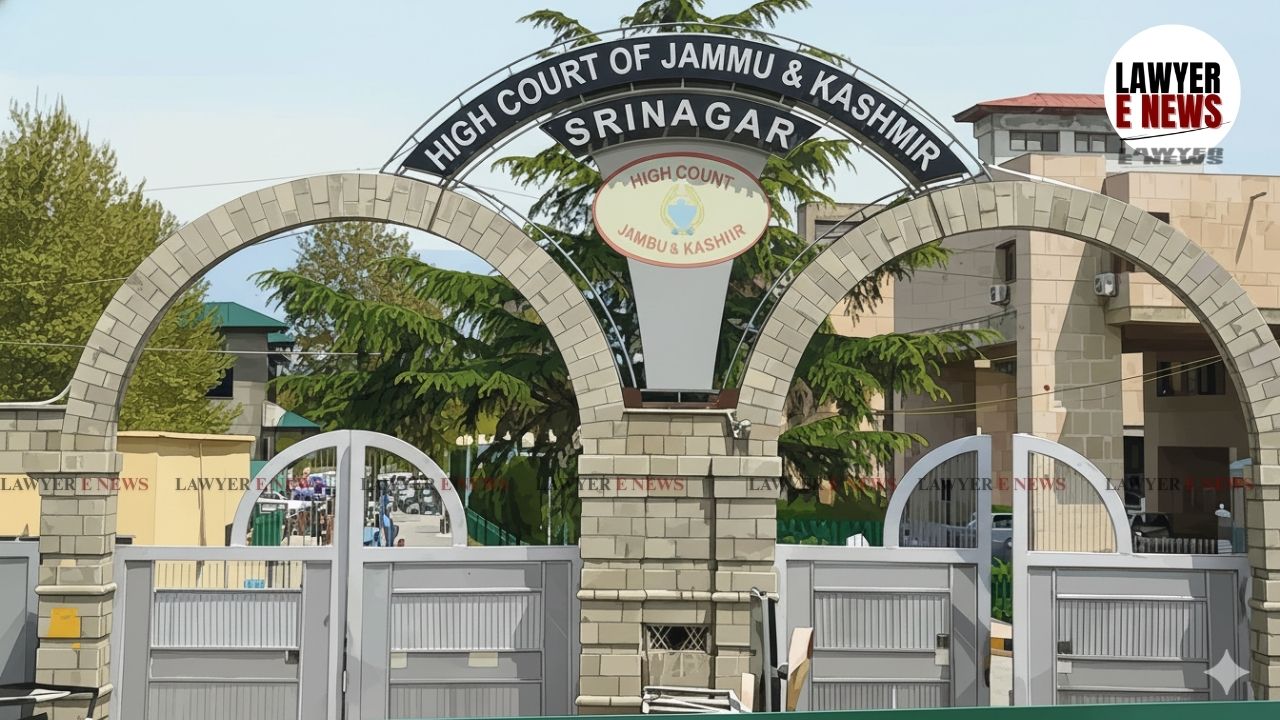
"Merely for the reason that a third-party could challenge such a judgment, the competent authority is not bound to refer such a dispute to the civil court." High Court of Jammu & Kashmir and Ladakh, in a significant ruling, held that a mere assertion of title or co-heirship, without any adjudicated right or declaratory decree, does not constitute a legally cognizable dispute to mandate a reference to the Principal Civil Court under Section 3H(4) of the National Highways Act, 1956.
A bench of Justice Moksha Khajuria Kazmi observed that an apportionment dispute must involve competing, legally recognizable interests, and strangers to the revenue record cannot stall the release of compensation by merely raising an unestablished claim.
BACKGROUND OF THE CASE
The dispute stemmed from the acquisition of land in Delina for the widening of the Baramulla-Kupwara National Highway. The petitioners, claiming to be legal heirs of the original estate holder's deceased daughter, sought a share in the compensation awarded exclusively to their aunt, who had been the sole recorded owner in the revenue records for over seven decades. After the District Collector, Baramulla, rejected their application seeking a reference of the apportionment dispute to the civil court, the petitioners approached the High Court.
LEGAL ISSUES
The primary question before the court was whether an unestablished claim of inheritance under personal law constitutes a valid dispute mandating a reference to a civil court for apportionment under Section 3H(4) of the National Highways Act, 1956. The court was also called upon to determine whether individuals who are not recorded owners and who failed to object during the acquisition proceedings qualify as "persons interested" with the locus to stall the disbursement of compensation.
COURT'S OBSERVATIONS
The court analyzed the statutory framework of Section 3H(4) of the National Highways Act alongside the Right to Fair Compensation and Transparency in Land Acquisition, Rehabilitation and Resettlement Act, 2013. The bench clarified the Supreme Court's ruling in Vinod Kumar versus District Magistrate, noting that the mandate to refer an apportionment dispute to a civil court presupposes the existence of legally recognizable interests. The court observed that the obligation to refer arises when identifiable claimants assert apportionment based on some prima facie existing interest, distinguishing this from cases where the very title of the claimant remains in dispute and is pending adjudication in a civil suit. "In the present case, the revenue record exclusively reflects Respondent No. 5 as the recorded owner. The Petitioners do not presently hold any declared share, decree, or adjudicated right in the property."
The court highlighted that the petitioners had maintained silence for over seventy years regarding the revenue entries and failed to file any objections during the 21-day statutory notice period under Section 3G of the National Highways Act. Relying on Sections 3(r) and 3(x) of the 2013 Act, the court noted that neither the petitioners nor their deceased mother were ever recorded as owners or tenants in the available records. Consequently, the bench concluded that the petitioners failed to demonstrate any prima facie foundation to establish their entitlement to the compensation awarded to the sole recorded owner. "In this case, the Respondent no.5 has been able to establish her right, title, interest, and ownership on the land which has been acquired by official respondents but petitioners herein have failed to establish anything so as to show their entitlement to the compensation for the said land, as such, they are strangers and cannot be categorized as 'persons interested' till they establish their rights before the competent Court of law."
"The dispute, which the competent authority may refer under Section 3H(4) of National Highways Act, must be one that the competent authority cannot decide without adjudication, it must be a dispute from the perspective of competent authority and not from the perspective of the person challenging it."
Addressing the argument that revenue entries do not confer title, the court agreed with the legal proposition laid down by the Supreme Court in Mansoor Saheb versus Salima, but held that this principle does not automatically grant the petitioners a right to statutory reference under the National Highways Act. Citing judgments from the Bombay and Kerala High Courts, the bench emphasized that a writ court cannot be converted into a forum for indirectly securing civil relief in matters involving disputed title. The court ruled that the petitioners' proper remedy lies in prosecuting their pending civil suit for declaration of title independently of the land acquisition proceedings. "The remedy available to such a person is to challenge the title deed in appropriate proceedings before the civil court, independent of the provisions under National Highways Act, 1956."
Dismissing the writ petitions, the High Court found no illegality or perversity in the District Collector's order refusing the reference. The court directed the immediate release of compensation to the recorded owner, subject to her furnishing an undertaking to duly compensate the petitioners to the extent of their share should they ultimately succeed in their pending civil suit.
Date of Decision: 30 March 2026