
-
by sayum
26 August 2026 1:49 PM







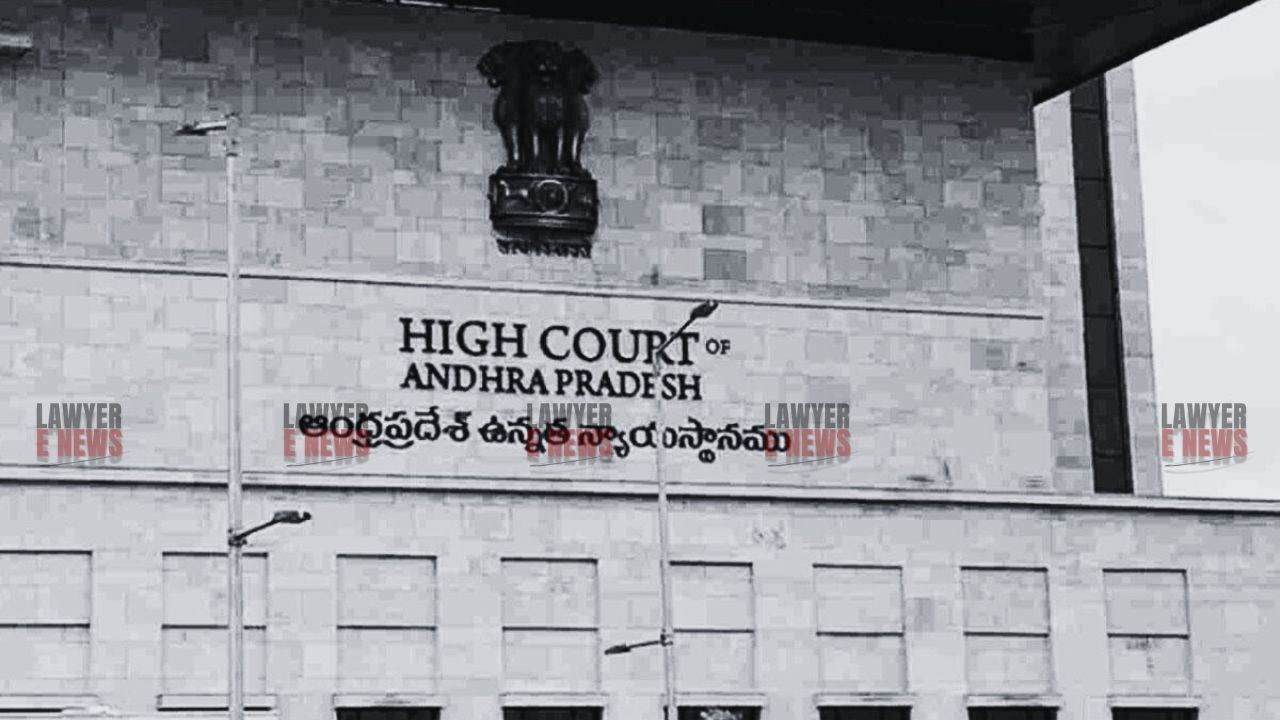
In a significant ruling that underscores the social welfare objective of the Motor Vehicles Act, 1988, the Andhra Pradesh High Court on October 8, 2025, upheld an award of ₹1.3 Crores, granted by the Motor Accidents Claims Tribunal, Vijayawada, to a man rendered quadriplegic in a road accident, even though the original compensation claimed was ₹82 lakhs.
The Division Bench of Justice Ravi Nath Tilhari and Justice Maheswara Rao Kuncheam firmly rejected the insurer’s contention that compensation must be limited to the amount claimed. The Court declared that, “there is no legal embargo or restriction that Tribunals or Courts cannot award compensation exceeding the claimed amount since the primary function of the adjudicating authority is to award ‘just compensation’.”
The Court further held that the claimant’s monthly income of ₹20,000 could be reasonably inferred despite the absence of direct documentary evidence, relying on oral testimony, lease agreements, and sale deeds. It upheld the Tribunal’s approach of adopting judicial guesswork to determine income, holding that in motor accident claims, "mathematical exactitude is neither possible nor required when determining just compensation."
"Statutory Duty of Tribunal Is to Award Just Compensation, Not to Adhere Blindly to Claimed Figures"
The appellant, Oriental Insurance Company Ltd., had challenged the award passed on 23.08.2018 in MVOP No. 527 of 2014, contending that the Tribunal erred in granting an amount higher than claimed, and that income had been assumed in the absence of tax returns or salary slips. The High Court, however, found no merit in either ground.
It categorically held that the Motor Vehicles Act is a beneficial legislation, intended to provide just and fair compensation to victims of road accidents and not confined by rigid procedural parameters. Citing the Supreme Court’s decision in Nagappa v. Gurudayal Singh, the Court reaffirmed that:
“Under the MV Act, there is no restriction that the Tribunal or Court cannot award compensation exceeding the claimed amount. The function is to award 'just compensation' based on the evidence produced.”
In response to the insurer’s argument that the Tribunal acted without jurisdiction in awarding excess compensation, the Bench observed that, “less valuation, if any, made in the Claim Petition would not be an impediment to award just compensation exceeding the claimed amount”, quoting the Supreme Court in Meenadevi v. Nun Chand Matho.
Referring to Kajal v. Jagadish Chand, where the Supreme Court awarded compensation above the claimed amount for a permanently disabled child, the High Court remarked that when the evidence on record reveals life-altering injuries and total dependence, the compensation must reflect the real and continuing suffering of the claimant.
"Tribunals Can and Must Rely on Broad-Based Evidence and Guesswork When Income Proof Is Absent"
The second challenge raised by the Insurance Company was that the Tribunal had arbitrarily fixed the claimant’s monthly income at ₹20,000 despite no income tax returns or salary documentation. The Court dismissed this objection as legally unsustainable.
The claimant, Kolli Suresh Kumar, had deposed that he was engaged in agriculture on leased lands and real estate transactions, earning between ₹40,000 to ₹50,000 per month before the accident. In support, he produced Ex.A-12, a lease agreement for 19.94 acres of land, and Ex.A-16, a registered sale deed along with encumbrance certificate proving multiple land transactions.
Although some documents were unregistered and no income tax returns were filed, the High Court relied on a host of Supreme Court rulings including K. Suresh v. New India Assurance Co. Ltd. and Chandra v. Mukesh Kumar Yadav, which held that:
“Some amount of guesswork is necessary, but it must not be totally detached from reality. In absence of documents, the Tribunal can assess income through logical inference from oral and circumstantial evidence.”
The Court noted that the claimant had sold property to fund his prolonged treatment and produced hospital bills, physiotherapy vouchers, and salary receipts for attendants and helpers. Thus, the Tribunal’s inference of a ₹20,000 monthly income was not speculative but grounded in a broad-based, judicious evaluation of the record.
It further cited R.D. Hattangadi v. Pest Control (India) Pvt. Ltd., reiterating that:
“In its very nature, fixing compensation in motor accident claims involves some guesswork, hypothetical consideration, and sympathy—viewed with objective standards.”
"Paralysed for Life, 20 Witnesses and ₹15 Lakhs in Treatment—Quantum Upheld as Just Compensation"
The claimant suffered a complete spinal cord injury at C5-C6 due to a car accident on 02.12.2013 and was rendered 100% permanently disabled, as certified by the District Medical Board (Ex.A-13). The Tribunal relied on the testimony of 20 witnesses, including doctors, physiotherapists, attendants, a cook, surgical shop proprietors, and rehabilitation specialists from CMC Vellore, to conclude that the claimant was bedridden for life and required lifelong care.
The Bench took note of the comprehensive oral and documentary evidence on record, including:
Ex.A-6 to Ex.A-28, encompassing medical bills, surgical equipment, ambulance charges, and helpers’ wages.
Evidence of PW-3 to PW-5 and PW-8, all physiotherapists confirming need for permanent care.
PW-9, neurosurgeon at Suraksha Hospital, who performed the spinal surgery.
PW-12, specialist from CMC Vellore, who detailed the claimant’s neuro-rehabilitation.
The Court noted that the Insurance Company did not examine a single witness nor effectively counter the evidence adduced by the claimant.
In such circumstances, the High Court observed that the Tribunal’s decision to award ₹1.3 Crores was not just reasonable but mandated by law, particularly under Section 168 of the Motor Vehicles Act, which directs the Tribunal to award compensation that “appears to be just.”
"Compensation Not a Bonanza, But Cannot Be a Pittance Either": Court Reiterates Scope of Just Compensation
The Bench cited with approval the Supreme Court’s articulation in State of Haryana v. Jasbir Kour, that:
“Compensation must be just—it cannot be a bonanza or a source of profit, but it should also not be a pittance.”
The Andhra Pradesh High Court emphasized that in cases involving catastrophic injury, lifelong disability, and complete dependence, tribunals must adopt a humane and restorative approach, not a technical or adversarial one.
It was also observed that the object of compensation under the Act is derived from the doctrine of restitutio in integrum—restoring the victim, as far as money can, to the position they would have been in but for the accident.
"Appellate Interference Unwarranted Where Tribunal’s View Is Reasonable and Based on Record"
Since the appellant only challenged two issues—quantum exceeding claim and absence of income proof—and did not dispute the Tribunal’s findings on negligence, disability, or medical expenses, the High Court refused to interfere.
Quoting Divisional Controller, KSRTC v. A.T. Mane, the Court observed:
“If the Tribunal has taken a possible view based on the material on record, the appellate court would be loath to interfere.”
Dismissing the appeal, the Court directed that: “The compensation amount awarded by the Tribunal shall be deposited by the appellants/respondents jointly and severally within a period of two (2) months. On such deposit, the claimant is entitled to withdraw the entire amount without furnishing any security.”
Date of Judgment: October 8, 2025





