-
by sayum
29 August 2026 3:15 PM







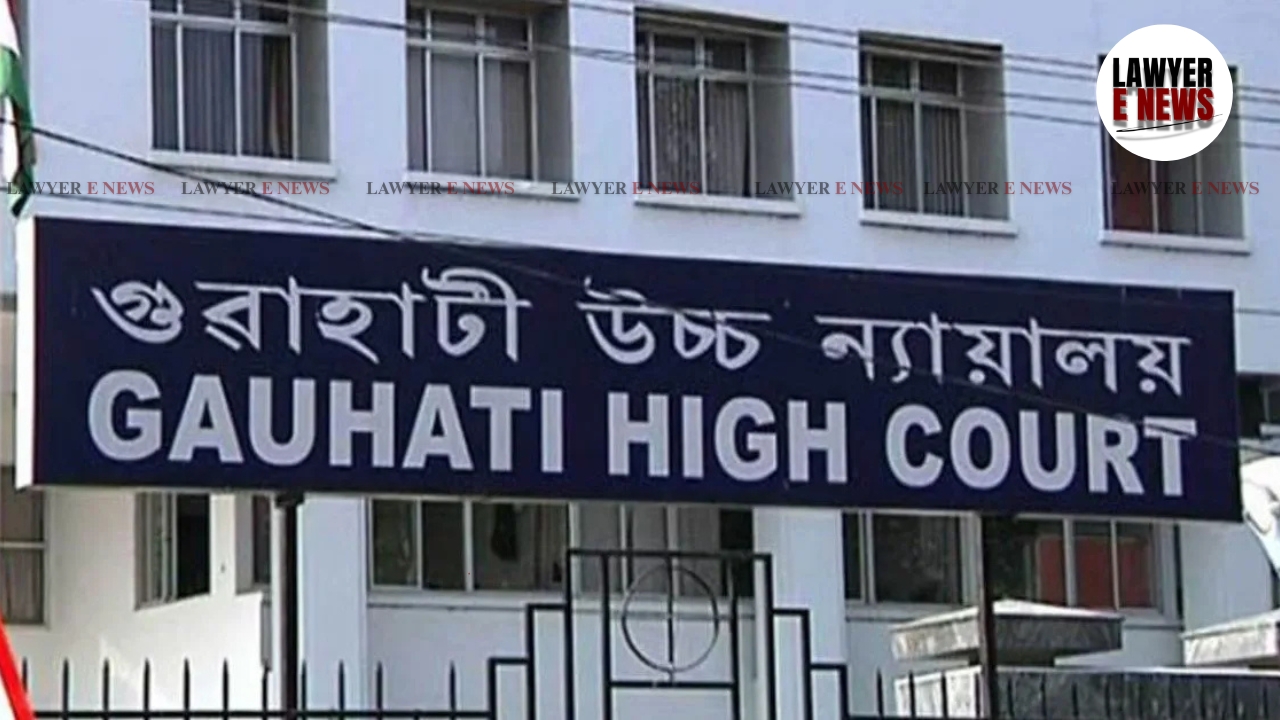
"Blacklisting entails stigmatic exclusion from all future contracts and carries civil consequences. The impugned clause in its present form, merely prescribes an eligibility criterion for a specific tender." Gauhati High Court, in a significant ruling dated April 1, 2026, held that a tender condition disqualifying bidders with a recent history of bridge collapse is a valid risk mitigation measure and does not amount to automatic blacklisting.
A division bench of Chief Justice Ashutosh Kumar and Justice Arun Dev Choudhury observed that requiring prior judicial adjudication to determine the cause of a past collapse before applying the disqualification clause would "defeat the very purpose of such a clause," as infrastructure failures often involve prolonged investigations.
The Union of India issued a revised Request for Proposal (RFP) for the construction of a second rail-cum-road bridge over the river Brahmaputra on an EPC basis. The RFP contained an eligibility condition disqualifying bidders who had experienced a bridge or flyover collapse attributable to design or quality failure in the preceding three years. SPS Construction India Private Limited challenged this clause and the subsequent rejection of its technical bid, which was discarded because a bridge it was constructing in Bihar had recently collapsed. A single judge dismissed the company's writ petitions, prompting the present writ appeal.
The primary question before the court was whether the eligibility condition disqualifying bidders with a history of bridge collapse, without prior adjudication of fault, amounted to arbitrary blacklisting. The court was also called upon to determine whether the impugned clause was vague and whether it violated the doctrine of a level playing field.
The court first addressed the appellant's contention that the clause was inherently vague and arbitrary, noting that the revised RFP specifically limited the disqualification to collapses attributable to design failure or quality failure. The bench stated that these are well-understood technical parameters in engineering practice and possess a rational nexus with the objective of ensuring structural safety in a highly complex infrastructure project. The judges held that such a condition acts as a crucial safeguard and a necessary risk-mitigation measure rather than an indeterminate or subjective barrier for contractors.
"Excluding the bidders for recent history of collapse attributable to design failure or quality failure is a legitimate policy choice."
Differentiating between a tender-specific condition and punitive debarment, the court categorically rejected the argument that the clause functioned as a mechanism for automatic blacklisting. The judges emphasised that blacklisting entails a stigmatic exclusion from all future contracts and carries severe civil consequences, whereas the impugned clause merely prescribed an eligibility criterion tailored for a specific, high-stakes tender. The bench clarified that the clause was preventive in character, not penal, and would not prohibit the appellant from participating in other unrelated tenders across the country.
"The impugned clause in its present form, merely prescribes an eligibility criterion for a specific tender. It neither imposes a penalty nor prohibits future participation in other tenders."
On the crucial argument that the clause could not be activated without a prior judicial or quasi-judicial determination of fault, the court observed that public procurement would become unworkable if tied to formal legal outcomes. The bench explained that infrastructure failures often trigger prolonged technical investigations and delayed findings, which cannot hold a time-sensitive tender process hostage. Relying on the Supreme Court's decisions in Tata Cellular v. Union of India and Jagdish Mandal v. State of Orissa, the court reiterated that tender authorities have wide latitude in prescribing eligibility criteria based on reasonable assumptions of risk.
"If the applicability of the clause were made contingent upon the final adjudication, the employer would be compelled to either indefinitely delay the procurement or ignore recent and potentially serious structural failures."
The court further elucidated that the burden lies squarely on the bidder to disclose a collapse incident fully and provide supporting materials to prove it was not caused by design or quality failures, such as force majeure or third-party interference. Because the appellant's undertaking lacked a clear, categorical statement absolving itself of design or quality failure regarding the Bihar bridge collapse, the tendering authority was fully justified in treating the bid as non-responsive. The judges noted that the absence of a formal adjudication places a heightened duty of disclosure on the bidder rather than rendering the clause unworkable.
"Where a bidder has a known history of collapse within the relevant period, it is incumbent upon such a bidder to disclose the incident fully and explain with supporting materials."
The court also upheld the legality of the three-year look-back period stipulated in the revised tender document, identifying it as a matter of commercial policy beyond the scope of routine judicial review. Citing the Supreme Court's precedent in Uflex Limited v. Government of Tamil Nadu, the division bench stated that authorities are best positioned to determine technical thresholds, and a recent structural failure is a highly relevant indicator of a contractor's present capabilities. The judges concluded that the three-year window lay well within a reasonable band of administrative discretion and was not manifestly arbitrary.
"A recent failure within 3(three) years is far more relevant indicator of a present capability than an older incident."
Finding no merit in the appellant's contentions, the Gauhati High Court concluded that the eligibility framework represented a legitimate exercise of contractual discretion aimed at safeguarding the public interest in a technically sensitive project. Consequently, the division bench dismissed the writ appeal and sustained the judgment of the single judge.
Date of Decision: 01 April 2026