-
by sayum
03 October 2026 9:56 AM







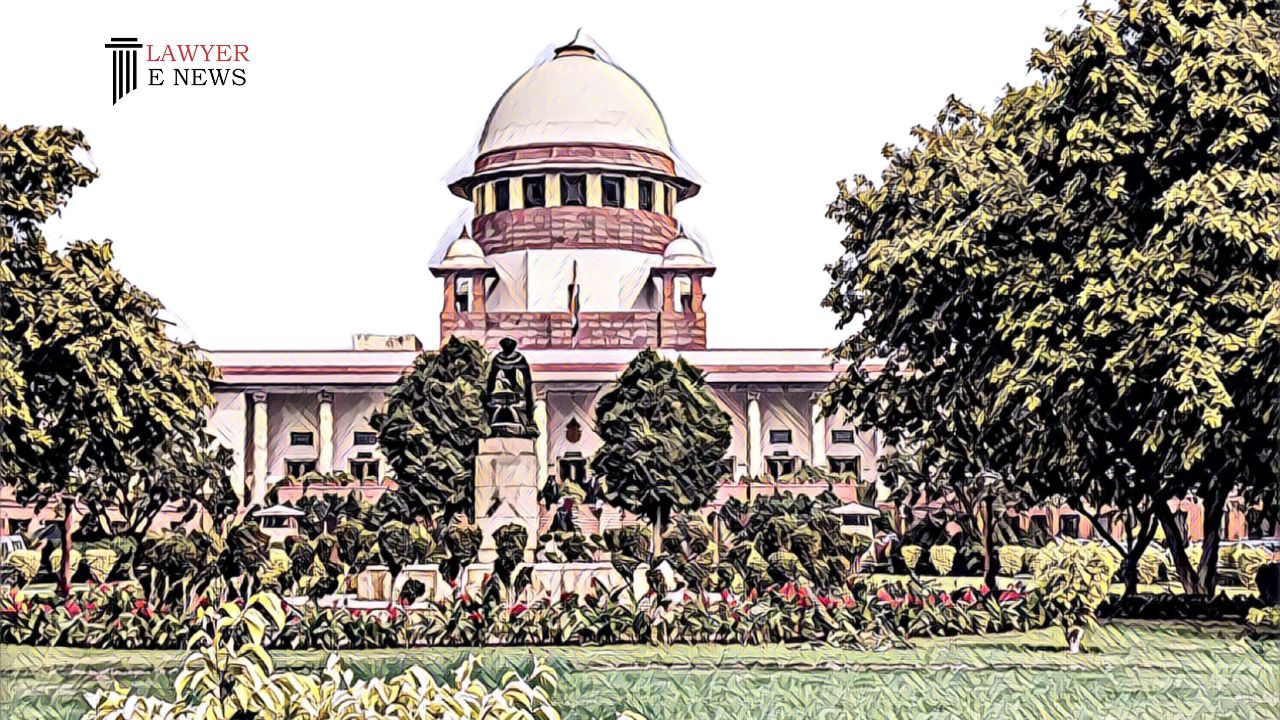
Supreme Court in a recent Judgement (Baini Prasad (D) Thr. LRs. Vs. Durga Devi D.D 02 Feb 2023) held that if a plaintiff establishes their title to land and files a suit for recovery of possession within the period of limitation, the doctrine of laches or acquiescence has no place in defeating their right to obtain relief. The court held that denying relief in such cases would be tantamount to allowing a trespasser or encroacher to purchase another person's property against their will.
The respondent (plaintiff) filed a civil suit seeking possession of a land parcel and a permanent injunction against the defendant (appellant). The trial court ruled in favor of the plaintiff, ordering the demolition of structures built on the land and handing over the land to the plaintiff.
The defendant appealed, and the First Appellate Court confirmed the findings on ownership and encroachment but modified the judgment, awarding the plaintiff compensation instead of ordering the recovery of possession and demolition due to the principles of acquiescence.
The plaintiff then filed a Second Appeal, and the High Court restored the trial court's original judgment for demolition and handing over possession of the land. The defendant's review petition was dismissed by the High Court.
The defendant filed two appeals by special leave: one against the Second Appeal judgment and the other against the dismissal of their review petition.
The Supreme Court observed that there are concurrent findings from the Trial Court, First Appellate Court, and the High Court on the questions of ownership and encroachment of the disputed land. They found no reason to revisit these factual findings based on the established judicial principle that concurrent findings of fact do not call for interference in an appeal under Article 136 of the Constitution of India in the absence of any valid ground for interference.
The respondent filed RSA No. 276 of 1996 against the setting aside of the trial Court's judgment for demolition and handing over possession of the land. The original appellant had not filed an independent appeal or cross-appeal against the First Appellate Court's judgment confirming findings on ownership and encroachment and ordering payment of compensation.
The scope of consideration in these appeals is confined to the question of whether the reversal by the High Court of the modification effected by the First Appellate Court warrants interference in the exercise of power under Article 136 of the Constitution of India.
The Supreme Court noted that Section 51 of the Transfer of Property Act (TP Act) offers two options for a person evicting another: either pay for the improvements made by the defendant (transferee) and take the land or sell their interests in the land to the transferee at market value. However, to use Section 51, one must be a 'transferee' as defined in the TP Act.
The Supreme Court ruled that the original appellant wasn't a 'transferee' under the TP Act or Section 51. Thus, the appellants couldn't rely on Section 51 to seek restoration concerning demolition and possession. The appellants didn't claim adverse possession and weren't eligible for relief under Section 51 of the TP Act. The Supreme Court considered whether the appellant (defendant) had pleaded and proved their plea of estoppel. Despite the non-framing of the issue of estoppel, the court was inclined to consider contentions founded on the principle of estoppel. The court referred to various decisions to clarify the concept of estoppel and its conditions.
The court pointed out that estoppel is an equitable doctrine that applies when a party with a right stand by and sees another dealing in a manner inconsistent with that right, and does not complain after the violation is completed. However, acquiescence will not apply if the lapse of time is of no importance or consequence.
The Supreme Court noted that equity would follow the law and tilt in favor of the law. To claim equity, the party must explain their previous conduct.
The Supreme Court observed that the appellant's contention regarding acquiescence was incoherent, as the respondent had objected to the construction on the disputed land. The court noted that the respondent sent a telegraphic notice to stop construction, made a complaint before the Deputy Commissioner, and filed a suit within the prescribed period of limitation.
The court stated that the burden was on the appellant to establish the respondent's acquiescence, and they failed to do so.
The court found that the appellant encroached on the respondent's land without bona fide intentions and constructed an extension of their residential building. The court held that recognizing the illegality and granting allowance based on estoppel would defeat its object of preventing fraud and securing justice between parties.
The Supreme Court observed that if a plaintiff establishes their title to land and files a suit for recovery of possession within the period of limitation, the doctrine of laches or acquiescence has no place in defeating their right to obtain relief. The court held that denying relief in such cases would be tantamount to allowing a trespasser or encroacher to purchase another person's property against their will.
The court found no flaw, legal error, perversity, or patent illegality in the High Court's findings favoring the respondent. The High Court set aside the First Appellate Court's judgment and restored the Trial Court's judgment and decree. Consequently, the appeals by the appellants failed, and the Supreme Court dismissed them.
Baini Prasad (D) Thr. LRs. Vs. Durga Devi