-
by sayum
27 August 2026 7:40 AM







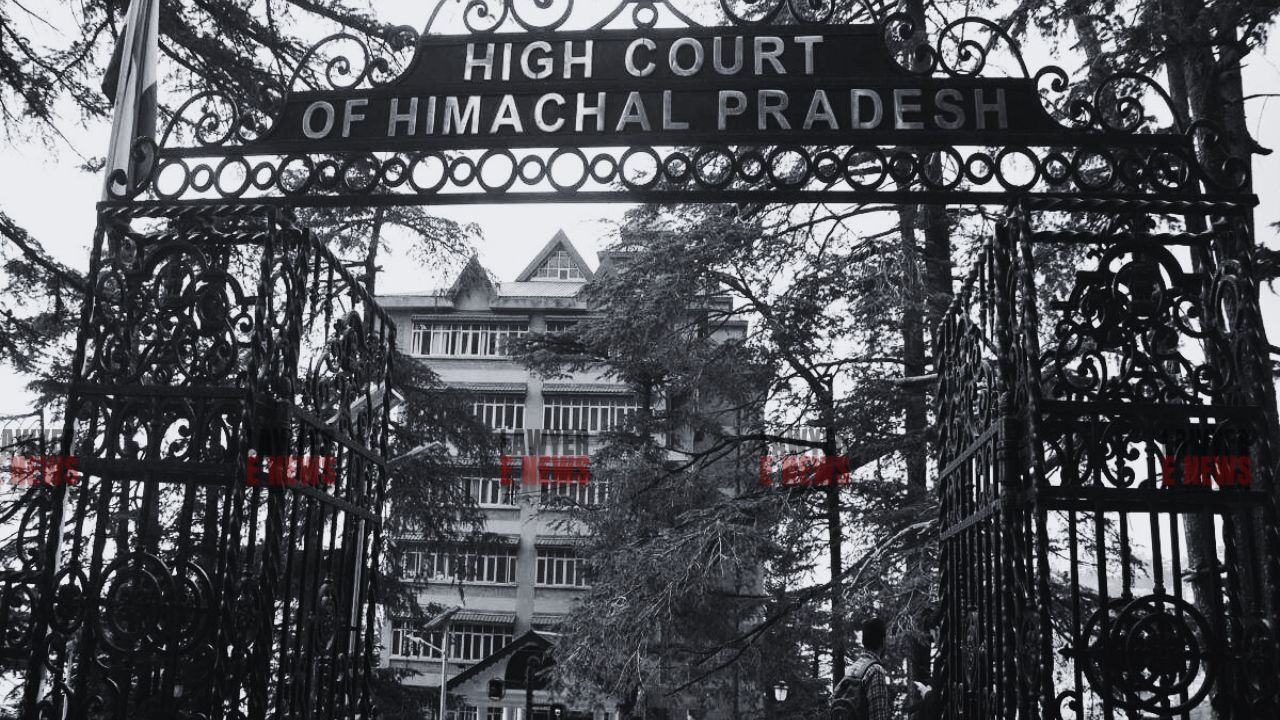
"It is well settled that the welfare State cannot claim adverse possession against its citizens. Thus, the suit on the basis of title cannot be said to be time barred..." Himachal Pradesh High Court, in a significant ruling , held that a welfare State cannot claim adverse possession to usurp a citizen's private property without following the due process of law.
While dealing with a case where the State utilized private land for road construction without paying compensation, a single-judge bench of Justice Romesh Verma observed that "the welfare State cannot claim adverse possession against its citizens," thereby rejecting the government's defense of delay and laches.
The dispute pertains to land owned by the respondents in District Mandi, which the State government utilized between 1993 and 1998 to construct the 'Karsog-Kunnu Road' without initiating acquisition proceedings or paying compensation. The landowners filed a civil suit in 2017, which was initially dismissed by the trial court but subsequently decreed by the First Appellate Court. The State then approached the High Court through a Regular Second Appeal, arguing that the suit was barred by limitation as it was filed over three decades after the road's construction.
The primary question before the court was whether the State could invoke the principles of delay, laches, and adverse possession to deny compensation to citizens whose land was utilized for a public utility. The court was also called upon to determine whether interference under Section 100 of the Code of Civil Procedure (CPC) was warranted against the concurrent findings of fact regarding the unauthorized utilization of the suit land.
Welfare State Cannot Claim Adverse Possession
The High Court firmly rejected the State's contention that the landowners' claim was time-barred or defeated by the equitable principle of acquiescence. The court noted that the government had produced no documentation to prove that the landowners had ever consented to the construction of the road through their property. Emphasizing the constitutional obligations of the government, the bench observed that the title of the rightful owners could only be defeated if the State proved perfection of title through adverse possession, which is impermissible for a government entity.
"Admittedly, the respondents/plaintiffs are the title holder of the suit property. Being owner of the suit property, they may file a suit at any stage until and unless the said right is defeated by the present appellants/ defendants by perfection of title by way of adverse possession."
Continuing Cause Of Action Under Article 300-A
Relying on the Supreme Court's landmark judgment in Vidya Devi vs. State of Himachal Pradesh, the court reiterated that forcibly dispossessing a person of their private property without legal sanction violates Article 300-A of the Constitution of India. The bench held that the deprivation of property without statutory acquisition creates a continuing cause of action. Consequently, the equitable defenses of delay and laches cannot be raised by the State to shield itself from its legal responsibility to pay fair compensation to the dispossessed citizens.
State Bears A Higher Burden Of Legality
The bench further invoked the Supreme Court's ruling in Sukh Dutt Ratra vs. State of H.P. to highlight that the State bears a higher responsibility to demonstrate that it has acted within the confines of legality. The court emphasized that a citizen's right to property cannot be extinguished merely because they approached the court belatedly, especially when the State itself failed to initiate mandatory acquisition proceedings. The court observed that denying compensation on technical grounds of limitation would be a travesty of justice and an abuse of executive power.
"The Hon’ble Apex Court has repeatedly held that no person can be deprived of his property without adopting due process of law, therefore, under such circumstances, the plea as set up by the appellants-State is not tenable..."
Limited Scope Of Interference Under Section 100 CPC
Addressing the maintainability of the Regular Second Appeal, the High Court delineated the strict boundaries of its jurisdiction under Section 100 of the CPC. The court held that the First Appellate Court is the final court of fact, and its findings cannot be disturbed unless they are demonstrably perverse or based on inadmissible evidence. Citing the Supreme Court's decisions in Hero Vinoth and Annamalai, the bench found no perversity in the lower appellate court's appreciation of the demarcation report and oral evidence.
No Substantial Question Of Law Arises
The bench concluded that the State's appeal was entirely devoid of merit as it failed to raise any debatable point of law that had not already been definitively settled by binding precedents. The court observed that the lower appellate court had correctly mandated the State to fulfill its statutory duty regarding land acquisition. Because the concurrent findings of fact clearly established the unauthorized utilization of the land, the court ruled that no substantial question of law was involved to warrant interference.
The High Court dismissed the Regular Second Appeal and affirmed the judgment of the First Appellate Court. The State government has been categorically directed to formally initiate acquisition proceedings for the utilized land and pay appropriate statutory compensation to the landowners in accordance with the law.
Date of Decision: 24 March 2026