-
by sayum
24 August 2026 6:22 AM







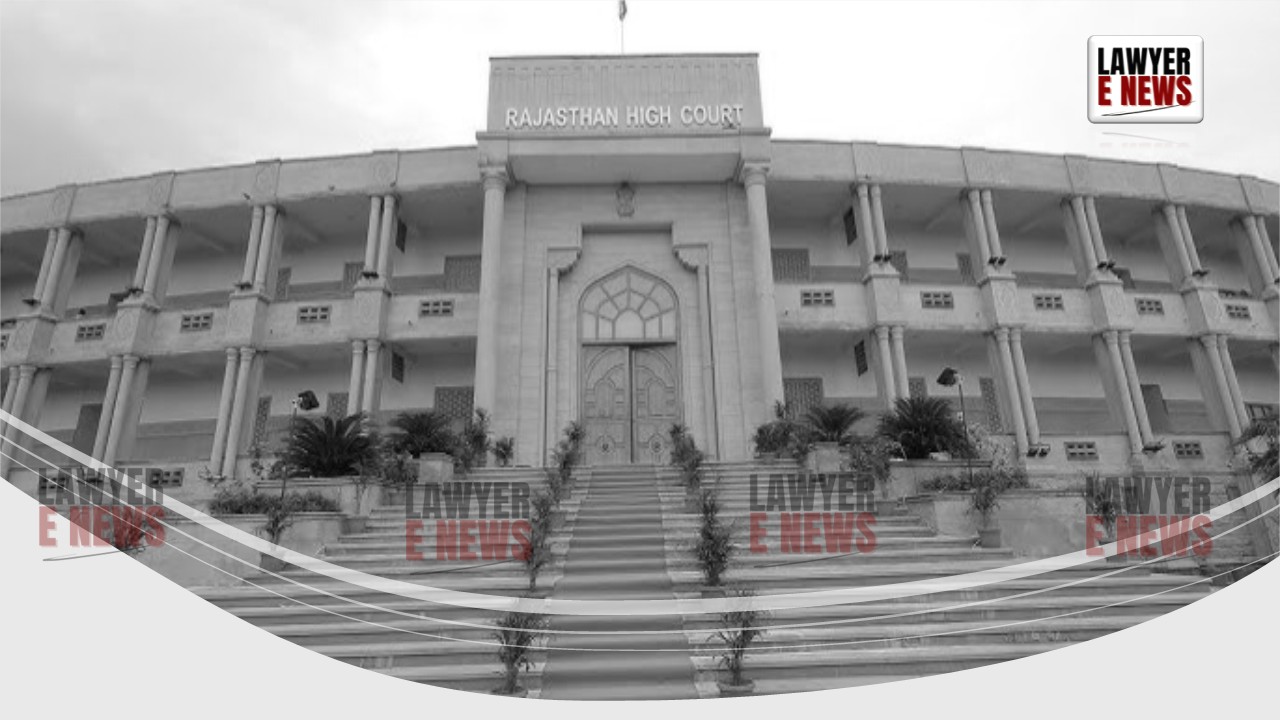
“Where the offender is the father—the very person entrusted as the child’s natural protector—the offence transcends ordinary criminality and assumes an abhorrent and grotesque character”— In a seminal ruling, the High Court of Rajasthan at Jodhpur, comprising Justice Vinit Kumar Mathur and Justice Chandra Shekhar Sharma, has upheld the conviction and life imprisonment of a man for the aggravated sexual assault of his minor daughter, emphasizing that judicial leniency in such cases would amount to an abdication of constitutional duty.
A Guardian Turned Predator
The case arose from a harrowing incident reported in August 2022. The complainant, the mother of the victim, had left her children at home to visit her brother for Raksha Bandhan. Upon her return, her eldest daughter, a student of Class VII (aged under 12), broke down and revealed that her father, Manoj, had sexually assaulted her on the night of August 12, 2022.
Further probing revealed a pattern of abuse; the victim disclosed that the appellant had raped her on two previous occasions while her mother was undergoing surgery. The accused had silenced the child through intimidation. Based on the mother's report, an FIR was registered under Section 376AB of the Indian Penal Code (IPC) and Section 6 of the POCSO Act. The Trial Court, in November 2022, convicted the appellant and sentenced him to life imprisonment (till death).
“The dignity of women and children admits of no compromise, and the legal system cannot countenance repeated violations of that dignity under the pretext of misplaced sympathy or alleged procedural niceties.”
Defense Plea: Marital Discord and Negative DNA Evidence
Challenging the conviction, the Amicus Curiae for the appellant argued that the case was a fabrication resulting from severe matrimonial discord. The defense contended that the complainant desired a divorce, which the appellant had refused, providing a motive for false implication.
Crucially, the defense relied heavily on the Forensic Science Laboratory (FSL) and DNA reports, which were negative and did not match the appellant’s biological samples. The defense argued that the Trial Court had committed a grave error by ignoring this exculpatory scientific evidence.
Judicial Reasoning: Sterling Testimony Trumps Technicalities
The Division Bench meticulously dissected the evidence, ultimately rejecting the defense's reliance on the negative DNA report and the theory of false implication. The Court placed heavy reliance on the testimony of the victim (PW-1), describing it as natural, cogent, and consistent.
The Bench observed that under Section 29 of the POCSO Act, a statutory presumption of culpability operates against the accused once foundational facts are established. In this case, the medical evidence (PW-9) confirming a torn hymen corroborated the victim's account. The Court held that the "bald suggestion" of marital discord was insufficient to rebut the presumption that a mother would not falsely implicate her husband in such a heinous crime at the cost of her minor daughter's reputation and well-being.
“When a father who is expected to be a shield, a guardian, a moral compass, becomes the source of the most severe violation of a child’s bodily integrity and dignity, the betrayal is not only personal but institutional.”
The Heinous Nature of Incest
In a strongly worded judgment, the Court invoked ancient wisdom and modern constitutional morality to condemn the act. Quoting the verse "Yatra naryastu pujyante...", the Bench underscored that the sanctity of the home is inviolable.
The Court relied on the recent Supreme Court ruling in Bhanei Prasad @ Raju Vs. State of Himachal Pradesh (2025 INSC 934), reiterating that incestuous sexual violence tears through the foundational fabric of familial trust. The Bench held that such crimes warrant the strongest judicial censure and that the law cannot condone such acts under the guise of rehabilitation.
Dismissing the appeal, the High Court upheld the sentence of Life Imprisonment till death. Furthermore, recognizing that justice must include restitution, the Court invoked the “Compensation Scheme for Women Victims/Survivors of Sexual Assault/Other Crimes, 2018”.
The State of Rajasthan was directed to pay Rs. 7,00,000/- (Seven Lakhs) to the victim, ensuring that the judicial response addressed not just the punishment of the offender, but the rehabilitation of the survivor.
Date of Decision: 08/01/2026