-
by kapil
26 November 2026 6:55 AM







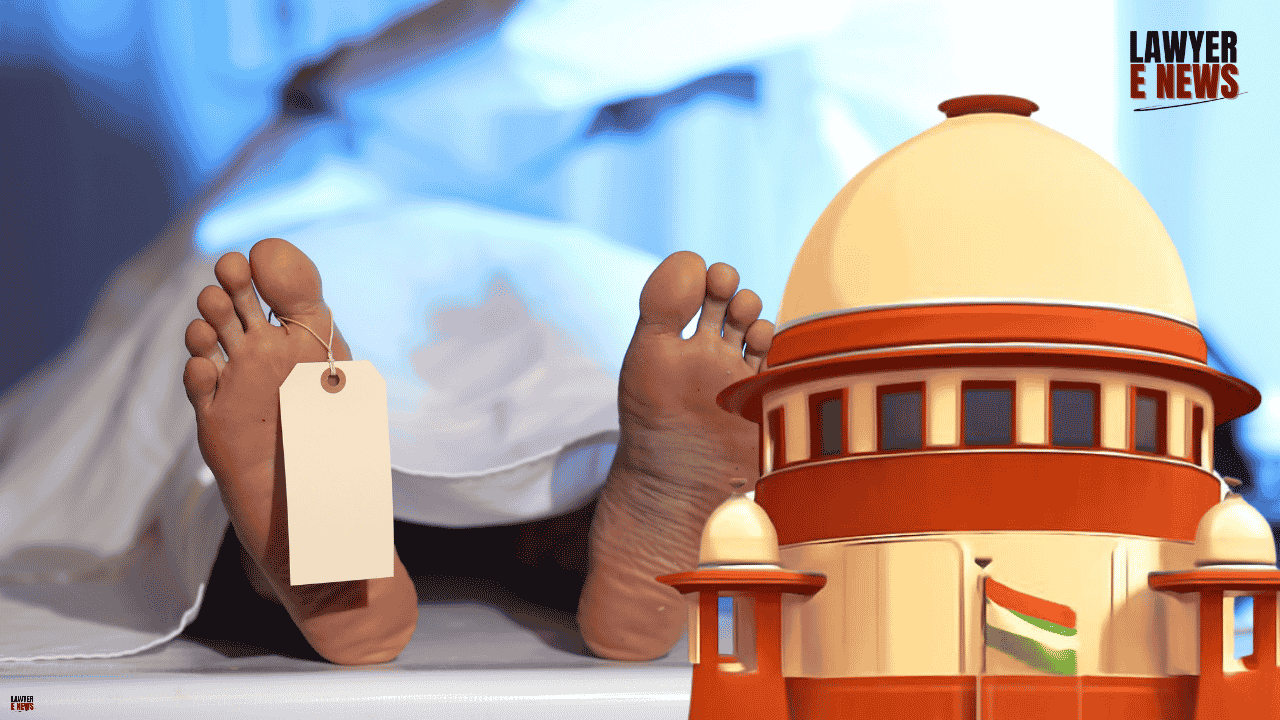
"The Court may refuse to act on medical opinion if it is demonstratively unreliable but the Court cannot substitute its own view to the opinion of the medical man." Holding that courts cannot substitute their own judicial conjecture for expert medical opinion when eyewitness testimony is diametrically opposed to autopsy findings, the Supreme Court bench comprising Justice Prashant Kumar Mishra and Justice Shree Chandrashekhar on November 25, 2026, set aside a murder conviction under Section 302 read with Section 34 of the Indian Penal Code. The Court ruled that where eyewitness accounts are irreconcilable with medical evidence, the prosecution fails to establish guilt beyond reasonable doubt.
The appellant, Prabhu Singh, approached the Supreme Court assailing the judgment of the Allahabad High Court, which had confirmed his conviction under Section 302 read with Section 34 of the IPC for the 1986 murder of Gajram Singh. The prosecution's case rested on the ocular testimonies of the deceased’s wife and daughter, who claimed that a co-accused shot the deceased in the forehead with a country-made pistol, causing his immediate death, while the appellant inflicted multiple stab wounds. However, the autopsy doctor discovered eight incised wounds and a solitary muscle-deep lacerated wound, finding no firearm injury, entry or exit wound, or bullet on the body.
Whether a conviction under Section 302 read with Section 34 IPC can be sustained when the core ocular account attributing death to a firearm injury is completely negated by post-mortem evidence?
Whether the trial court and the High Court committed a grave error of law by discarding expert medical opinion and substituting their own view that a lacerated forehead wound could have been caused by a gunshot?
The Supreme Court observed that the trial court and the High Court erred significantly in adopting a textbook approach that ocular evidence invariably overrides medical evidence. The bench underscored that the prosecution’s theory rested fundamentally on a gunshot fired at point-blank range causing instantaneous death, which found zero corroboration in the post-mortem report.
Ocular evidence cannot override medical evidence when both are completely contradictory
The bench emphasized the distinction between reconcilable inconsistencies and total contradictions between ocular and medical accounts. Referring to precedents, the Court noted that while ocular testimony can prevail where an explanation for the discrepancy is plausible, absolute variance invalidates the prosecution's case.
"In our opinion what the trial Judge has missed out is that the medical evidence can be ignored where there is a possibility of an explanation to the inconsistency with the ocular evidence. However, where the eyewitness account and the medical evidence are completely opposite to each other and there is no possibility of accepting the testimony of eyewitness then the Court is bound to hold that the prosecution failed to establish the charge beyond reasonable doubt," the bench held.
Courts cannot assume the role of medical experts to bridge fatal evidentiary gaps
The Court criticized the lower courts for speculating that the deceased's lacerated forehead wound was caused by a bullet, despite the examining doctor concluding it was caused by a blunt weapon and the prosecution never putting any such theory to the doctor.
"The High Court, in our considered view, committed a serious error in law and overlooked a fundamental rule in criminal trial that it was the duty of the public prosecutor to cross-examine and seek explanation from the post-mortem doctor as to cause of the Injury No. 1. It is important particularly because this was not the case of the prosecution that a bullet was removed from or found stuck in the forehead of the deceased," the Court recorded.
Prosecution must prove through expert testimony that alleged weapons caused the injuries
The bench reiterated that the prosecution bears the affirmative burden of demonstrating through expert testimony that the injuries sustained could indeed be caused by the weapon attributed to the accused. The failure to do so, coupled with shoddy investigation, entitles the accused to the benefit of doubt.
"It has always been considered a duty of the prosecution to prove by expert evidence that the injuries were likely to be caused or at least possible by the weapon used in the crime. There is a gap, a huge gap, in the prosecution case on a most fundamental point but the Courts below took the textbook view that ocular evidence shall take precedence over medical evidence," the bench observed.
Highlighting additional vulnerabilities in the prosecution's case, the Court noted that an independent witness turned hostile, another eyewitness was withheld, the crime weapons were never recovered, and a third assailant remained unidentified, creating a lingering doubt regarding the appellant's participation in the offence.
The Supreme Court allowed the criminal appeal, set aside the judgment of conviction passed by the Sessions Court as well as the affirming judgment of the Allahabad High Court, and directed the appellant to be released forthwith.
Date of Decision: November 25, 2026