-
by sayum
25 August 2026 6:11 AM







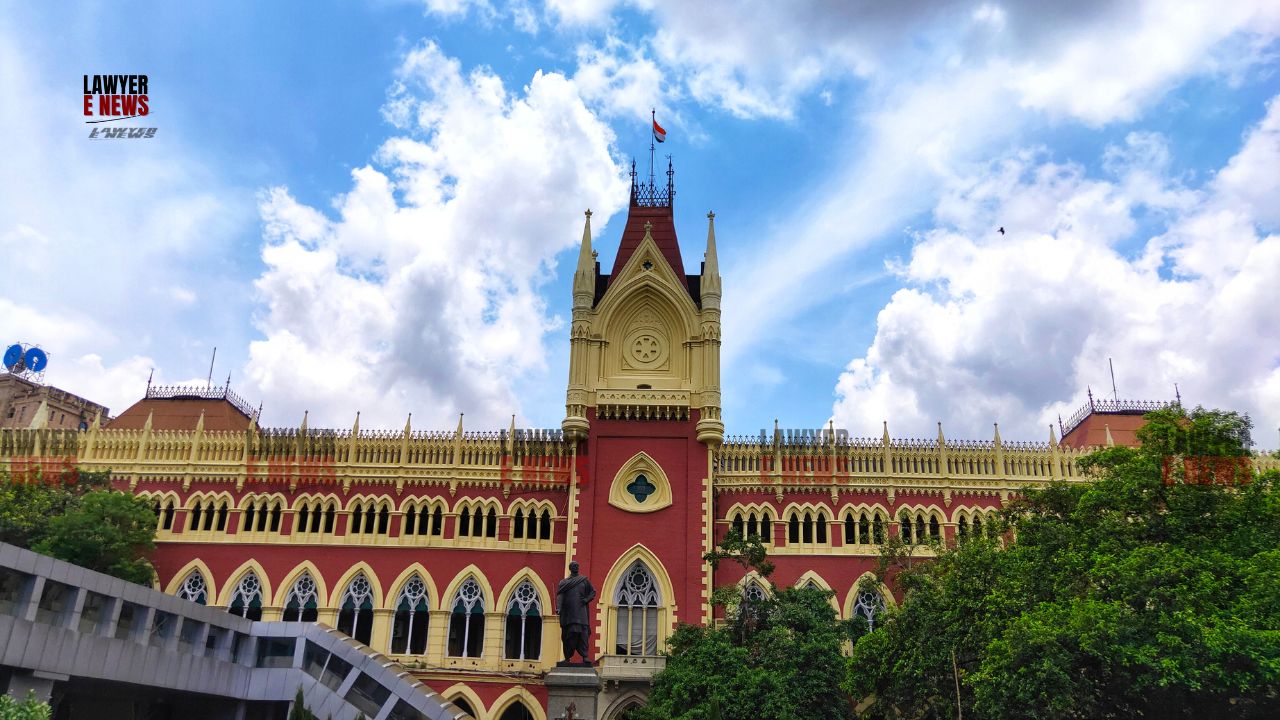
“The right to assemble does not mean that such right can be exercised at any and every place”— In a judgment Calcutta High Court, speaking through a Division Bench comprising Chief Justice Sujoy Paul and Justice Partha Sarathi Sen, upheld the State’s decision to disallow a peaceful sit-in demonstration in front of Nabanna, the State Secretariat. The Court ruled that the constitutional right to protest under Article 19 is not absolute and may be subject to reasonable restrictions in the interest of public order and administration, especially in sensitive public locations like a government headquarters.
Appellant, Sankar Ghosh, an elected MLA, challenged the order of a Single Judge who had allowed a restricted protest at an alternative location—Mandirtala Bus Stand—instead of the originally proposed site directly in front of Nabanna. The Division Bench dismissed the intra-court appeal, affirming that the Single Judge had taken a “plausible view” in accordance with constitutional limitations and existing legal precedent.
“Right to Protest Not an Indefeasible Right at Any Venue”: Court Affirms Limits on Article 19(1)(a) and 19(1)(b)
The Court firmly held that the freedom of speech and the right to assemble peacefully—enshrined under Articles 19(1)(a) and 19(1)(b) of the Constitution—do not confer an absolute or unqualified right to protest at any location of the protestor’s choosing.
Quoting from the Supreme Court’s ruling in Ramlila Maidan Incident, In Re (2012) 5 SCC 1, the Bench noted:
“The right to hold meeting in public places is subject to control of the appropriate authority regarding the time and place of the meeting.” [Para 18]
The Court also drew attention to the Apex Court’s observations in Shaheen Bagh (In Re) (2020) 10 SCC 439:
“We cannot accept the plea of applicants that an indeterminable number of people can assemble whenever they choose to protest.” [Para 19]
The Bench clarified that even if the number of protestors is fixed or small—as in this case where only 50 MLAs were to participate—it does not bestow an “indefeasible right” to stage the protest exactly at the entrance of a State’s administrative hub.
Failure to Challenge Prohibitory Order Under Section 163 BNSS Fatal to the Appellant’s Case
The judgment also underscores a critical procedural point: the appellant failed to challenge the prohibitory order issued under Section 163 of the Bharatiya Nagarik Suraksha Sanhita, 2023 (successor to Section 144 Cr.P.C.), which had been invoked for the Howrah metropolitan area.
The Bench observed:
“In the absence of challenging the order issued under Section 163 BNSS, we find no reason to examine the legality, validity and propriety of the said order/action.” [Para 18]
The Court reaffirmed that judicial scrutiny of such prohibitory orders is possible, but the remedy lies in a specific challenge before the Magistrate or through appropriate judicial channels. In the absence of such a challenge, the appellant’s plea questioning the order under Section 163 must fail. [Para 14]
Citing Indira Gandhi Case, Court Balances Liberty With Law
Beginning its analysis with a quotation from Justice K.K. Mathew in Indira Nehru Gandhi v. Raj Narain (1975 Supp SCC 1), the Bench eloquently framed the constitutional dilemma:
“The major problem of human society is to combine that degree of liberty without which law is tyranny with that degree of law without which liberty becomes licence...” [Para 13]
This philosophical underpinning set the tone for the judgment, where the Court’s role was defined as balancing the right to protest with the right of the State to maintain order and discipline, particularly in public spaces where governance is being conducted.
Precedents Cannot Create Parity Without Context: Prior Permission Not Binding
The appellant had attempted to rely on prior orders, including a coordinate bench’s interim order in Debranjan Banerjee v. State of West Bengal [WPA(P) 360 of 2024], and permissions granted in Suvendu Adhikari v. State of West Bengal [WPA 15915 of 2024], to argue for parity.
However, the Court rejected this argument, stating:
“Reliance on earlier permissions granted in other cases held to be fact-specific and not conferring parity as a matter of right.” [Headnotes]
The Court found that the prohibitory order was not in place in the Debranjan Banerjee case, thus making it distinguishable on facts. Moreover, executive discretion in regulating protests cannot be invalidated merely because permission was previously granted in different circumstances. [Para 20]
Judicial Deference to Administrative Discretion
Concluding its analysis, the Court noted that administrative decisions regulating the venue and manner of protest are not to be interfered with unless they are patently illegal, without jurisdiction, or tainted with mala fides.
“The learned Single Judge has taken a plausible view which does not warrant interference in this intra court appeal.” [Para 21]
The Bench emphasized that the alternative arrangement proposed by the Single Judge—protest at Mandirtala Bus Stand from 10 AM to 4 PM with conditions—was both reasonable and constitutionally compliant.
Protest Rights Exist, But Within Limits of Law and Public Order
In sum, the Calcutta High Court's judgment reaffirms the doctrine of reasonable restrictions under Articles 19(2) and 19(3), emphasizing that while the right to protest remains vital in a democracy, it cannot override the rights of others or the administrative imperatives of governance.
By declining permission to hold a dharna directly in front of Nabanna, but allowing it at a designated location, the State was found to be acting within its constitutional and statutory bounds, and the Court rightly declined to substitute its own judgment in the matter.
"No fundamental right to protest at any place of one’s choosing" — Calcutta High Court reaffirms State’s power to regulate assemblies in public interest
Date of Decision: January 29, 2026