-
by sayum
25 August 2026 8:14 AM







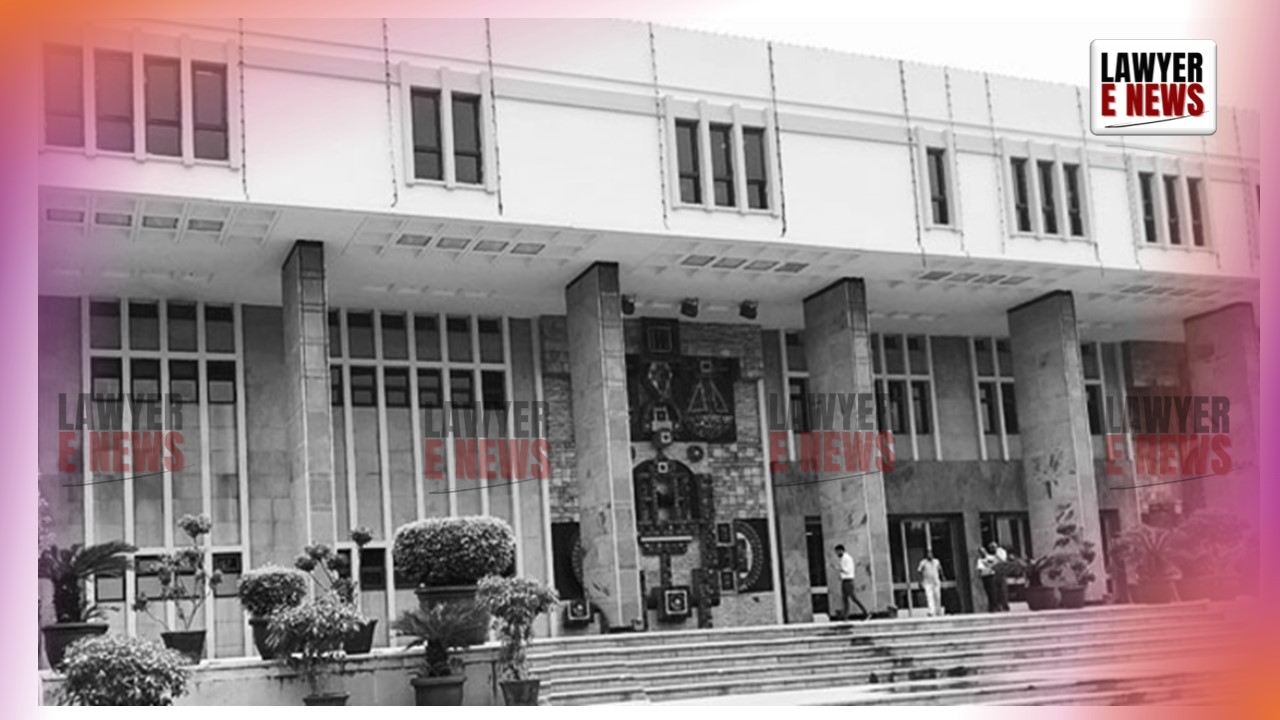
“Doctrine of Exclusion Cannot Be Invoked In Absence of Clear Language” – In a significant judgment touching upon service jurisprudence and interpretation of disciplinary rules, the Delhi High Court held that a retired public servant can validly be appointed as an Inquiry Officer under Rule 11(2) of the Export Inspection Agency Employees (Classification, Control and Appeal) Rules, 1978, as there exists no express or implied exclusion to that effect.
“The Expression ‘Public Servant’ Must Be Interpreted to Include Retired Officials When Appointed and Paid for a Public Duty”
Rejecting the contention that Rule 11(2) of the EIA Rules confines the appointment of an Inquiry Officer to a currently serving public servant, the Court ruled:
"The language of Rule 11(2) of the EIA Rules does not indicate that by necessary implication the retired public servants can be excluded. Applying the principle of interpretation laid down in Union of India v. Alok Kumar, it would not be incorrect to hold that even the expression ‘public servant’ occurring in Rule 11(2) of the EIA Rules would include retired public servant as well." [Para 50]
The Court distinguished the judgment in Ravi Malik v. National Film Development Corpn. Ltd. [(2004) 13 SCC 427], where the Supreme Court had held that a retired officer cannot be considered a public servant under the relevant rules. The Division Bench noted that Ravi Malik had not considered the broader definition of “public servant” under Section 21 of the IPC, which includes individuals remunerated for performing public duties.
Citing the precedent in Alok Kumar and reaffirmed in Union of India v. Jagdish Chandra Sethy [2023 SCC OnLine SC 1932], the Court emphasized:
“A person engaged by a competent authority to work on a fee or fixed remuneration can be a public servant. It is difficult to accept the contention that such a person, performing delegated functions in accordance with law, would not be an ‘authority’ within the meaning of Rule 11(2).” [Para 52]
Personal Hearing Is Contemplated At Inquiry Stage, Not After Inquiry Report
The Court also overruled the Single Judge’s finding that the disciplinary process was vitiated due to the failure to provide a personal hearing after the submission of the Inquiry Report. Interpreting Rule 11(4) of the EIA Rules, the Division Bench clarified that:
“The expression ‘he desires to be heard in person’ under Rule 11(4) applies at the stage of submission of written statement of defence post service of charge sheet. It does not contemplate a separate opportunity of personal hearing after the inquiry is concluded.” [Para 59]
The Court found that Parveen Kumar was given full opportunity to participate during the inquiry, was provided a copy of the Inquiry Report, and had submitted a detailed representation thereafter. Therefore, no procedural or natural justice violation occurred.
“The disciplinary proceedings were conducted in strict adherence to the EIA Rules. The petitioner has utterly failed to establish infringement of any rule, including Rule 11(4).” [Para 70]
Findings of Inquiry Based on Evidence – Judicial Review Not Permitted to Reappreciate Merits
On the merits of the charges, the Court upheld the findings of guilt and the consequential penalty of reduction in rank from Technical Officer to Junior Scientific Assistant, imposed by the Disciplinary Authority and confirmed in departmental appeal.
Rejecting the employee’s contention that the case was one of “no evidence,” the Court emphasized the limited scope of judicial review:
“An administrative order punishing a delinquent employee is not ordinarily subject to correction in judicial review. If there is some legal evidence on which the findings can be based, then adequacy or even reliability of that evidence is not a matter for canvassing before the High Court.” [Para 77, relying on Bhupenderpal Singh Gill v. State of Punjab, 2025 INSC 83]
The Court noted that the Inquiring Authority had assessed evidence relating to three charges, including willful disobedience, filing misleading tour plans, and using indecent language against superiors—all of which were supported by documentary and oral evidence.
No Interference Warranted; Proceedings Were Legally Sound
The High Court concluded that both the appointment of a retired officer as Inquiry Officer and the procedure followed under the EIA Rules were valid and in consonance with law. The Bench overruled the Single Judge’s judgment and restored the punishment order passed by the disciplinary authority.
“For the aforesaid reasons, it is difficult for us to maintain the judgment and order passed by learned Single Judge.” [Para 80]
Date of Decision: January 22, 2026