-
by sayum
10 August 2026 4:11 AM







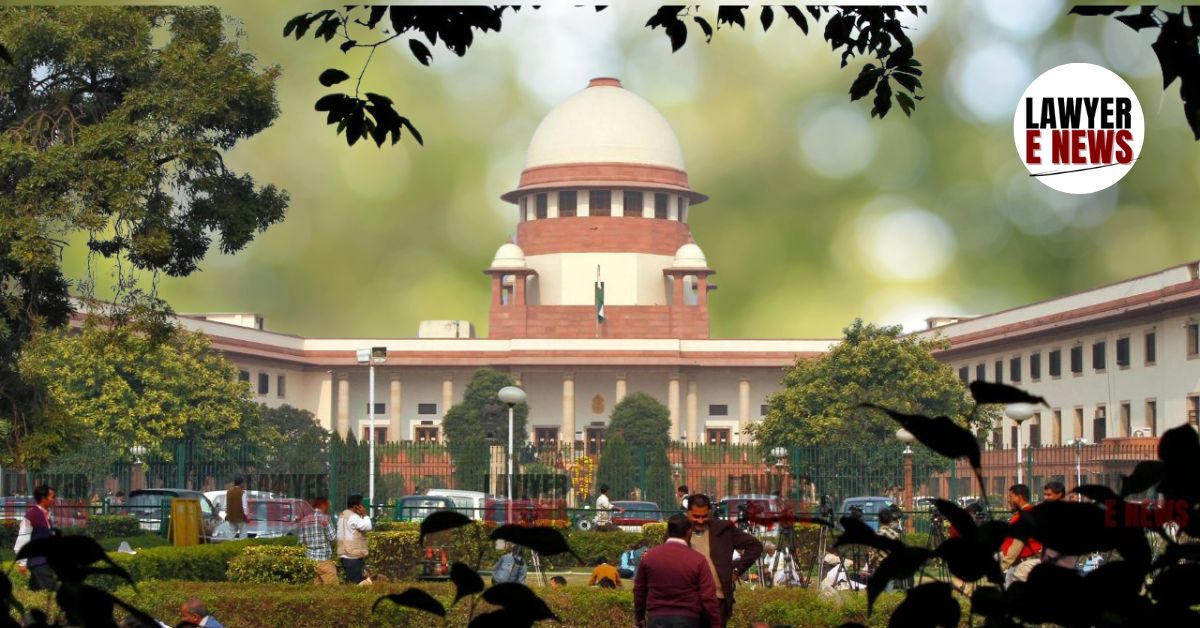
“Framing of AI Rules Under IT Act, Deepfake Monitoring During Elections, and National AI Oversight Body Urged in PIL Dismissed for Parallel Jurisdiction”, - Supreme Court of India refused to entertain a sweeping Public Interest Litigation filed by Advocate Narendra Kumar Goswami, who sought urgent regulatory and legal interventions against the unregulated use of Artificial Intelligence (AI)-generated deepfakes. The bench, comprising Justice Surya Kant and Justice Nongmeikapam Kotiswar Singh, observed that the same issues were already under active consideration before the Delhi High Court and advised the petitioner to approach the High Court instead.
"This Court does not deem it necessary to entertain this parallel proceeding," remarked the Bench while disposing of Writ Petition (Civil) No. 300 of 2025.
“Watermark AI Content, Create Deepfake Monitoring Cells, Amend MCC: Petitioner Proposes China-Model and Judicial Oversight”
The petitioner’s plea outlined a robust, multi-pronged framework demanding statutory, electoral, national security, and educational interventions. Among the notable prayers was a direction to the Union of India to frame rules under Section 87(2)(zg) of the Information Technology Act, 2000 to mandate watermarking of AI-generated content. Goswami suggested replicating China’s “Deep Synthesis Provisions” by embedding metadata identifying origin, AI tools used, and creators in all synthetic media content, including images, audio, and video.
"Watermarking of all AI-generated content with metadata disclosing origin, tools used, and creator identity, as per China's Deep Synthesis Provisions," he urged, also recommending penalties for non-compliance under Section 45 of the IT Act.
The petition also sought the establishment of a National AI Regulation Authority under Section 88 of the IT Act, chaired by a retired Supreme Court judge, along the lines of the monitoring mechanism in M.C. Mehta v. Union of India (1986) 2 SCC 176.
Additionally, Goswami targeted the Election Commission under Article 324 of the Constitution, urging it to form a "Deepfake Monitoring Cell" empowered to pre-certify political advertisements involving AI and take real-time takedown actions under Rule 16 of the Conduct of Elections Rules, 1961. A repository of debunked deepfakes and amendments to the Model Code of Conduct were also sought.
Further, the plea advocated for a "National Deepfake Literacy Mission" through NCERT and Samagra Shiksha Abhiyan and requested mandatory AI threat protocols by the Ministry of Home Affairs under Section 66F of the IT Act (Cyber Terrorism), including CERT-In notifications and deepfake reporting mandates.
“Right to Truth and Privacy Under Article 21 Are at Stake”: PIL Framed as Constitutional Crisis
Calling the absence of AI-specific regulation a violation of fundamental rights, the petitioner urged the Court to declare that unregulated deepfakes infringe upon:
The right to privacy and dignity under Article 21 (K.S. Puttaswamy),
The right to a free and informed vote under Article 19(1)(a) (PUCL v. Union of India), and
The right to equality under Article 14 (Navtej Singh Johar).
He even invoked the doctrine from Vishaka v. State of Rajasthan (1997) to justify judicial guidelines in the absence of adequate legislation, contending: “Declare that the IT Act, 2000, is inadequate to address deepfakes, necessitating judicial guidelines.”
A court-monitored committee of five experts—including a retired Supreme Court judge, the Director-General of CERT-In, Election Commission Secretary, DG-NIA, and Director of IIT Delhi—was also proposed to draft a model law within 90 days and monitor compliance.
“Petitioner Redirected to Delhi High Court Already Hearing Similar Matter”
The Supreme Court noted that similar reliefs were already being canvassed in Chaitanya Rohilla v. Union of India (W.P. (C) No. 15596/2023) before the Delhi High Court, where a Division Bench headed by the Chief Justice was actively considering the issue.
“We do not deem it necessary to entertain this parallel proceeding. The petitioner is relegated to the High Court of Delhi with liberty to seek his impleadment and assist the High Court,” stated the Bench, while requesting the High Court to "accord audience" to the petitioner and "consider the valuable suggestions" he may offer.
Date of Decision: 16 May 2025