-
by sayum
05 August 2026 6:43 AM







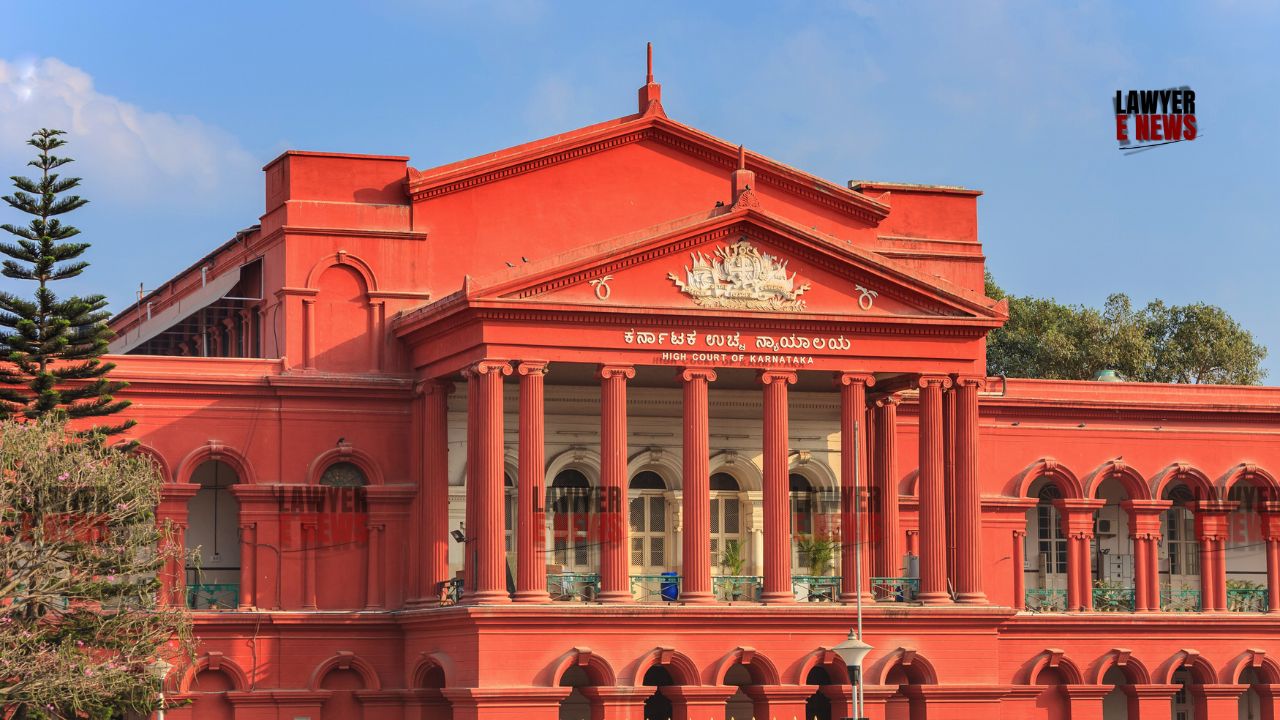
"Deeming Fiction Under Section 5(2) Overrides Administrative Flip-Flops" — In a significant ruling Karnataka High Court set aside the cancellation of a stone crusher licence granted to M/s Prabhavathi Stone Crushers, holding that once a site is declared a "Safer Zone", subsequent contradictory distance reports or administrative revisions cannot invalidate that status.
A Division Bench comprising Chief Justice N.V. Anjaria and Justice M.I. Arun allowed Writ Petition Nos. 4010 of 2024 and 9037 of 2022, filed by the petitioner against the District Stone Crusher Licensing Authority, and held that the Form-C licence granted in 2019 stood deemed extended for 20 years under the amended Section 5(2) of the Karnataka Regulation of Stone Crushers Act, 2011. The contempt petition filed due to alleged non-compliance with an interim order was dismissed as infructuous.
The petitioner, M/s Prabhavathi Stone Crushers, was granted a licence under Form-C for establishing a stone crusher unit on Survey No. 117/2, Alpahalli Village, Mandya District, after the area was formally declared a “Safer Zone” through Notification dated 14.12.2017. The declaration followed a joint inspection by multiple authorities including the Department of Mines and Geology, Forest Department, Revenue Department, and the Karnataka State Pollution Control Board.
The licence was subsequently cancelled on 31.03.2022, on the ground that the unit was located within 100 meters of a Major District Road, allegedly in violation of Section 6(1)(b) of the Act. Initially reported to be at a distance of 73 meters, a later report bizarrely reduced this figure to 35 meters, leading to administrative confusion and cancellation of the licence.
The petitioner challenged this action in Writ Petition No. 9037 of 2022, while also seeking recognition of the deemed extension of the licence under the amended law through Writ Petition No. 4010 of 2024. The contempt petition (CCC No. 48 of 2023) stemmed from an alleged failure to comply with an interim stay granted in the writ proceedings.
The High Court addressed three central legal questions:
Whether the cancellation of a licence based on inconsistent post-licence reports was legally sustainable.
Whether the petitioner was entitled to the benefit of deemed extension for 20 years under Section 5(2) as amended.
Whether the contempt petition survived in light of the court’s interim and final orders.
On the validity of the cancellation, the Court held:
“It is an undisputed fact that when the Licence Form-C was granted… the factum of distance was verified… and it was duly noticed that the land did not fall within the peripheral range of 100 meters from the Major District Road.”
The Court firmly rejected the use of contradictory and retrospective measurements, remarking that the 2017 Safer Zone Notification had been issued only after a proper joint inspection and found no reason to doubt the integrity of that process. It added:
“There is no gainsaying that the petitioner would be entitled to get the benefit of operational ambit of the aforesaid extension.”
On the application of amended Section 5(2), the Court emphasized that the provision incorporates a deeming fiction:
“All existing crusher licenses granted before the commencement of Karnataka Stone Crusher Regulation (Amendment) Act, 2020 shall be deemed to have been granted for a period of twenty years from the date of original grant.”
The Court noted that since the licence dated 02.02.2019 was valid and subsisting on the date the amendment came into force, the petitioner was entitled to a statutory twenty-year extension. As the judgment observed:
“The petitioner’s licence was in existence and valid to attract the beneficial deeming provision under Section 5(2) of the Act. This aspect would operate outweighingly.”
The Explanation to Section 6, which insulates earlier safer zone declarations from the impact of subsequent constructions or developments, was relied on to reinforce the point:
“Any habitation, school, temples or road coming up subsequent to declaration of safer zone shall not affect the operation or continuance of such declaration and shall not affect any extension of licence under section 5.”
Regarding the contempt proceedings, the Court noted that its interim order dated 28.04.2022 had stayed the cancellation and had been acted upon, making the contempt petition redundant:
“The contempt petition will not survive.”
After reviewing the facts and law, the Court unequivocally set aside the cancellation and granted the reliefs sought in both writ petitions. It ordered:
“The order dated 31.03.2022 passed by respondent No.3—the District Regulation of Stone Crusher and Licensing Authority is liable to be set aside. It is set aside.”
On the issue of extension, the Court declared:
“It is declared that the petitioner is deemed to have been granted extension for its licence for a period of twenty years under Section 5(2) of the Amended Act No.28 of 2020… respondent Nos.1 and 2 are directed to treat Form-C Licence No.34/2018-19/2806 dated 02.02.2019 granted to the petitioner to have been extended for twenty years from the said date.”
The Court concluded: “Both the petitions stand allowed… The contempt petition will not survive.”
In defending the sanctity of administrative finality and statutory rights, the Karnataka High Court has underscored that once a site is lawfully declared a safer zone and licence is granted, authorities cannot retrospectively question it on flimsy or conflicting grounds. The judgment affirms that legislative amendments with deeming fictions must be given full effect, and any administrative disruption to such protected rights will not be tolerated.
This ruling stands as a resounding message: administrative authorities must act within bounds and cannot renege on lawful declarations years after the fact, especially when statutory protections explicitly bar such reversals.
Date of Decision: 28 May 2025