-
by sayum
09 August 2026 1:53 PM







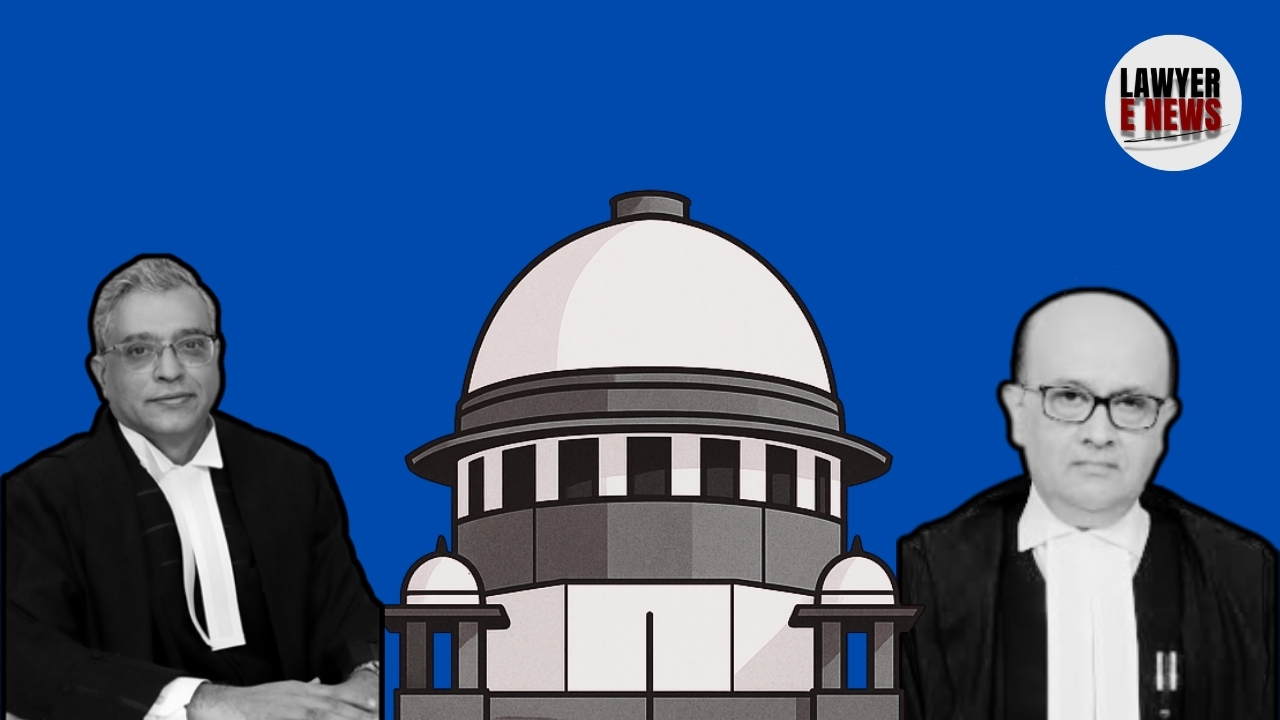
“Allowing Appeal to Proceed After Abatement Would Lead to Inconsistent and Contradictory Decrees”, On 18th July 2025, the Supreme Court of India delivered a crucial judgment where Division Bench of Justice Pamidighantam Sri Narasimha and Justice Manoj Misra dealt with the important question of whether non-substitution of legal representatives of one deceased co-appellant in a second appeal leads to total abatement of the appeal, particularly in cases involving joint and indivisible decrees. Affirming the High Court’s ruling, the Supreme Court dismissed the appeals and categorically held that the second appeal stood abated in its entirety due to failure to substitute legal representatives of one of the deceased co-appellants. The Court emphasised that continuation of appeal in such cases would inevitably result in conflicting decrees, which the judicial process cannot permit.
The Supreme Court made it absolutely clear that, “Where both defendants jointly claim ownership and a decree is passed against them on common grounds, non-substitution of legal representatives of one deceased co-appellant necessarily leads to abatement of the entire appeal.” The Court observed that continuation of the appeal after such abatement would result in a situation where, “one final decree holds the deceased defendant as tenant, while the surviving defendant could get an order declaring ownership, resulting in inconsistent and mutually destructive decrees.”
The litigation had its genesis in a civil suit instituted by the respondent Parasram in 1983 (later renumbered as Suit No. 16A of 1997), seeking a declaration of ownership and recovery of possession against Suresh Chandra and Ram Babu, who were the predecessors-in-interest of the appellants. The plaintiff claimed title over the property through his ancestor Tej Singh and asserted that the defendants were tenants unlawfully denying his ownership. On the other hand, the defendants Suresh Chandra and Ram Babu filed a joint written statement denying tenancy and claiming ownership rights through their ancestor Gokul Prasad, who they claimed had acquired ownership in a partition in 1947.
The trial court dismissed the suit, accepting the defendants' version. However, in appeal, the first appellate court reversed the trial court’s decision, decreeing ownership and possession in favour of the plaintiff, holding that the defendants were tenants and not owners. Aggrieved, both Suresh Chandra’s legal heirs and Ram Babu jointly filed a second appeal before the High Court.
During pendency of the second appeal, Ram Babu died in August 2015. Although information of his death was given to the court in 2016, no substitution of legal representatives was effected within the prescribed period. Only in 2022, after an abatement order was passed, applications for condonation of delay and substitution were filed, which the High Court rejected. The appellants’ challenge against these orders reached the Supreme Court.
Delay and Abatement
The Supreme Court examined in detail the long and unexplained delay in filing applications for substitution and setting aside abatement. The Court noted that the appellants, who were close relatives of the deceased Ram Babu, “failed to show any sufficient cause” for the delay. The Court remarked, “When death is of a close family member who is a co-appellant, courts cannot lightly accept ignorance as an excuse after a lapse of several years.”
The judgment pointed out that applications for substitution were filed in 2022, nearly seven years after Ram Babu’s death and after the appeal had already abated. It held that the High Court had rightly exercised its discretion in refusing to condone the delay, observing, “A party cannot sleep over their responsibility and expect courts to revive lapsed rights after unexplained years of inaction.”
Indivisible Nature of Decree and Risk of Conflicting Judgments
The central reasoning of the Supreme Court’s decision lay in the indivisible nature of the decree passed by the first appellate court. The Court explained that the defendants had jointly claimed ownership through their common ancestor and jointly contested the plaintiff’s case. By operation of law, on failure to substitute Ram Babu’s heirs, the decree against him became final, declaring him tenant and the plaintiff owner.
The Supreme Court ruled that, “Continuing the appeal with only the surviving appellants, who had raised identical claims with the deceased defendant, would produce conflicting decrees.” The Court expounded further, “One decree will declare the plaintiff to be owner and deceased defendant a tenant, while another decree may potentially declare the surviving appellant to be owner – such contradictory outcomes destroy judicial discipline and coherence of decrees.”
In a telling observation, the Court reiterated the settled principle laid down in Sardar Amarjit Singh Kalra v. Pramod Gupta, stating, “When a decree is joint and indivisible, non-substitution of legal representatives of one party renders the entire appeal incompetent, for otherwise courts will be compelled to authorise inconsistent judicial outcomes.”
The Court also discussed the application of Order XLI Rule 4 of the CPC, which allows one of several parties to file an appeal against the whole decree on common grounds. The Court firmly rejected its applicability in this case, stating, “Order XLI Rule 4 applies when the appeal is instituted by some of the parties; but when all defendants have jointly filed the appeal, the procedural consequence of abatement under Order XXII operates without exception.”
Clarification on the Limited Role of Order XLI Rule 4
The Supreme Court clarified that, “Once an appeal is filed jointly by all defendants, surviving appellants cannot invoke Rule 4 of Order XLI to bypass abatement, because the appeal was not filed by some for the benefit of others, but by all together.” The Court reiterated its previous rulings that, “The procedural law mandates substitution to avoid abatement, and provisions of Order XLI Rule 4 cannot be used to revive extinguished rights after finality attaches to the decree against the deceased.”
The Court distinguished cases where Order XLI Rule 4 could apply, stating that it could only be invoked where surviving parties pursued appeal on behalf of non-appealing co-defendants, but not when all had joined as appellants and one died pending appeal.
In a definitive ruling, the Supreme Court concluded that both on facts and in law, the appellants’ appeal deserved no interference. The judgment declared, “The High Court rightly held that the entire second appeal stood abated due to non-substitution of legal representatives of Ram Babu, for the joint decree was inseparable and continuance of appeal would result in contradictory judgments on the same cause.”
The Court therefore dismissed the civil appeals, affirming the High Court’s order on abatement and rejection of condonation of delay. Emphasising the necessity of finality in litigation and the avoidance of inconsistent decrees, the Supreme Court underscored the importance of diligent prosecution of cases and respect for procedural discipline in appellate proceedings.
This judgment serves as a reaffirmation of the foundational principle that civil litigation must not result in fragmented and conflicting judicial determinations. The ruling clearly conveys that, “When the joint decree becomes final against one, the entire appeal collapses, for justice cannot permit conflicting decrees on the same subject matter.”
Date of Decision: 18th July 2025