-
by sayum
09 August 2026 1:53 PM







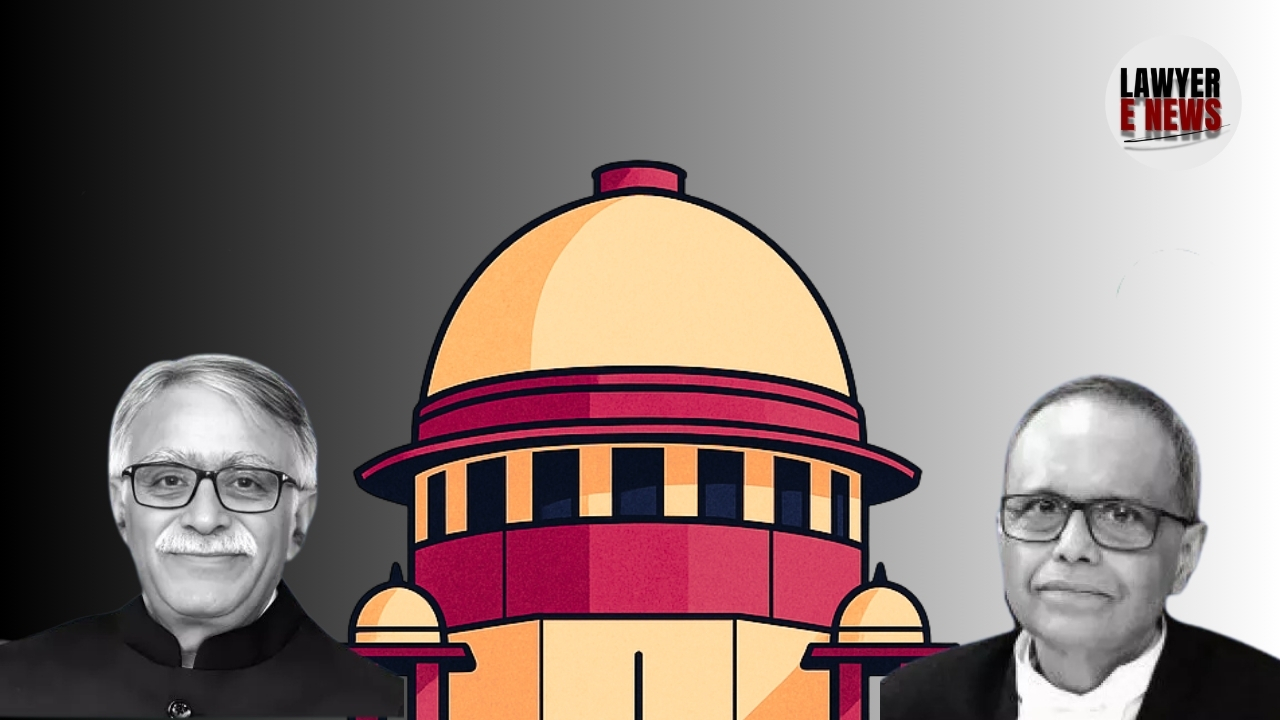
“Courts Must Scrutinize Disinheritance Of Spouse With Greater Vigilance To Satisfy Judicial Conscience”: On 17th July 2025, the Supreme Court of India delivered a significant verdict affirming the High Court’s decision to invalidate a Will that disinherited the lawful wife of the deceased without any justification. The Court upheld that the complete omission of the wife in the Will, particularly when evidence established a harmonious marital relationship, constituted a grave suspicious circumstance that was neither explained nor rebutted by the propounder, who stood to benefit. The appeals challenging the High Court’s reversal of concurrent findings were dismissed.
The legal contest revolved around agricultural land measuring over 67 kanals in Punjab, owned by Maya Singh. Upon Maya Singh’s death in 1991, his nephew, Gurdial Singh, propounded a Will allegedly executed by Maya Singh in 1991, disinheriting Maya Singh’s wife, Jagir Kaur, and vesting the property entirely in Gurdial Singh. While the Trial Court and First Appellate Court accepted the Will as genuine based on formal proof of execution and attestation, the Punjab and Haryana High Court reversed these findings, noting glaring suspicious circumstances, especially the deliberate omission of Maya Singh’s wife from his testamentary disposition.
The Supreme Court was tasked with deciding whether such an omission, accompanied by absence of reasoning, negated the presumption of a free disposing mind and rendered the Will invalid.
At the center of the case was the fundamental principle governing the proof of a Will under Section 63 of the Indian Succession Act, 1925 and Section 68 of the Indian Evidence Act, 1872. The Court reiterated the solemn duty of courts in testamentary matters, especially where disinheritance occurs without reason.
The Supreme Court cited with approval the enduring jurisprudence laid down in H. Venkatachala Iyengar v. B.N. Thimmajamma, observing: “When a Will is surrounded by suspicious circumstances, mere proof of signature or attestation does not suffice. The propounder carries the onus to dispel legitimate suspicion and satisfy the judicial conscience that the Will represents the free volition of the testator.”
Notably, the Bench emphasized: “The complete silence on the part of the executant qua his wife, while executing the Will, renders the Will a suspicious document and leads to the inference that the same had not been executed by the executant of his free disposing mind.”
The Court refused to accept that registration of the Will or formal proof of execution could override the substantive doubts created by the inexplicable exclusion of the wife.
The Court took a holistic view of the case, rejecting the narrow formalistic approach adopted by the Trial and First Appellate Court. It was particularly alarmed by the fact that Gurdial Singh, the propounder, not only stood to inherit the entire property but had also attempted to question the very status of Jagir Kaur as Maya Singh’s lawful wife. The Will’s complete silence regarding the wife, despite clear evidence of a sustained marital relationship, raised, in the Court’s words,
“a tell-tale insignia of the propounder’s hand rather than the free will of the testator.”
The judgment quoted extensively from Ram Piari v. Bhagwant & Ors. to reaffirm the requirement of reasons for disinheritance, stating:
“Prudence requires that reason for denying the benefit of inheritance to natural heirs must be evident; absence of it shrouds the disposition with suspicion.”
Rejecting the appellant’s argument that Jagir Kaur received pension and money from Maya Singh, the Court categorically held:
“No evidence was led to show whether the quantum of money said to be settled in favour of the wife was reasonable enough to justify her total exclusion from inheritance.”
Crucially, the Court invoked the guiding principle laid down in Leela Rajagopal v. Kamala Menon Cocharan, holding:
“It is the cumulative effect of the unusual features and suspicious circumstances which must weigh with the court; judicial conscience cannot rest satisfied on mere technical compliance when the disinheritance itself strikes at the root of natural succession.”
In a firm and reasoned conclusion, the Supreme Court declared:
“This omission of the wife from the Will was not incidental—it was a calculated erasure that impugns the free agency of the testator and compels judicial skepticism. The High Court correctly reversed the erroneous findings of the lower courts.”
The appeals were dismissed, reaffirming the High Court’s judgment in favour of the wife’s legal representatives, declaring her rightful ownership and possession over the disputed property.
This judgment strengthens the legal edifice surrounding testamentary dispositions, sending a clear message that courts will guard against the manipulation of testamentary instruments, particularly where the disinheritance of close family members is unexplained and dubious. It reiterates that proof of execution is not the end of the matter; judicial conscience must be satisfied that a Will reflects the genuine, uncoerced intention of the testator.
Date of Decision: 17th July 2025