-
by sayum
25 August 2026 4:32 AM







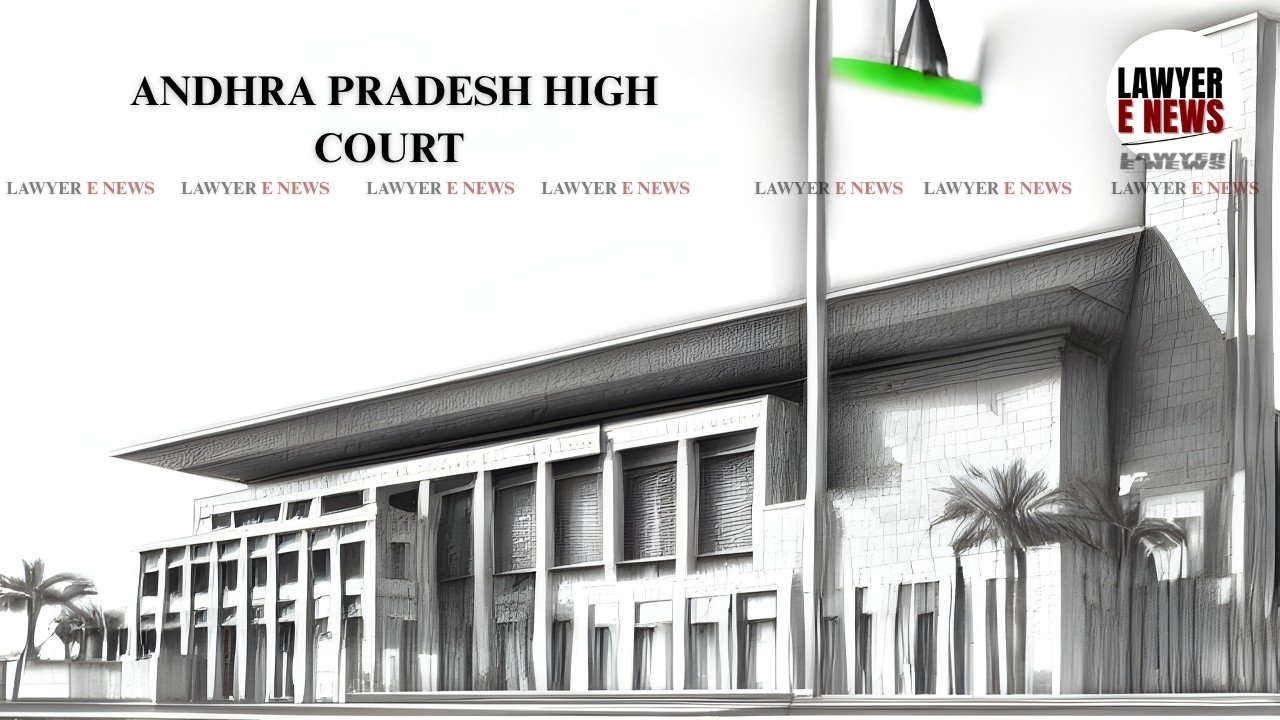
“Remedy of the Defendant Was Execution, Not Denial of Partition” — In a ruling that decisively clarifies the legal implications of prior decrees in partition disputes, the Andhra Pradesh High Court allowed a second appeal restoring a partition decree that had been erroneously reversed by the First Appellate Court. The judgment, delivered by Justice V. Gopala Krishna Rao held that failure to comply with a monetary direction in a previous second appeal did not extinguish the plaintiffs' title, and the right to seek partition remained intact, absent any registered relinquishment deed.
Addressing the misinterpretation of a prior High Court decree (Ex.A-1 in S.A. No. 641 of 1988), the Court firmly held:
“The First Appellate Court has misconstrued the clauses in the decree and judgment passed in S.A.No.641 of 1988. The decree created only a charge for the sum due—it did not extinguish the title nor bar partition.”
The Court therefore set aside the First Appellate Court's order and restored the Trial Court’s decree granting partition of the suit property into equal shares between the legal heirs of Sonti Babu Rao and the defendant Sonti Sivananda Rao.
“Charge on Property for Rs. 5,300/- Did Not Extinguish Ownership — Only Mode of Enforcement Was Through Execution or Auction”
The dispute originated from the plaintiffs’ claim to partition of a joint house property in Ashok Nagar, Kakinada, jointly purchased in 1964 by late Sonti Babu Rao (husband of plaintiff no.1 and father of plaintiffs 2–7) and the defendant, his brother. After Babu Rao’s death in 1988, his wife and children sought partition of the property, asserting ½ share.
The defendant, however, resisted partition, arguing that the plaintiffs had forfeited their rights by not paying Rs. 5,300 with interest, as directed by the High Court in a prior second appeal (S.A. No. 641 of 1988). That earlier litigation had dealt with the same property, resulting in a decree that awarded the defendant recovery of Rs. 5,300 along with 6% interest from 1975, enforceable by creating a charge on the share of Babu Rao.
The First Appellate Court accepted the defendant’s argument and reversed the Trial Court’s decree for partition. However, the High Court in the present second appeal held that this was a fundamental misreading of the earlier decree.
Justice Gopala Krishna Rao noted:
“There was no direction in the earlier decree that failure to pay the amount would lead to forfeiture of title. The only remedy available to the defendant was to seek enforcement of the charge through execution by auction.”
The Court further clarified that title over immovable property cannot be defeated in the absence of a registered relinquishment deed, observing:
“This Court had previously held that unless a relinquishment deed is executed, Ex.A-1 could be taken only as an agreement. In absence of such deed, title remains unaffected.”
“Oral Agreement to Sell Plaintiff’s Share Not Proved — No Evidence Brought by Defendant Despite Allegations”
In a desperate bid to block the partition, the defendant had claimed that the plaintiffs orally agreed to sell their share for Rs. 1,00,000 after the earlier High Court decree. He argued that the present suit was a dishonest attempt to backtrack from that arrangement.
However, the Court found this defence wholly unsupported by evidence. No documentary proof, no witness testimony, and no written acknowledgment substantiated the oral sale plea.
Justice Rao observed:
“The defendant failed to prove the existence of any oral agreement. It is not even his case that the plaintiffs refused to pay the decretal amount—rather, he refused to accept it and opposed partition.”
Adding weight to this finding, the Court noted that the plaintiffs had eventually deposited Rs. 13,409 in the Trial Court on 20 August 2005, which covered the principal and interest ordered in the prior decree. A copy of the payment challan was produced, undermining the defendant's assertion of non-payment.
“First Appellate Court’s Findings Are Vitiated by Misreading of Decree and Misapplication of Law”: High Court Finds Interference Under Section 100 CPC Justified
Under Section 100 of the CPC, second appeals are maintainable only on substantial questions of law. In this case, the Court framed the issue as:
“Whether the reversal of the partition decree was vitiated by misinterpretation of the High Court’s earlier decree in S.A.No.641 of 1988?”
Answering in the affirmative, Justice Rao stressed that the First Appellate Court's judgment was perverse and based on a misreading of material clauses in the earlier High Court judgment. Citing precedents such as Bhagwan Sharma v. Bani Ghosh and Kondira Dagadu Kadam v. Savitribai Sopan Gujar, the Court emphasized that interference under Section 100 CPC is permissible where the findings are based on a misconstruction of documentary evidence or erroneous application of settled law.
“The First Appellate Court, without reappreciating the evidence properly, came to an incorrect conclusion that the plaintiffs were not entitled to partition, despite no extinguishment of their title being pleaded or proved.”
“Partition Cannot Be Denied When Title Is Undisputed and Co-Ownership Admitted”: High Court Reinforces Principle of Joint Ownership
The High Court reaffirmed that co-ownership creates an inherent right to seek partition, and that mere existence of a debt or charge on the property does not defeat the co-owner’s right.
In categorical terms, the Court held:
“The plaintiffs, being co-owners with the defendant, are entitled to partition. The earlier decree only created a money charge; it did not nullify ownership. Non-execution by the defendant cannot result in denial of legal remedy to the plaintiffs.”
Partition Suit Restored, Appeal Allowed — Each Party to Bear Own Costs
Allowing the second appeal, the High Court passed the following order:
“The judgment and decree dated 02.03.2010 in A.S.No.104 of 2005 is set aside. The judgment and decree dated 15.07.2005 in O.S.No.45 of 2001 passed by the Trial Court is restored. Each party shall bear their own costs.”
This ruling puts an end to over two decades of litigation between co-heirs, confirming that partition cannot be blocked by technicalities when title is not relinquished, and dues can be recovered through execution proceedings.
Date of Decision: 19 November 2025